

3-7 Slater Determinants and the Pauling “3-Electron Bond”
45
lize the derivation of the identity
1
1
1
ab
1
*
ab
2
ab
b
a
for the Pauling
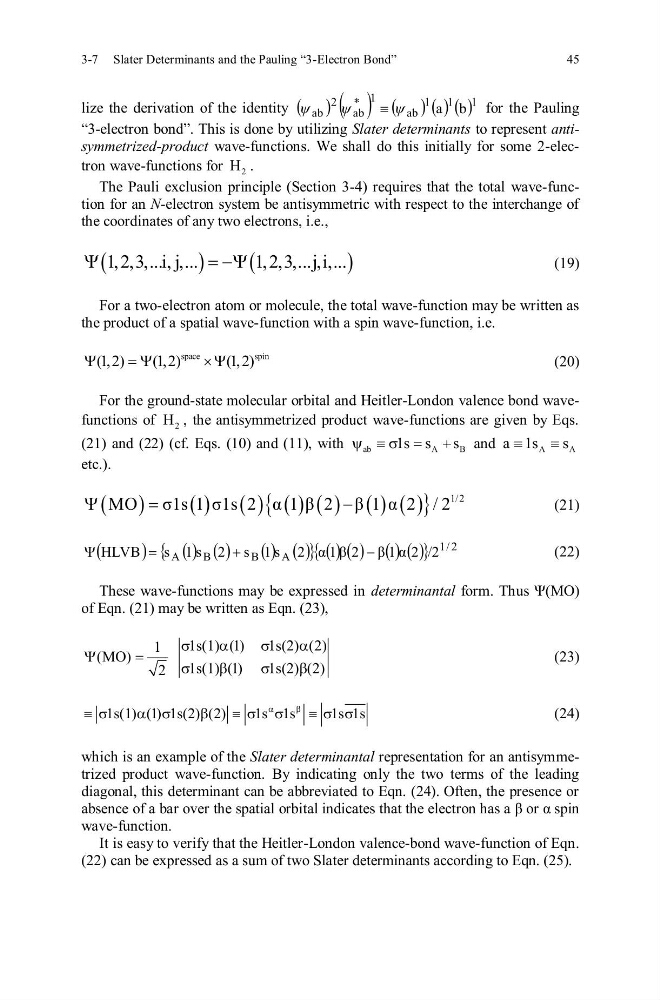
“3-electron bond”. This is done by utilizing Slater determinants to represent antisymmetrized-product wave-functions. We shall do this initially for some 2-electron wave-functions for 2
H .
The Pauli exclusion principle (Section 3-4) requires that the total wave-function for an N-electron system be antisymmetric with respect to the interchange of
the coordinates of any two electrons, i.e.,
1, 2,3,...i, j,...
1, 2,3,...j,i,...
(19)
For a two-electron atom or molecule, the total wave-function may be written as
the product of a spatial wave-function with a spin wave-function, i.e.
space
spin
(1,2)
(1,2)
(1, 2)
(20)
For the ground-state molecular orbital and Heitler-London valence bond wavefunctions of 2
H , the antisymmetrized product wave-functions are given by Eqs.
(21) and (22) (cf. Eqs. (10) and (11), with ab
A
B
1s s s
and
A
A
a 1s
s
etc.).
1/ 2
MO σ1s 1 σ1s 2 α 1 β 2 β 1 α 2 / 2
(21)
2
/
1
A
B
B
A
/2
2
α
1
β
2
β
1
α
2
s
1
s
2
s
1
s
HLVB
(22)
These wave-functions may be expressed in determinantal form. Thus Ψ(MO)
of Eqn. (21) may be written as Eqn. (23),
1s(1) (1)
1s(2) (2)
1
(MO)
1s(1) (1)
1s(2) (2)
2
(23)
1s(1) (1) 1s(2) (2)
1s 1s
1s 1s
(24)
which is an example of the Slater determinantal representation for an antisymmetrized product wave-function. By indicating only the two terms of the leading
diagonal, this determinant can be abbreviated to Eqn. (24). Often, the presence or
absence of a bar over the spatial orbital indicates that the electron has a β or α spin
wave-function.
It is easy to verify that the Heitler-London valence-bond wave-function of Eqn.
(22) can be expressed as a sum of two Slater determinants according to Eqn. (25).
45
lize the derivation of the identity
1
1
1
ab
1
*
ab
2
ab
b
a
for the Pauling
“3-electron bond”. This is done by utilizing Slater determinants to represent antisymmetrized-product wave-functions. We shall do this initially for some 2-electron wave-functions for 2
H .
The Pauli exclusion principle (Section 3-4) requires that the total wave-function for an N-electron system be antisymmetric with respect to the interchange of
the coordinates of any two electrons, i.e.,
1, 2,3,...i, j,...
1, 2,3,...j,i,...
(19)
For a two-electron atom or molecule, the total wave-function may be written as
the product of a spatial wave-function with a spin wave-function, i.e.
space
spin
(1,2)
(1,2)
(1, 2)
(20)
For the ground-state molecular orbital and Heitler-London valence bond wavefunctions of 2
H , the antisymmetrized product wave-functions are given by Eqs.
(21) and (22) (cf. Eqs. (10) and (11), with ab
A
B
1s s s
and
A
A
a 1s
s
etc.).
1/ 2
MO σ1s 1 σ1s 2 α 1 β 2 β 1 α 2 / 2
(21)
2
/
1
A
B
B
A
/2
2
α
1
β
2
β
1
α
2
s
1
s
2
s
1
s
HLVB
(22)
These wave-functions may be expressed in determinantal form. Thus Ψ(MO)
of Eqn. (21) may be written as Eqn. (23),
1s(1) (1)
1s(2) (2)
1
(MO)
1s(1) (1)
1s(2) (2)
2
(23)
1s(1) (1) 1s(2) (2)
1s 1s
1s 1s
(24)
which is an example of the Slater determinantal representation for an antisymmetrized product wave-function. By indicating only the two terms of the leading
diagonal, this determinant can be abbreviated to Eqn. (24). Often, the presence or
absence of a bar over the spatial orbital indicates that the electron has a β or α spin
wave-function.
It is easy to verify that the Heitler-London valence-bond wave-function of Eqn.
(22) can be expressed as a sum of two Slater determinants according to Eqn. (25).