

3-3 Electron-Pair Bonds
37
ce-bond structures ( A B
) and ( A B ) whose wave-functions are the atomic orbitals a and b respectively, i.e. we may write
A · B (A B)
(A B)
ab = a + kb a + kb
For the 1-electron bond of the hydrogen molecule ion 2
H
, with 1s atomic orbitals, the bonding molecular orbital wave-function and corresponding valence-bond
structures are ab
A
B
1s 1s
1s
and
H · H
(H H )
(H H)
. In
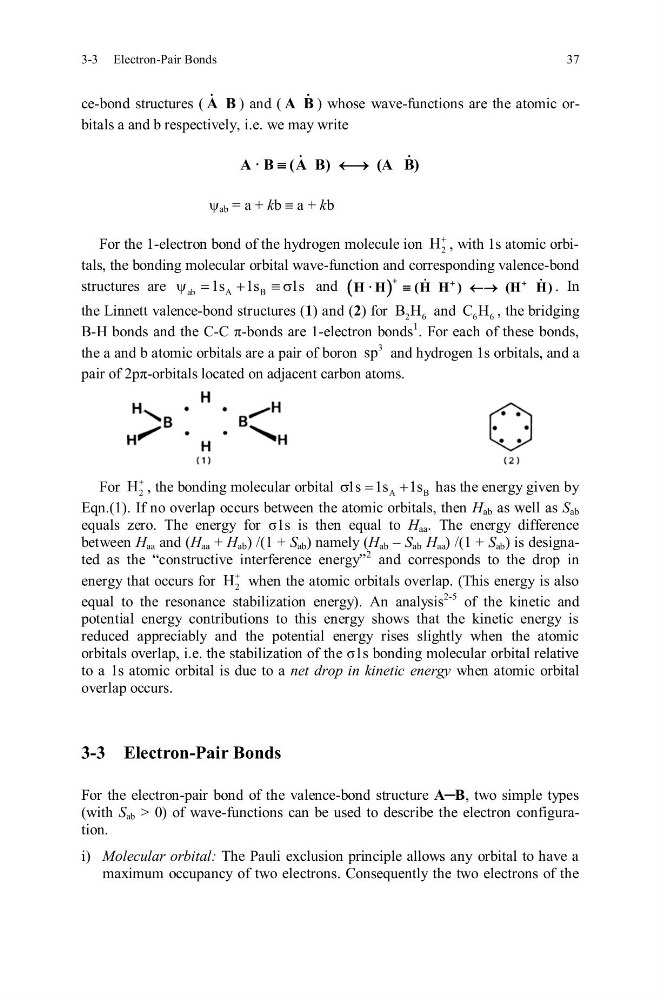
the Linnett valence-bond structures (1) and (2) for 2 6
B H and 6 6
C H , the bridging
B-H bonds and the C-C π-bonds are 1-electron bonds
1 . For each of these bonds,
the a and b atomic orbitals are a pair of boron
3
sp and hydrogen 1s orbitals, and a
pair of 2pπ-orbitals located on adjacent carbon atoms.
For 2
H
, the bonding molecular orbital
A
B
1s 1s 1s
has the energy given by
Eqn.(1). If no overlap occurs between the atomic orbitals, then H ab as well as S ab
equals zero. The energy for σ1s is then equal to H aa . The energy difference
between H aa and (H aa + H ab ) /(1 + S ab ) namely (H ab – S ab H aa ) /(1 + S ab ) is designated as the “constructive interference energy”
2 and corresponds to the drop in
energy that occurs for 2
H
when the atomic orbitals overlap. (This energy is also
equal to the resonance stabilization energy). An analysis
2-5 of the kinetic and
potential energy contributions to this energy shows that the kinetic energy is
reduced appreciably and the potential energy rises slightly when the atomic
orbitals overlap, i.e. the stabilization of the σ1s bonding molecular orbital relative
to a 1s atomic orbital is due to a net drop in kinetic energy when atomic orbital
overlap occurs.
3-3 Electron-Pair Bonds
For the electron-pair bond of the valence-bond structure A─B, two simple types
(with S ab > 0) of wave-functions can be used to describe the electron configuration.
i) Molecular orbital: The Pauli exclusion principle allows any orbital to have a
maximum occupancy of two electrons. Consequently the two electrons of the
37
ce-bond structures ( A B
) and ( A B ) whose wave-functions are the atomic orbitals a and b respectively, i.e. we may write
A · B (A B)
(A B)
ab = a + kb a + kb
For the 1-electron bond of the hydrogen molecule ion 2
H
, with 1s atomic orbitals, the bonding molecular orbital wave-function and corresponding valence-bond
structures are ab
A
B
1s 1s
1s
and
H · H
(H H )
(H H)
. In
the Linnett valence-bond structures (1) and (2) for 2 6
B H and 6 6
C H , the bridging
B-H bonds and the C-C π-bonds are 1-electron bonds
1 . For each of these bonds,
the a and b atomic orbitals are a pair of boron
3
sp and hydrogen 1s orbitals, and a
pair of 2pπ-orbitals located on adjacent carbon atoms.
For 2
H
, the bonding molecular orbital
A
B
1s 1s 1s
has the energy given by
Eqn.(1). If no overlap occurs between the atomic orbitals, then H ab as well as S ab
equals zero. The energy for σ1s is then equal to H aa . The energy difference
between H aa and (H aa + H ab ) /(1 + S ab ) namely (H ab – S ab H aa ) /(1 + S ab ) is designated as the “constructive interference energy”
2 and corresponds to the drop in
energy that occurs for 2
H
when the atomic orbitals overlap. (This energy is also
equal to the resonance stabilization energy). An analysis
2-5 of the kinetic and
potential energy contributions to this energy shows that the kinetic energy is
reduced appreciably and the potential energy rises slightly when the atomic
orbitals overlap, i.e. the stabilization of the σ1s bonding molecular orbital relative
to a 1s atomic orbital is due to a net drop in kinetic energy when atomic orbital
overlap occurs.
3-3 Electron-Pair Bonds
For the electron-pair bond of the valence-bond structure A─B, two simple types
(with S ab > 0) of wave-functions can be used to describe the electron configuration.
i) Molecular orbital: The Pauli exclusion principle allows any orbital to have a
maximum occupancy of two electrons. Consequently the two electrons of the