

36
Chapter 3 Wave-Functions and Valence-Bond Structures for 1-Electron Bonds, …
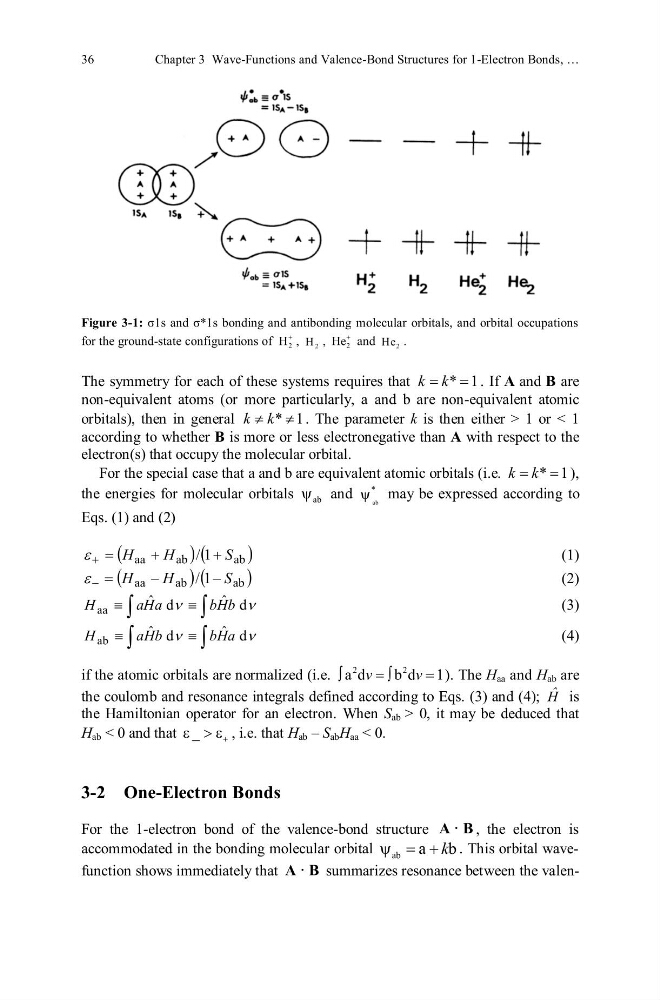
Figure 3-1: σ1s and σ*1s bonding and antibonding molecular orbitals, and orbital occupations
for the ground-state configurations of 2
H
, 2
H ,
2
He
and
2
He .
The symmetry for each of these systems requires that
1
k k*
. If A and B are
non-equivalent atoms (or more particularly, a and b are non-equivalent atomic
orbitals), then in general
1
k k*
. The parameter k is then either > 1 or < 1
according to whether B is more or less electronegative than A with respect to the
electron(s) that occupy the molecular orbital.
For the special case that a and b are equivalent atomic orbitals (i.e.
1
k k*
),
the energies for molecular orbitals ab
and
ab
*
may be expressed according to
Eqs. (1) and (2)
ab
ab
aa
1
/
S
H
H
(1)
ab
ab
aa
1
/
S
H
H
(2)
d
ˆ
d
ˆ
aa
b
H
b
a
H
a
H
(3)
d
ˆ
d
ˆ
ab
a
H
b
b
H
a
H
(4)
if the atomic orbitals are normalized (i.e.
2
2
a d
b d 1
v
v ). The H aa and H ab are
the coulomb and resonance integrals defined according to Eqs. (3) and (4); ˆ
H is
the Hamiltonian operator for an electron. When S ab > 0, it may be deduced that
H ab < 0 and that
_
, i.e. that H ab – S ab H aa < 0.
3-2 One-Electron Bonds
For the 1-electron bond of the valence-bond structure A · B , the electron is
accommodated in the bonding molecular orbital ab a b
k
. This orbital wavefunction shows immediately that A · B summarizes resonance between the valen-
Chapter 3 Wave-Functions and Valence-Bond Structures for 1-Electron Bonds, …
Figure 3-1: σ1s and σ*1s bonding and antibonding molecular orbitals, and orbital occupations
for the ground-state configurations of 2
H
, 2
H ,
2
He
and
2
He .
The symmetry for each of these systems requires that
1
k k*
. If A and B are
non-equivalent atoms (or more particularly, a and b are non-equivalent atomic
orbitals), then in general
1
k k*
. The parameter k is then either > 1 or < 1
according to whether B is more or less electronegative than A with respect to the
electron(s) that occupy the molecular orbital.
For the special case that a and b are equivalent atomic orbitals (i.e.
1
k k*
),
the energies for molecular orbitals ab
and
ab
*
may be expressed according to
Eqs. (1) and (2)
ab
ab
aa
1
/
S
H
H
(1)
ab
ab
aa
1
/
S
H
H
(2)
d
ˆ
d
ˆ
aa
b
H
b
a
H
a
H
(3)
d
ˆ
d
ˆ
ab
a
H
b
b
H
a
H
(4)
if the atomic orbitals are normalized (i.e.
2
2
a d
b d 1
v
v ). The H aa and H ab are
the coulomb and resonance integrals defined according to Eqs. (3) and (4); ˆ
H is
the Hamiltonian operator for an electron. When S ab > 0, it may be deduced that
H ab < 0 and that
_
, i.e. that H ab – S ab H aa < 0.
3-2 One-Electron Bonds
For the 1-electron bond of the valence-bond structure A · B , the electron is
accommodated in the bonding molecular orbital ab a b
k
. This orbital wavefunction shows immediately that A · B summarizes resonance between the valen-