

38
Chapter 3 Wave-Functions and Valence-Bond Structures for 1-Electron Bonds, …
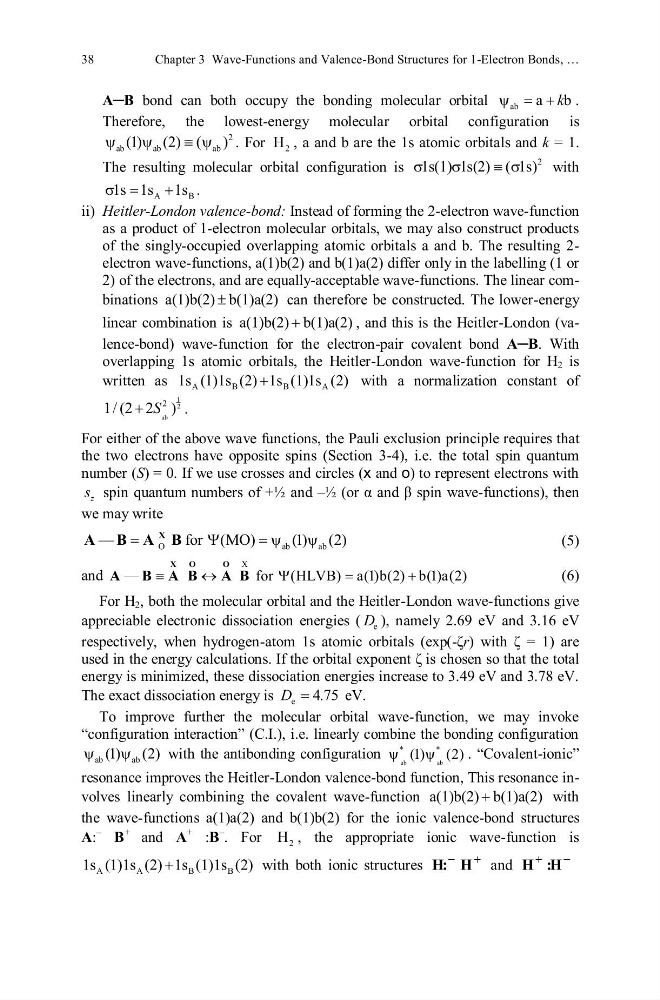
A─B bond can both occupy the bonding molecular orbital ab a b
k .
Therefore, the lowest-energy molecular orbital configuration is
2
ab
ab
ab
(1) (2) ( )
. For 2
H , a and b are the 1s atomic orbitals and k = 1.
The resulting molecular orbital configuration is
2
1s(1) 1s(2) ( 1s)
with
A
B
1s 1s 1s
.
ii) Heitler-London valence-bond: Instead of forming the 2-electron wave-function
as a product of 1-electron molecular orbitals, we may also construct products
of the singly-occupied overlapping atomic orbitals a and b. The resulting 2electron wave-functions, a(1)b(2) and b(1)a(2) differ only in the labelling (1 or
2) of the electrons, and are equally-acceptable wave-functions. The linear combinations a(1)b(2) b(1)a(2)
can therefore be constructed. The lower-energy
linear combination is a(1)b(2) b(1)a(2)
, and this is the Heitler-London (valence-bond) wave-function for the electron-pair covalent bond A─B. With
overlapping 1s atomic orbitals, the Heitler-London wave-function for H 2 is
written as
A
B
B
A
1s (1)1s (2) 1s (1)1s (2)
with a normalization constant of
1
2
ab
2
1/ (2 2 )
S .
For either of the above wave functions, the Pauli exclusion principle requires that
the two electrons have opposite spins (Section 3-4), i.e. the total spin quantum
number (S) = 0. If we use crosses and circles (x and o) to represent electrons with
z
s spin quantum numbers of +½ and –½ (or α and β spin wave-functions), then
we may write
O
ab
ab
—
for (MO)
(1) (2)
X
A B A B
(5)
and
X
—
for (HLVB) a(1)b(2) b(1)a(2)
X O
O
A B A B
A B
(6)
For H 2 , both the molecular orbital and the Heitler-London wave-functions give
appreciable electronic dissociation energies ( e
D ), namely 2.69 eV and 3.16 eV
respectively, when hydrogen-atom 1s atomic orbitals (exp(-ζr) with ζ = 1) are
used in the energy calculations. If the orbital exponent ζ is chosen so that the total
energy is minimized, these dissociation energies increase to 3.49 eV and 3.78 eV.
The exact dissociation energy is e 4.75
D
eV.
To improve further the molecular orbital wave-function, we may invoke
“configuration interaction” (C.I.), i.e. linearly combine the bonding configuration
ab
ab
(1) (2)
with the antibonding configuration
ab
ab
*
*
(1) (2)
. “Covalent-ionic”
resonance improves the Heitler-London valence-bond function, This resonance involves linearly combining the covalent wave-function a(1)b(2) b(1)a(2)
with
the wave-functions a(1)a(2) and b(1)b(2) for the ionic valence-bond structures
A:
– B
+ and A
+ :B
–
. For
2
H , the appropriate ionic wave-function is
A
A
B
B
1s (1)1s (2) 1s (1)1s (2)
with both ionic structures
H
:
H
and
H
:
H
Chapter 3 Wave-Functions and Valence-Bond Structures for 1-Electron Bonds, …
A─B bond can both occupy the bonding molecular orbital ab a b
k .
Therefore, the lowest-energy molecular orbital configuration is
2
ab
ab
ab
(1) (2) ( )
. For 2
H , a and b are the 1s atomic orbitals and k = 1.
The resulting molecular orbital configuration is
2
1s(1) 1s(2) ( 1s)
with
A
B
1s 1s 1s
.
ii) Heitler-London valence-bond: Instead of forming the 2-electron wave-function
as a product of 1-electron molecular orbitals, we may also construct products
of the singly-occupied overlapping atomic orbitals a and b. The resulting 2electron wave-functions, a(1)b(2) and b(1)a(2) differ only in the labelling (1 or
2) of the electrons, and are equally-acceptable wave-functions. The linear combinations a(1)b(2) b(1)a(2)
can therefore be constructed. The lower-energy
linear combination is a(1)b(2) b(1)a(2)
, and this is the Heitler-London (valence-bond) wave-function for the electron-pair covalent bond A─B. With
overlapping 1s atomic orbitals, the Heitler-London wave-function for H 2 is
written as
A
B
B
A
1s (1)1s (2) 1s (1)1s (2)
with a normalization constant of
1
2
ab
2
1/ (2 2 )
S .
For either of the above wave functions, the Pauli exclusion principle requires that
the two electrons have opposite spins (Section 3-4), i.e. the total spin quantum
number (S) = 0. If we use crosses and circles (x and o) to represent electrons with
z
s spin quantum numbers of +½ and –½ (or α and β spin wave-functions), then
we may write
O
ab
ab
—
for (MO)
(1) (2)
X
A B A B
(5)
and
X
—
for (HLVB) a(1)b(2) b(1)a(2)
X O
O
A B A B
A B
(6)
For H 2 , both the molecular orbital and the Heitler-London wave-functions give
appreciable electronic dissociation energies ( e
D ), namely 2.69 eV and 3.16 eV
respectively, when hydrogen-atom 1s atomic orbitals (exp(-ζr) with ζ = 1) are
used in the energy calculations. If the orbital exponent ζ is chosen so that the total
energy is minimized, these dissociation energies increase to 3.49 eV and 3.78 eV.
The exact dissociation energy is e 4.75
D
eV.
To improve further the molecular orbital wave-function, we may invoke
“configuration interaction” (C.I.), i.e. linearly combine the bonding configuration
ab
ab
(1) (2)
with the antibonding configuration
ab
ab
*
*
(1) (2)
. “Covalent-ionic”
resonance improves the Heitler-London valence-bond function, This resonance involves linearly combining the covalent wave-function a(1)b(2) b(1)a(2)
with
the wave-functions a(1)a(2) and b(1)b(2) for the ionic valence-bond structures
A:
– B
+ and A
+ :B
–
. For
2
H , the appropriate ionic wave-function is
A
A
B
B
1s (1)1s (2) 1s (1)1s (2)
with both ionic structures
H
:
H
and
H
:
H