

2-5 “Long-Bond” Lewis Structures and a Need for an “Increased-Valence” Theory
25
overlap integrals ( yb
ybd
S
v etc.,) are much smaller than are those that pertain
for pairs of atomic orbitals located on adjacent atomic centres. Thus, we have
calculated yb
y b
0.01
S
S
. For the N-N and N-O π- or -bonds of structures
(1)-(3), which utilize atomic orbitals on adjacent atoms, the overlap integrals are
ya
y a
0.26
S
S
, and ab
a b
0.19
S
S
. Consequently, if we assume that the
magnitude of the overlap integral provides a qualitative guide to the extent of
covalent bonding, then there is less covalent bonding for structures (5) and (6)
than there is for structures (1)-(4).
It is conceivable that the reduction in nearest-neighbour covalent bonding that
occurs in the “long-bond” structures (5) and (6) may be either partially or completely compensated by the absence of atomic formal charges in these structures.
Should this be the case, then consideration of both rules (a) and (b) together on a
more equal footing would lead us to conclude that Lewis structures (1), (2) (3), (5)
and (6) could all make important contributions to the ground-state resonance
description of the electronic structure of N 2 O. For F 2 O 2 , Lewis structures (1), (2),
(3) and (5) of Figure 2-10 might also be selected as important structures. If we
extend these types of considerations to other molecules, then according to the
electroneutrality principle, we have no right to assume that “long-bond” Lewis
structures make minor contributions to the ground-state resonance description for
many molecules. The results for a number of calculations of valence-bond wavefunctions
13,17 indicate that this assumption is especially not valid when the
standard Lewis structures (for example, structures (1)-(4) of Figure 2-9 for N 2 O)
carry non-zero atomic formal charges and one or more of the “long-bond”
structures do not. The generalized valence-bond calculations of Goddard and his
co-workers
18 , and the valence-bond calculations of Hiberty and Le-Forestier
19 ,
provide further support for this conclusion.
Although perhaps it is very much concealed, the wavefunctions (or bondeigenfunctions) for valence-bond structures with “long bonds” also contribute to
the molecular orbital description for 4-electron 3-centre bonding
13,17
. We shall
demonstrate this here for a symmetrical 4-electron 3-centre bonding unit, with the
molecular orbitals of Eqn. (1). These molecular orbitals may be used to express
the lowest-energy molecular orbital configuration
2
2
1
2
( ) ( )
as a linear
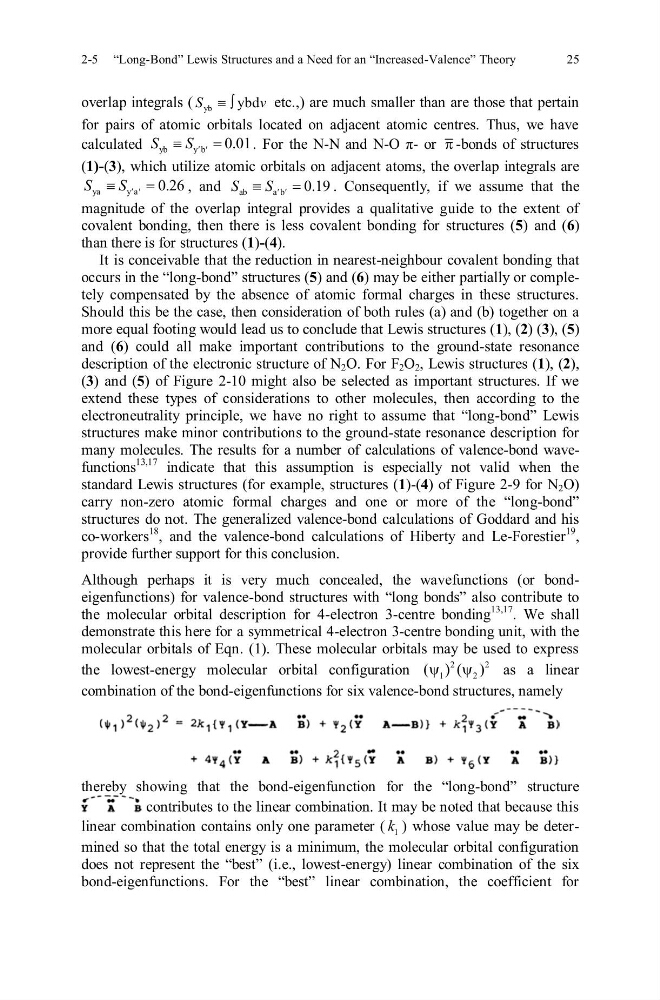
combination of the bond-eigenfunctions for six valence-bond structures, namely
thereby showing that the bond-eigenfunction for the “long-bond” structure
contributes to the linear combination. It may be noted that because this
linear combination contains only one parameter ( 1
k ) whose value may be determined so that the total energy is a minimum, the molecular orbital configuration
does not represent the “best” (i.e., lowest-energy) linear combination of the six
bond-eigenfunctions. For the “best” linear combination, the coefficient for
25
overlap integrals ( yb
ybd
S
v etc.,) are much smaller than are those that pertain
for pairs of atomic orbitals located on adjacent atomic centres. Thus, we have
calculated yb
y b
0.01
S
S
. For the N-N and N-O π- or -bonds of structures
(1)-(3), which utilize atomic orbitals on adjacent atoms, the overlap integrals are
ya
y a
0.26
S
S
, and ab
a b
0.19
S
S
. Consequently, if we assume that the
magnitude of the overlap integral provides a qualitative guide to the extent of
covalent bonding, then there is less covalent bonding for structures (5) and (6)
than there is for structures (1)-(4).
It is conceivable that the reduction in nearest-neighbour covalent bonding that
occurs in the “long-bond” structures (5) and (6) may be either partially or completely compensated by the absence of atomic formal charges in these structures.
Should this be the case, then consideration of both rules (a) and (b) together on a
more equal footing would lead us to conclude that Lewis structures (1), (2) (3), (5)
and (6) could all make important contributions to the ground-state resonance
description of the electronic structure of N 2 O. For F 2 O 2 , Lewis structures (1), (2),
(3) and (5) of Figure 2-10 might also be selected as important structures. If we
extend these types of considerations to other molecules, then according to the
electroneutrality principle, we have no right to assume that “long-bond” Lewis
structures make minor contributions to the ground-state resonance description for
many molecules. The results for a number of calculations of valence-bond wavefunctions
13,17 indicate that this assumption is especially not valid when the
standard Lewis structures (for example, structures (1)-(4) of Figure 2-9 for N 2 O)
carry non-zero atomic formal charges and one or more of the “long-bond”
structures do not. The generalized valence-bond calculations of Goddard and his
co-workers
18 , and the valence-bond calculations of Hiberty and Le-Forestier
19 ,
provide further support for this conclusion.
Although perhaps it is very much concealed, the wavefunctions (or bondeigenfunctions) for valence-bond structures with “long bonds” also contribute to
the molecular orbital description for 4-electron 3-centre bonding
13,17
. We shall
demonstrate this here for a symmetrical 4-electron 3-centre bonding unit, with the
molecular orbitals of Eqn. (1). These molecular orbitals may be used to express
the lowest-energy molecular orbital configuration
2
2
1
2
( ) ( )
as a linear
combination of the bond-eigenfunctions for six valence-bond structures, namely
thereby showing that the bond-eigenfunction for the “long-bond” structure
contributes to the linear combination. It may be noted that because this
linear combination contains only one parameter ( 1
k ) whose value may be determined so that the total energy is a minimum, the molecular orbital configuration
does not represent the “best” (i.e., lowest-energy) linear combination of the six
bond-eigenfunctions. For the “best” linear combination, the coefficient for