

24
Chapter 2 Pauling “3-Electron Bonds”, 4-Electron 3-Centre Bonding, and the Need …
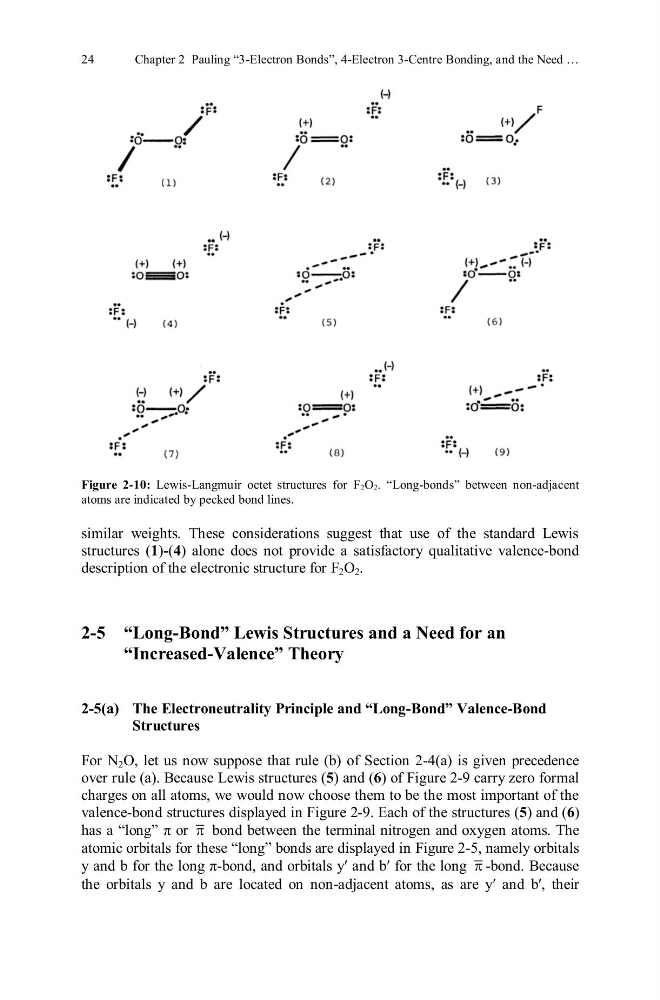
Figure 2-10: Lewis-Langmuir octet structures for F2O2. “Long-bonds” between non-adjacent
atoms are indicated by pecked bond lines.
similar weights. These considerations suggest that use of the standard Lewis
structures (1)-(4) alone does not provide a satisfactory qualitative valence-bond
description of the electronic structure for F 2 O 2 .
2-5 “Long-Bond” Lewis Structures and a Need for an
“Increased-Valence” Theory
2-5(a) The Electroneutrality Principle and “Long-Bond” Valence-Bond
Structures
For N 2 O, let us now suppose that rule (b) of Section 2-4(a) is given precedence
over rule (a). Because Lewis structures (5) and (6) of Figure 2-9 carry zero formal
charges on all atoms, we would now choose them to be the most important of the
valence-bond structures displayed in Figure 2-9. Each of the structures (5) and (6)
has a “long” π or bond between the terminal nitrogen and oxygen atoms. The
atomic orbitals for these “long” bonds are displayed in Figure 2-5, namely orbitals
y and b for the long π-bond, and orbitals y′ and b′ for the long -bond. Because
the orbitals y and b are located on non-adjacent atoms, as are y′ and b′, their
Chapter 2 Pauling “3-Electron Bonds”, 4-Electron 3-Centre Bonding, and the Need …
Figure 2-10: Lewis-Langmuir octet structures for F2O2. “Long-bonds” between non-adjacent
atoms are indicated by pecked bond lines.
similar weights. These considerations suggest that use of the standard Lewis
structures (1)-(4) alone does not provide a satisfactory qualitative valence-bond
description of the electronic structure for F 2 O 2 .
2-5 “Long-Bond” Lewis Structures and a Need for an
“Increased-Valence” Theory
2-5(a) The Electroneutrality Principle and “Long-Bond” Valence-Bond
Structures
For N 2 O, let us now suppose that rule (b) of Section 2-4(a) is given precedence
over rule (a). Because Lewis structures (5) and (6) of Figure 2-9 carry zero formal
charges on all atoms, we would now choose them to be the most important of the
valence-bond structures displayed in Figure 2-9. Each of the structures (5) and (6)
has a “long” π or bond between the terminal nitrogen and oxygen atoms. The
atomic orbitals for these “long” bonds are displayed in Figure 2-5, namely orbitals
y and b for the long π-bond, and orbitals y′ and b′ for the long -bond. Because
the orbitals y and b are located on non-adjacent atoms, as are y′ and b′, their