

314
Chapter 24 A Note on Pauling “3-Electron Bonds” and Covalent-Ionic Resonance
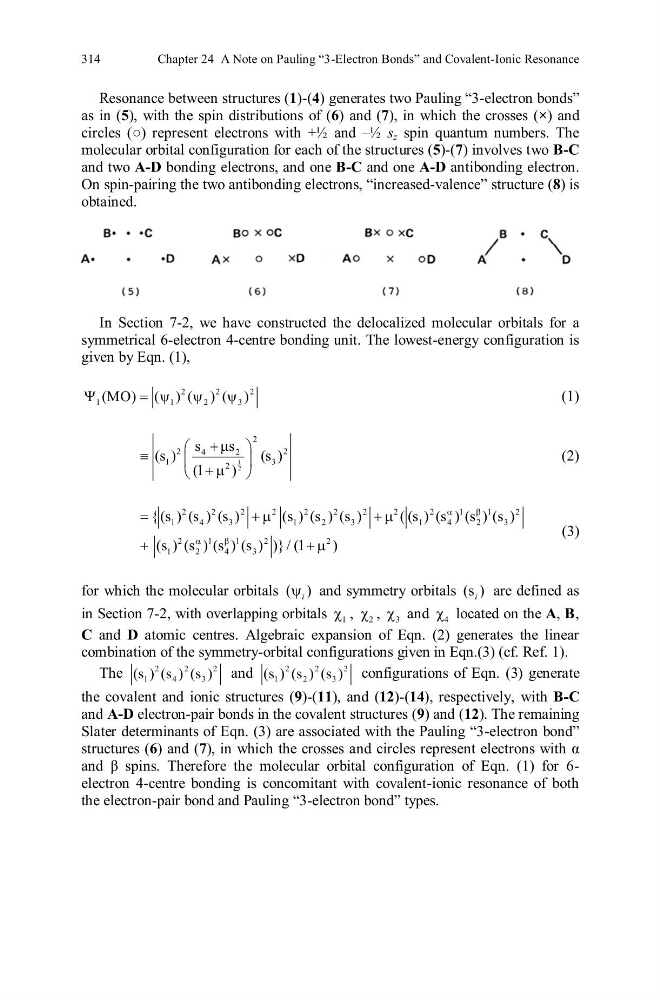
Resonance between structures (1)-(4) generates two Pauling “3-electron bonds”
as in (5), with the spin distributions of (6) and (7), in which the crosses (×) and
circles (○) represent electrons with +½ and –½ s z spin quantum numbers. The
molecular orbital configuration for each of the structures (5)-(7) involves two B-C
and two A-D bonding electrons, and one B-C and one A-D antibonding electron.
On spin-pairing the two antibonding electrons, “increased-valence” structure (8) is
obtained.
In Section 7-2, we have constructed the delocalized molecular orbitals for a
symmetrical 6-electron 4-centre bonding unit. The lowest-energy configuration is
given by Eqn. (1),
2
2
2
1
1
2
3
(M ) ( ) ( ) ( )
(1)
1
2
2
2
2
4
2
1
3
2
s
s
(s )
(s )
(1
)
(2)
2
2
2
2
2
2
2
2
2
1
1
2
1
4
3
1
2
3
1
4
2
3
2
1
1
2
2
1
2
4
3
{ (s ) (s ) (s )
(s ) (s ) (s )
( (s ) (s ) (s ) (s )
(s ) (s ) (s ) (s ) )} / (1
)
(3)
for which the molecular orbitals ( )
i
and symmetry orbitals (s )
i
are defined as
in Section 7-2, with overlapping orbitals 1
, 2
, 3
and 4
located on the A, B,
C and D atomic centres. Algebraic expansion of Eqn. (2) generates the linear
combination of the symmetry-orbital configurations given in Eqn.(3) (cf. Ref. 1).
The
2
2
2
1
4
3
(s ) (s ) (s ) and
2
2
2
1
2
3
(s ) (s ) (s ) configurations of Eqn. (3) generate
the covalent and ionic structures (9)-(11), and (12)-(14), respectively, with B-C
and A-D electron-pair bonds in the covalent structures (9) and (12). The remaining
Slater determinants of Eqn. (3) are associated with the Pauling “3-electron bond”
structures (6) and (7), in which the crosses and circles represent electrons with α
and β spins. Therefore the molecular orbital configuration of Eqn. (1) for 6electron 4-centre bonding is concomitant with covalent-ionic resonance of both
the electron-pair bond and Pauling “3-electron bond” types.
Chapter 24 A Note on Pauling “3-Electron Bonds” and Covalent-Ionic Resonance
Resonance between structures (1)-(4) generates two Pauling “3-electron bonds”
as in (5), with the spin distributions of (6) and (7), in which the crosses (×) and
circles (○) represent electrons with +½ and –½ s z spin quantum numbers. The
molecular orbital configuration for each of the structures (5)-(7) involves two B-C
and two A-D bonding electrons, and one B-C and one A-D antibonding electron.
On spin-pairing the two antibonding electrons, “increased-valence” structure (8) is
obtained.
In Section 7-2, we have constructed the delocalized molecular orbitals for a
symmetrical 6-electron 4-centre bonding unit. The lowest-energy configuration is
given by Eqn. (1),
2
2
2
1
1
2
3
(M ) ( ) ( ) ( )
(1)
1
2
2
2
2
4
2
1
3
2
s
s
(s )
(s )
(1
)
(2)
2
2
2
2
2
2
2
2
2
1
1
2
1
4
3
1
2
3
1
4
2
3
2
1
1
2
2
1
2
4
3
{ (s ) (s ) (s )
(s ) (s ) (s )
( (s ) (s ) (s ) (s )
(s ) (s ) (s ) (s ) )} / (1
)
(3)
for which the molecular orbitals ( )
i
and symmetry orbitals (s )
i
are defined as
in Section 7-2, with overlapping orbitals 1
, 2
, 3
and 4
located on the A, B,
C and D atomic centres. Algebraic expansion of Eqn. (2) generates the linear
combination of the symmetry-orbital configurations given in Eqn.(3) (cf. Ref. 1).
The
2
2
2
1
4
3
(s ) (s ) (s ) and
2
2
2
1
2
3
(s ) (s ) (s ) configurations of Eqn. (3) generate
the covalent and ionic structures (9)-(11), and (12)-(14), respectively, with B-C
and A-D electron-pair bonds in the covalent structures (9) and (12). The remaining
Slater determinants of Eqn. (3) are associated with the Pauling “3-electron bond”
structures (6) and (7), in which the crosses and circles represent electrons with α
and β spins. Therefore the molecular orbital configuration of Eqn. (1) for 6electron 4-centre bonding is concomitant with covalent-ionic resonance of both
the electron-pair bond and Pauling “3-electron bond” types.