

Chapter 24 A Note on Pauling “3-Electron Bonds” and Covalent-Ionic Resonance
315
When 1 (MO)
of Eqn. (1) is linearly combined with the excited configuration
2 (M )
of Eqn. (4),
2
2
2
2
1
2
4
(M ) ( ) ( ) ( )
(4)
1
2
2
2
2
3
1
3
4
2
s
s
(s ) (s )
(1
)
(5)
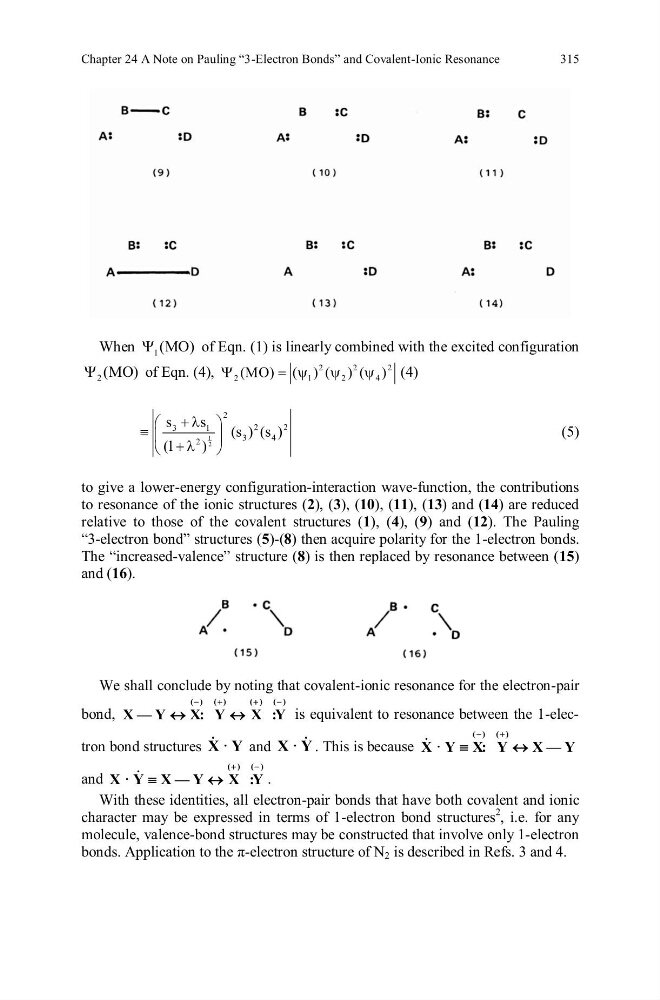
to give a lower-energy configuration-interaction wave-function, the contributions
to resonance of the ionic structures (2), (3), (10), (11), (13) and (14) are reduced
relative to those of the covalent structures (1), (4), (9) and (12). The Pauling
“3-electron bond” structures (5)-(8) then acquire polarity for the 1-electron bonds.
The “increased-valence” structure (8) is then replaced by resonance between (15)
and (16).
We shall conclude by noting that covalent-ionic resonance for the electron-pair
bond,
( ) ( )
( ) ( )
X — Υ
X: Υ
X :Y
is equivalent to resonance between the 1-electron bond structures X · Υ
and X · Y . This is because
( ) ( )
X · Υ X: Υ
X — Υ
and
( ) ( )
X · Υ Χ — Υ
Χ :Υ
.
With these identities, all electron-pair bonds that have both covalent and ionic
character may be expressed in terms of 1-electron bond structures
2
, i.e. for any
molecule, valence-bond structures may be constructed that involve only 1-electron
bonds. Application to the π-electron structure of N 2 is described in Refs. 3 and 4.
315
When 1 (MO)
of Eqn. (1) is linearly combined with the excited configuration
2 (M )
of Eqn. (4),
2
2
2
2
1
2
4
(M ) ( ) ( ) ( )
(4)
1
2
2
2
2
3
1
3
4
2
s
s
(s ) (s )
(1
)
(5)
to give a lower-energy configuration-interaction wave-function, the contributions
to resonance of the ionic structures (2), (3), (10), (11), (13) and (14) are reduced
relative to those of the covalent structures (1), (4), (9) and (12). The Pauling
“3-electron bond” structures (5)-(8) then acquire polarity for the 1-electron bonds.
The “increased-valence” structure (8) is then replaced by resonance between (15)
and (16).
We shall conclude by noting that covalent-ionic resonance for the electron-pair
bond,
( ) ( )
( ) ( )
X — Υ
X: Υ
X :Y
is equivalent to resonance between the 1-electron bond structures X · Υ
and X · Y . This is because
( ) ( )
X · Υ X: Υ
X — Υ
and
( ) ( )
X · Υ Χ — Υ
Χ :Υ
.
With these identities, all electron-pair bonds that have both covalent and ionic
character may be expressed in terms of 1-electron bond structures
2
, i.e. for any
molecule, valence-bond structures may be constructed that involve only 1-electron
bonds. Application to the π-electron structure of N 2 is described in Refs. 3 and 4.