

Chapter 24 A Note on Pauling “3-Electron
Bonds” and Covalent-Ionic
Resonance
If a pair of electrons occupy two overlapping atomic orbitals centred on two atoms
X and Y, then the X-Y bond may be described in terms of resonance between a
covalent structure and two ionic structures, viz
This type of covalent-ionic resonance, which involves an electron-pair bond in
the covalent structure, is widely known. The discussions of Section 7-3 and 8-1(c)
show that for 6-electron 4-centre bonding units, another type of covalent-ionic
resonance is also possible, namely that which generates a Pauling “3-electron
bond” between the diatomic moieties. If we generalize the discussion of Section
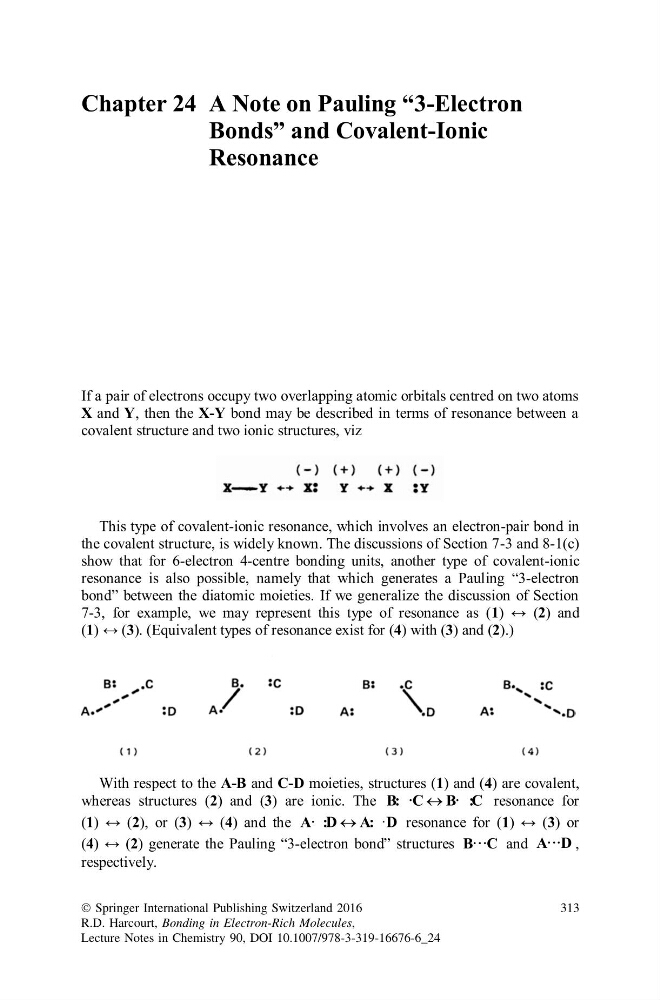
7-3, for example, we may represent this type of resonance as (1) ↔ (2) and
(1) ↔ (3). (Equivalent types of resonance exist for (4) with (3) and (2).)
With respect to the A-B and C-D moieties, structures (1) and (4) are covalent,
whereas structures (2) and (3) are ionic. The
B: ·C B· :C resonance for
(1) ↔ (2), or (3) ↔ (4) and the
·
A· :D A: D resonance for (1) ↔ (3) or
(4) ↔ (2) generate the Pauling “3-electron bond” structures B···C and A···D ,
respectively.
Ó Springer International Publishing Switzerland 2016
R.D. Harcourt, Bonding in Electron-Rich Molecules,
Lecture Notes in Chemistry 90, DOI 10.1007/978-3-319-16676-6_24
313
Bonds” and Covalent-Ionic
Resonance
If a pair of electrons occupy two overlapping atomic orbitals centred on two atoms
X and Y, then the X-Y bond may be described in terms of resonance between a
covalent structure and two ionic structures, viz
This type of covalent-ionic resonance, which involves an electron-pair bond in
the covalent structure, is widely known. The discussions of Section 7-3 and 8-1(c)
show that for 6-electron 4-centre bonding units, another type of covalent-ionic
resonance is also possible, namely that which generates a Pauling “3-electron
bond” between the diatomic moieties. If we generalize the discussion of Section
7-3, for example, we may represent this type of resonance as (1) ↔ (2) and
(1) ↔ (3). (Equivalent types of resonance exist for (4) with (3) and (2).)
With respect to the A-B and C-D moieties, structures (1) and (4) are covalent,
whereas structures (2) and (3) are ionic. The
B: ·C B· :C resonance for
(1) ↔ (2), or (3) ↔ (4) and the
·
A· :D A: D resonance for (1) ↔ (3) or
(4) ↔ (2) generate the Pauling “3-electron bond” structures B···C and A···D ,
respectively.
Ó Springer International Publishing Switzerland 2016
R.D. Harcourt, Bonding in Electron-Rich Molecules,
Lecture Notes in Chemistry 90, DOI 10.1007/978-3-319-16676-6_24
313