

Addendum Chapter 23
311
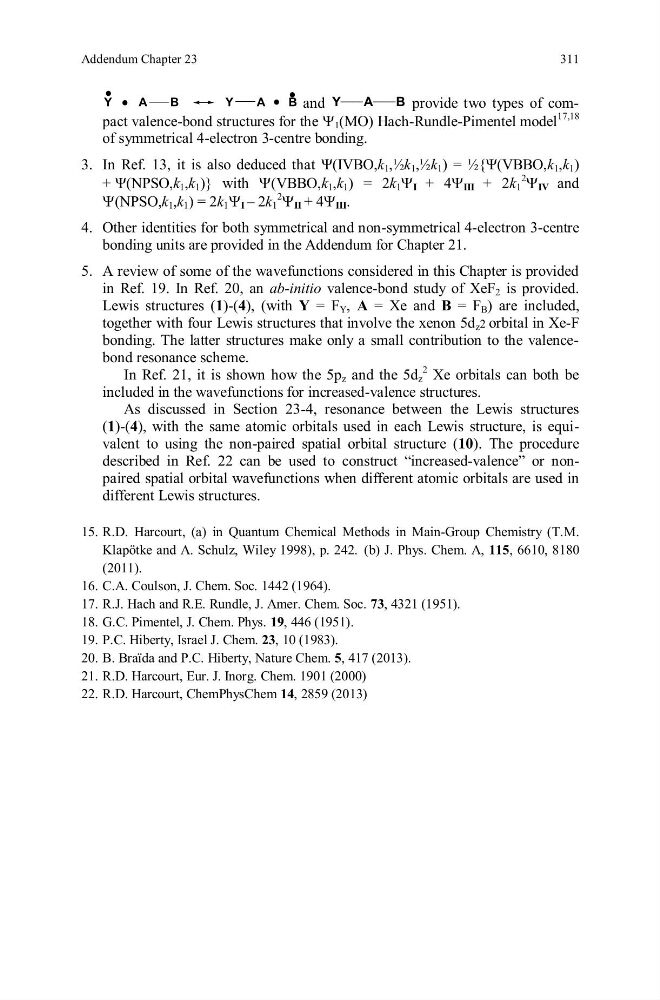
Y
A
B
Y
A
B and Y
A
B provide two types of compact valence-bond structures for the 1 (MO) Hach-Rundle-Pimentel model
17,18
of symmetrical 4-electron 3-centre bonding.
3. In Ref. 13, it is also deduced that Ψ(IVBO,k 1 ,½k 1 ,½k 1 ) = ½{Ψ(VBBO,k 1 ,k 1 )
+Ψ(NPSO,k 1 ,k 1 )} with (VBBO,k 1 ,k 1 ) = 2k 1 I + 4 III + 2k 1
2
IV and
(NPSO,k 1 ,k 1 ) = 2k 1 I – 2k 1
2
II + 4 III .
4. Other identities for both symmetrical and non-symmetrical 4-electron 3-centre
bonding units are provided in the Addendum for Chapter 21.
5. A review of some of the wavefunctions considered in this Chapter is provided
in Ref. 19. In Ref. 20, an ab-initio valence-bond study of XeF 2 is provided.
Lewis structures (1)-(4), (with Y = F Y , A = Xe and B = F B ) are included,
together with four Lewis structures that involve the xenon 5d z 2 orbital in Xe-F
bonding. The latter structures make only a small contribution to the valencebond resonance scheme.
In Ref. 21, it is shown how the 5p z and the 5d z
2 Xe orbitals can both be
included in the wavefunctions for increased-valence structures.
As discussed in Section 23-4, resonance between the Lewis structures
(1)-(4), with the same atomic orbitals used in each Lewis structure, is equivalent to using the non-paired spatial orbital structure (10). The procedure
described in Ref. 22 can be used to construct “increased-valence” or nonpaired spatial orbital wavefunctions when different atomic orbitals are used in
different Lewis structures.
15. R.D. Harcourt, (a) in Quantum Chemical Methods in Main-Group Chemistry (T.M.
Klapötke and A. Schulz, Wiley 1998), p. 242. (b) J. Phys. Chem. A, 115, 6610, 8180
(2011).
16. C.A. Coulson, J. Chem. Soc. 1442 (1964).
17. R.J. Hach and R.E. Rundle, J. Amer. Chem. Soc. 73, 4321 (1951).
18. G.C. Pimentel, J. Chem. Phys. 19, 446 (1951).
19. P.C. Hiberty, Israel J. Chem. 23, 10 (1983).
20. B. Braïda and P.C. Hiberty, Nature Chem. 5, 417 (2013).
21. R.D. Harcourt, Eur. J. Inorg. Chem. 1901 (2000)
22. R.D. Harcourt, ChemPhysChem 14, 2859 (2013)
311
Y
A
B
Y
A
B and Y
A
B provide two types of compact valence-bond structures for the 1 (MO) Hach-Rundle-Pimentel model
17,18
of symmetrical 4-electron 3-centre bonding.
3. In Ref. 13, it is also deduced that Ψ(IVBO,k 1 ,½k 1 ,½k 1 ) = ½{Ψ(VBBO,k 1 ,k 1 )
+Ψ(NPSO,k 1 ,k 1 )} with (VBBO,k 1 ,k 1 ) = 2k 1 I + 4 III + 2k 1
2
IV and
(NPSO,k 1 ,k 1 ) = 2k 1 I – 2k 1
2
II + 4 III .
4. Other identities for both symmetrical and non-symmetrical 4-electron 3-centre
bonding units are provided in the Addendum for Chapter 21.
5. A review of some of the wavefunctions considered in this Chapter is provided
in Ref. 19. In Ref. 20, an ab-initio valence-bond study of XeF 2 is provided.
Lewis structures (1)-(4), (with Y = F Y , A = Xe and B = F B ) are included,
together with four Lewis structures that involve the xenon 5d z 2 orbital in Xe-F
bonding. The latter structures make only a small contribution to the valencebond resonance scheme.
In Ref. 21, it is shown how the 5p z and the 5d z
2 Xe orbitals can both be
included in the wavefunctions for increased-valence structures.
As discussed in Section 23-4, resonance between the Lewis structures
(1)-(4), with the same atomic orbitals used in each Lewis structure, is equivalent to using the non-paired spatial orbital structure (10). The procedure
described in Ref. 22 can be used to construct “increased-valence” or nonpaired spatial orbital wavefunctions when different atomic orbitals are used in
different Lewis structures.
15. R.D. Harcourt, (a) in Quantum Chemical Methods in Main-Group Chemistry (T.M.
Klapötke and A. Schulz, Wiley 1998), p. 242. (b) J. Phys. Chem. A, 115, 6610, 8180
(2011).
16. C.A. Coulson, J. Chem. Soc. 1442 (1964).
17. R.J. Hach and R.E. Rundle, J. Amer. Chem. Soc. 73, 4321 (1951).
18. G.C. Pimentel, J. Chem. Phys. 19, 446 (1951).
19. P.C. Hiberty, Israel J. Chem. 23, 10 (1983).
20. B. Braïda and P.C. Hiberty, Nature Chem. 5, 417 (2013).
21. R.D. Harcourt, Eur. J. Inorg. Chem. 1901 (2000)
22. R.D. Harcourt, ChemPhysChem 14, 2859 (2013)