

308
Chapter 23 Some Comparisons of Types of Wave-Funcions
Ψ
IVBO
2
2
2
1
2
3
4
6
Υ A B
(
)
( — · ,
) k
k k
k k
kk
(16)
for resonance between the five canonical Lewis structures (1)-(4) and (6). The
formal charges for the omitted canonical structure (15) suggest that this structure
should have a small weight, and therefore this three-parameter function should
approximate closely to the Ψ(best) for Ψ( Υ — A · B ,IVBO) .
To obtain the variationally-best energy for Ψ( Υ — A · B ,IVBO), a fourth
variational parameter is needed. One (but not the only) way to introduce the additional parameter involves replacing R
= b + k”a with R
= b + k”a + ly.
23-7 Conclusions
Throughout this book, it will be noticed how usually we have used a HeitlerLondon type wave-function for the (fractional) two-electron Y-A bond of the
“increased-valence” structure (11). Invoking such a wave-function is the simplest
way to ensure that the “increased-valence” structure summarizes resonance
between the standard and “long-bond” Lewis structures (2) and (3), each of which
has a Heitler-London electron-pair bond. But, as we have done in Sections 23-3,
23-5, the Chapter 21 Addendum and Chapter 25, we may also use two-centre bond
orbitals as wave functions for the two-electron Y-A bonds of structures (2) and
(11) as well as for the one-electron A-B bond of structure (11). In Section 23-6,
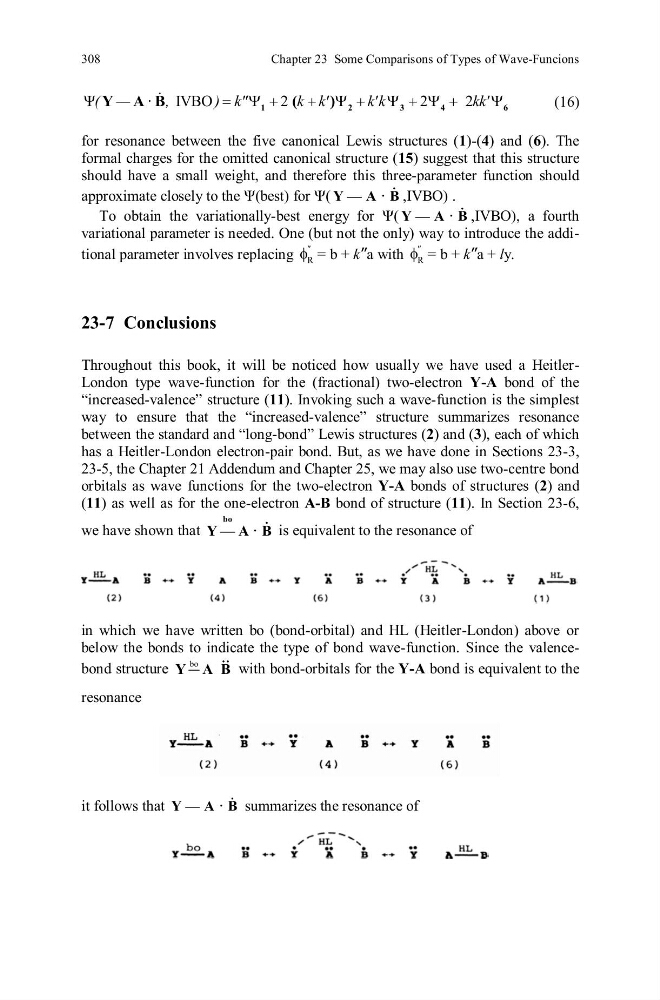
we have shown that
bo
Υ — A · B is equivalent to the resonance of
in which we have written bo (bond-orbital) and HL (Heitler-London) above or
below the bonds to indicate the type of bond wave-function. Since the valencebond structure
bo
Υ A B with bond-orbitals for the Y-A bond is equivalent to the
resonance
it follows that Υ — A · Β summarizes the resonance of
Chapter 23 Some Comparisons of Types of Wave-Funcions
Ψ
IVBO
2
2
2
1
2
3
4
6
Υ A B
(
)
( — · ,
) k
k k
k k
kk
(16)
for resonance between the five canonical Lewis structures (1)-(4) and (6). The
formal charges for the omitted canonical structure (15) suggest that this structure
should have a small weight, and therefore this three-parameter function should
approximate closely to the Ψ(best) for Ψ( Υ — A · B ,IVBO) .
To obtain the variationally-best energy for Ψ( Υ — A · B ,IVBO), a fourth
variational parameter is needed. One (but not the only) way to introduce the additional parameter involves replacing R
= b + k”a with R
= b + k”a + ly.
23-7 Conclusions
Throughout this book, it will be noticed how usually we have used a HeitlerLondon type wave-function for the (fractional) two-electron Y-A bond of the
“increased-valence” structure (11). Invoking such a wave-function is the simplest
way to ensure that the “increased-valence” structure summarizes resonance
between the standard and “long-bond” Lewis structures (2) and (3), each of which
has a Heitler-London electron-pair bond. But, as we have done in Sections 23-3,
23-5, the Chapter 21 Addendum and Chapter 25, we may also use two-centre bond
orbitals as wave functions for the two-electron Y-A bonds of structures (2) and
(11) as well as for the one-electron A-B bond of structure (11). In Section 23-6,
we have shown that
bo
Υ — A · B is equivalent to the resonance of
in which we have written bo (bond-orbital) and HL (Heitler-London) above or
below the bonds to indicate the type of bond wave-function. Since the valencebond structure
bo
Υ A B with bond-orbitals for the Y-A bond is equivalent to the
resonance
it follows that Υ — A · Β summarizes the resonance of