

23-6
“Improved” Ψ(IVBO) and Ψ(best)
307
The Ψ(NPSO) may be improved by using the bond-orbitals L y a
k
,
R
b
a
k
, L y
a
k
, and R b a
k
instead of
L
y a
k
and
R
b a
k
. If this is done, Ψ(ΝΡSO) is given by Eqn.(14),
( SO) (
)
2
4
k k
kk
I
II
ΙΙI
(14)
which generates low energies in Table 23-4. However, because it omits IV ,
Ψ(ΝΡSO) can never become equivalent to Ψ(best), With Ψ(ΙVΒΟ), we may
construct either two-parameter or three-parameter variational wavefunctions. For
example, we may use L y a
k
and L y
a
k
for both electrons of the (fractional) two-electron Y-A bond of structure (11), and R b
a
k
for the oneelectron A-B bond of this structure, together with the R b a
k
, R b
a
k
and L y
a
k
for structure (12). By introducing these orbitals into Ψ(IVBO),
we may express this wave function according to Eqn.(15)
(IVBO) (
)
2
4
2
k k k
kk
kk
II
III
IV
(15)
which may be shown
13 to be equivalent to
3
(4 / )
C (best). Therefore, for symmetrical systems, resonance between the two “increased-valence” structures (11) and
(12) is equivalent to unrestricted resonance between the the canonical Lewis
structures (1)-(6). Therefore, if we use non-orthogonal bond orbitals as wavefunctions for (fractional) electron-pair bonds and one-electron bonds, we may use
“increased-valence” structures and know that these can correspond to the best
description of symmetrical 4-electron 3-centre bonding units.
In Table 23-4, we have reported some two-parameter Ψ(ΙVΒΟ), for which we
have assumed that k = k′ in the bond orbitals for the two-electron bond. As is the
case for the two-parameter Ψ(ΝΡSO), the energies of these Ψ(IVBO) are very
low.
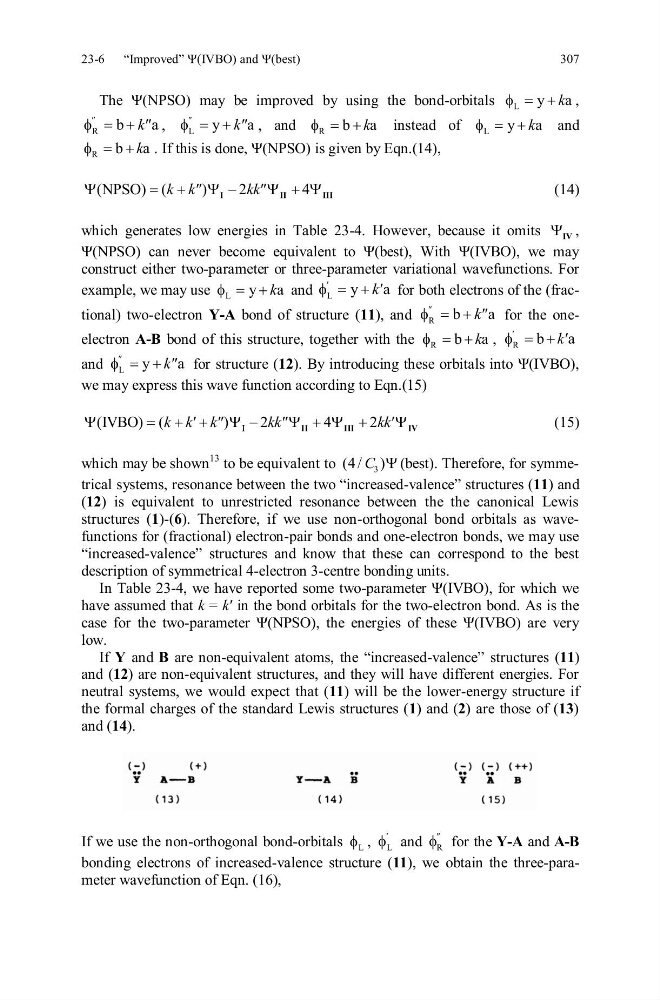
If Y and B are non-equivalent atoms, the “increased-valence” structures (11)
and (12) are non-equivalent structures, and they will have different energies. For
neutral systems, we would expect that (11) will be the lower-energy structure if
the formal charges of the standard Lewis structures (1) and (2) are those of (13)
and (14).
If we use the non-orthogonal bond-orbitals L
, L
and R
for the Y-A and A-B
bonding electrons of increased-valence structure (11), we obtain the three-parameter wavefunction of Eqn. (16),
“Improved” Ψ(IVBO) and Ψ(best)
307
The Ψ(NPSO) may be improved by using the bond-orbitals L y a
k
,
R
b
a
k
, L y
a
k
, and R b a
k
instead of
L
y a
k
and
R
b a
k
. If this is done, Ψ(ΝΡSO) is given by Eqn.(14),
( SO) (
)
2
4
k k
kk
I
II
ΙΙI
(14)
which generates low energies in Table 23-4. However, because it omits IV ,
Ψ(ΝΡSO) can never become equivalent to Ψ(best), With Ψ(ΙVΒΟ), we may
construct either two-parameter or three-parameter variational wavefunctions. For
example, we may use L y a
k
and L y
a
k
for both electrons of the (fractional) two-electron Y-A bond of structure (11), and R b
a
k
for the oneelectron A-B bond of this structure, together with the R b a
k
, R b
a
k
and L y
a
k
for structure (12). By introducing these orbitals into Ψ(IVBO),
we may express this wave function according to Eqn.(15)
(IVBO) (
)
2
4
2
k k k
kk
kk
II
III
IV
(15)
which may be shown
13 to be equivalent to
3
(4 / )
C (best). Therefore, for symmetrical systems, resonance between the two “increased-valence” structures (11) and
(12) is equivalent to unrestricted resonance between the the canonical Lewis
structures (1)-(6). Therefore, if we use non-orthogonal bond orbitals as wavefunctions for (fractional) electron-pair bonds and one-electron bonds, we may use
“increased-valence” structures and know that these can correspond to the best
description of symmetrical 4-electron 3-centre bonding units.
In Table 23-4, we have reported some two-parameter Ψ(ΙVΒΟ), for which we
have assumed that k = k′ in the bond orbitals for the two-electron bond. As is the
case for the two-parameter Ψ(ΝΡSO), the energies of these Ψ(IVBO) are very
low.
If Y and B are non-equivalent atoms, the “increased-valence” structures (11)
and (12) are non-equivalent structures, and they will have different energies. For
neutral systems, we would expect that (11) will be the lower-energy structure if
the formal charges of the standard Lewis structures (1) and (2) are those of (13)
and (14).
If we use the non-orthogonal bond-orbitals L
, L
and R
for the Y-A and A-B
bonding electrons of increased-valence structure (11), we obtain the three-parameter wavefunction of Eqn. (16),