

23-7
Conclusions
309
Such an “increased-valence” description is therefore more elaborate than that
which uses the Heitler-London formulation for all two-electron bonds, namely
but both do include (in different ways) the standard and “long-bond” Lewis
structures Υ — A Β and
. Our essential point is that by using
Υ — A · Β , we do stabilize Υ — A Β through interaction with
, no
matter what type of wave function is used for the two-electron Y-A bonds. The
fundamental process of (fractional or non-fractional) electron-pair bond formation
involves spin-pairing two unpaired electrons with opposite spins that occupy
overlapping orbitals, and the nature of the bond wave-functions need not be
prescribed uniquely. Therefore, when we write
we must obtain a lower energy than when we use Υ — A Β alone.
If we want to use one valence-bond structure to summarize resonance between
the “long-bond” structure (2) and other canonical structures, in Section 23-4 we
have found that we may also use the NPSO structure (10). Because this structure
summarizes resonance between the canonical structures (1), (2), (3) and (4),
Ψ(NPSO) must generate a lower energy than do the wave-functions for either
B
HL
Y — A · or
HL
HL
Υ — A · Β
Υ · A — Β
. (These “increased-valence” structures
are equivalent to the (2) ↔ (3), and (1) ↔ (2) ↔ (3) resonances, respectively.)
However, one advantage that is obtained by using either (11), or (11) ↔ (12), is
that the “increased-valence” structures are very easily generated from the standard
Lewis structure (1) and (2). And if we use bond-orbitals for all three bonding
electrons of
bo
Y — A · B , then this structure must be more stable than (10), since it
is easy to show that
bo
Y — A · B summarizes resonance between structures (10)
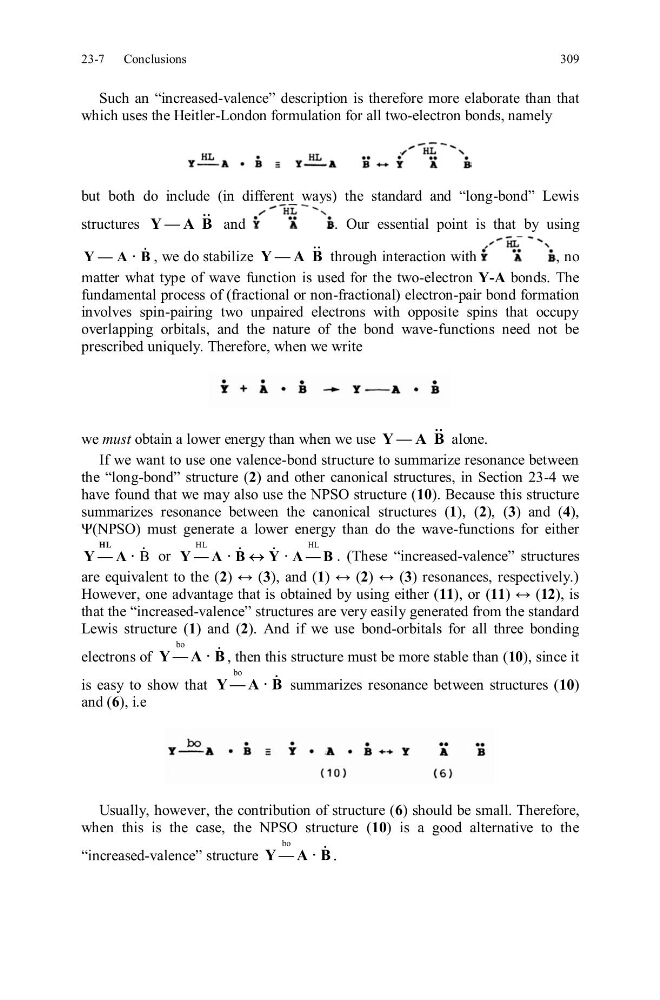
and (6), i.e
Usually, however, the contribution of structure (6) should be small. Therefore,
when this is the case, the NPSO structure (10) is a good alternative to the
“increased-valence” structure
bo
Y — A · B .
Conclusions
309
Such an “increased-valence” description is therefore more elaborate than that
which uses the Heitler-London formulation for all two-electron bonds, namely
but both do include (in different ways) the standard and “long-bond” Lewis
structures Υ — A Β and
. Our essential point is that by using
Υ — A · Β , we do stabilize Υ — A Β through interaction with
, no
matter what type of wave function is used for the two-electron Y-A bonds. The
fundamental process of (fractional or non-fractional) electron-pair bond formation
involves spin-pairing two unpaired electrons with opposite spins that occupy
overlapping orbitals, and the nature of the bond wave-functions need not be
prescribed uniquely. Therefore, when we write
we must obtain a lower energy than when we use Υ — A Β alone.
If we want to use one valence-bond structure to summarize resonance between
the “long-bond” structure (2) and other canonical structures, in Section 23-4 we
have found that we may also use the NPSO structure (10). Because this structure
summarizes resonance between the canonical structures (1), (2), (3) and (4),
Ψ(NPSO) must generate a lower energy than do the wave-functions for either
B
HL
Y — A · or
HL
HL
Υ — A · Β
Υ · A — Β
. (These “increased-valence” structures
are equivalent to the (2) ↔ (3), and (1) ↔ (2) ↔ (3) resonances, respectively.)
However, one advantage that is obtained by using either (11), or (11) ↔ (12), is
that the “increased-valence” structures are very easily generated from the standard
Lewis structure (1) and (2). And if we use bond-orbitals for all three bonding
electrons of
bo
Y — A · B , then this structure must be more stable than (10), since it
is easy to show that
bo
Y — A · B summarizes resonance between structures (10)
and (6), i.e
Usually, however, the contribution of structure (6) should be small. Therefore,
when this is the case, the NPSO structure (10) is a good alternative to the
“increased-valence” structure
bo
Y — A · B .