

302
Chapter 23 Some Comparisons of Types of Wave-Funcions
charge separations, and best electron charge correlation (i.e. best spatial separation
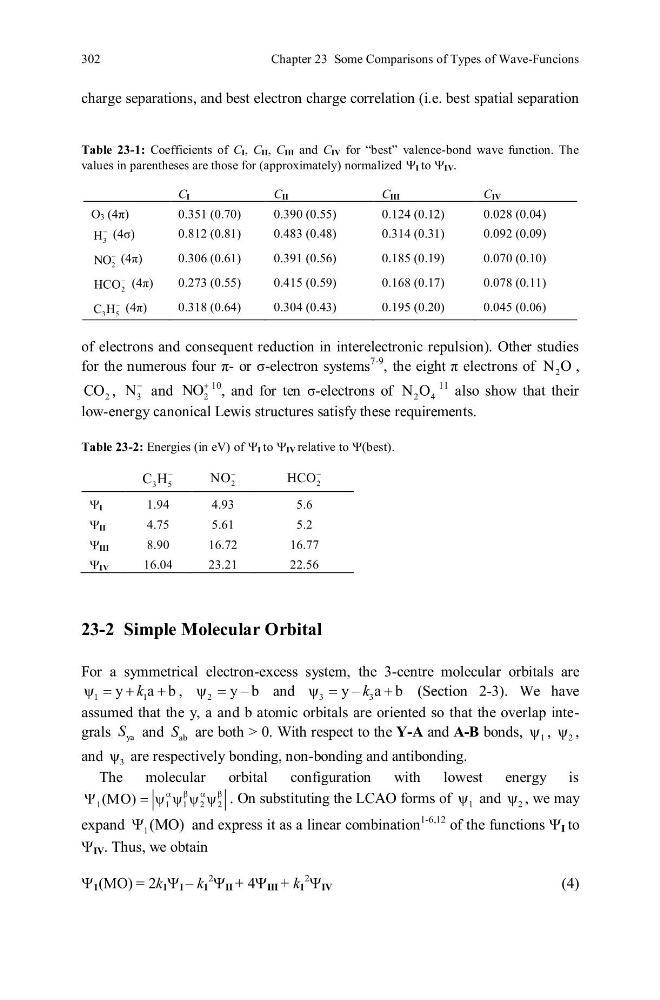
Table 23-1: Coefficients of CI, CII, CIII and CIV for “best” valence-bond wave function. The
values in parentheses are those for (approximately) normalized I to IV.
CI
CII
CIII
CIV
O3 (4π)
0.351 (0.70)
0.390 (0.55)
0.124 (0.12)
0.028 (0.04)
3
H
(4σ)
0.812 (0.81)
0.483 (0.48)
0.314 (0.31)
0.092 (0.09)
2
NO
(4π)
0.306 (0.61)
0.391 (0.56)
0.185 (0.19)
0.070 (0.10)
2
HCO
(4π)
0.273 (0.55)
0.415 (0.59)
0.168 (0.17)
0.078 (0.11)
3 5
C H
(4π)
0.318 (0.64)
0.304 (0.43)
0.195 (0.20)
0.045 (0.06)
of electrons and consequent reduction in interelectronic repulsion). Other studies
for the numerous four π- or σ-electron systems
7-9 , the eight π electrons of 2
N O ,
2
CO , 3
N
and
2
NO
10 , and for ten σ-electrons of 2 4
N O
11 also show that their
low-energy canonical Lewis structures satisfy these requirements.
Table 23-2: Energies (in eV) of I to IV relative to (best).
3 5
C H
2
NO
2
HCO
I
1.94
4.93
5.6
II
4.75
5.61
5.2
III
8.90
16.72
16.77
IV
16.04
23.21
22.56
23-2 Simple Molecular Orbital
For a symmetrical electron-excess system, the 3-centre molecular orbitals are
1
1
y
a b
k
,
2
y – b
and
3
3
y – a b
k
(Section 2-3). We have
assumed that the y, a and b atomic orbitals are oriented so that the overlap integrals ya
S and ab
S are both > 0. With respect to the Y-A and A-B bonds, 1
, 2
,
and 3
are respectively bonding, non-bonding and antibonding.
The molecular
orbital
configuration
with
lowest
energy is
1
1
1
2
2
(M )
. On substituting the LCAO forms of 1
and 2
, we may
expand 1 (M )
and express it as a linear combination
1-6,12 of the functions I to
IV . Thus, we obtain
1 (MO) = 2k 1 I – k 1
2
II + 4 III + k 1
2
IV
(4)
Chapter 23 Some Comparisons of Types of Wave-Funcions
charge separations, and best electron charge correlation (i.e. best spatial separation
Table 23-1: Coefficients of CI, CII, CIII and CIV for “best” valence-bond wave function. The
values in parentheses are those for (approximately) normalized I to IV.
CI
CII
CIII
CIV
O3 (4π)
0.351 (0.70)
0.390 (0.55)
0.124 (0.12)
0.028 (0.04)
3
H
(4σ)
0.812 (0.81)
0.483 (0.48)
0.314 (0.31)
0.092 (0.09)
2
NO
(4π)
0.306 (0.61)
0.391 (0.56)
0.185 (0.19)
0.070 (0.10)
2
HCO
(4π)
0.273 (0.55)
0.415 (0.59)
0.168 (0.17)
0.078 (0.11)
3 5
C H
(4π)
0.318 (0.64)
0.304 (0.43)
0.195 (0.20)
0.045 (0.06)
of electrons and consequent reduction in interelectronic repulsion). Other studies
for the numerous four π- or σ-electron systems
7-9 , the eight π electrons of 2
N O ,
2
CO , 3
N
and
2
NO
10 , and for ten σ-electrons of 2 4
N O
11 also show that their
low-energy canonical Lewis structures satisfy these requirements.
Table 23-2: Energies (in eV) of I to IV relative to (best).
3 5
C H
2
NO
2
HCO
I
1.94
4.93
5.6
II
4.75
5.61
5.2
III
8.90
16.72
16.77
IV
16.04
23.21
22.56
23-2 Simple Molecular Orbital
For a symmetrical electron-excess system, the 3-centre molecular orbitals are
1
1
y
a b
k
,
2
y – b
and
3
3
y – a b
k
(Section 2-3). We have
assumed that the y, a and b atomic orbitals are oriented so that the overlap integrals ya
S and ab
S are both > 0. With respect to the Y-A and A-B bonds, 1
, 2
,
and 3
are respectively bonding, non-bonding and antibonding.
The molecular
orbital
configuration
with
lowest
energy is
1
1
1
2
2
(M )
. On substituting the LCAO forms of 1
and 2
, we may
expand 1 (M )
and express it as a linear combination
1-6,12 of the functions I to
IV . Thus, we obtain
1 (MO) = 2k 1 I – k 1
2
II + 4 III + k 1
2
IV
(4)