

23-3
Standard Valence-Bond Resonance
303
with one variational parameter, 1
k . Since Ψ(best) has three independent variation
parameters, namely C I , C II , and C III , with C IV related to them through normalization, 1 (M )
is a more-restricted function than is Ψ(best). 1 (M )
also gives
considerable weight to either or both III and IV , neither of which is important
for the systems of Table 21-1.
In Table 23-3, some calculated energies for 1 (M )
are reported; they are
higher than the energies for Ψ(best).
Table 23-3: Energies (in eV) of VB, MO, IV and NPSO wave-functions relative to Ψ(best).
3 5
C H
2
NO
2
HCO
VBHL(Ψ1)
1.94
4.93
5.16
VBBO
3.01
5.92
5.82
MO
1.07
2.04
1.91
IVBO
0.99
1.91
1.82
IVHL
0.47
0.88
0.81
NPSO
0.41
0.59
0.80
23-3 Standard Valence-Bond Resonance
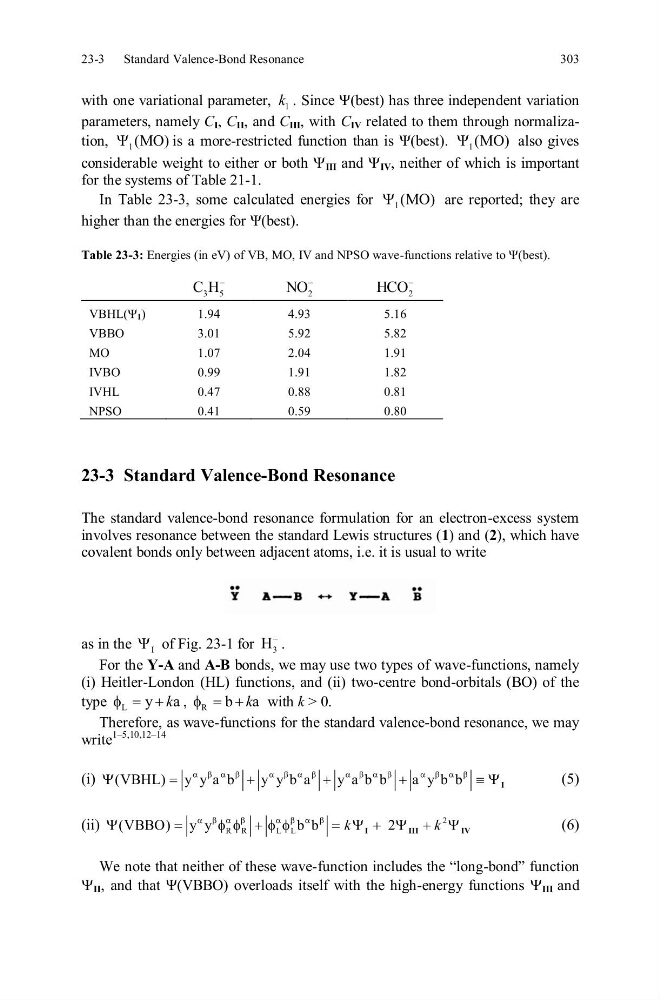
The standard valence-bond resonance formulation for an electron-excess system
involves resonance between the standard Lewis structures (1) and (2), which have
covalent bonds only between adjacent atoms, i.e. it is usual to write
as in the I
of Fig. 23-1 for 3
H
.
For the Y-A and A-B bonds, we may use two types of wave-functions, namely
(i) Heitler-London (HL) functions, and (ii) two-centre bond-orbitals (BO) of the
type L y a
k
, R b a
k
with k > 0.
Therefore, as wave-functions for the standard valence-bond resonance, we may
write
1–5,10,12–14
(i) (VBHL) y y a b
y y b a
y a b b
a y b b
I
(5)
(ii)
2
R R
L L
(VBBO) y y
b b
2
k
k
I
III
IV
(6)
We note that neither of these wave-function includes the “long-bond” function
II , and that Ψ(VΒΒΟ) overloads itself with the high-energy functions III and
Standard Valence-Bond Resonance
303
with one variational parameter, 1
k . Since Ψ(best) has three independent variation
parameters, namely C I , C II , and C III , with C IV related to them through normalization, 1 (M )
is a more-restricted function than is Ψ(best). 1 (M )
also gives
considerable weight to either or both III and IV , neither of which is important
for the systems of Table 21-1.
In Table 23-3, some calculated energies for 1 (M )
are reported; they are
higher than the energies for Ψ(best).
Table 23-3: Energies (in eV) of VB, MO, IV and NPSO wave-functions relative to Ψ(best).
3 5
C H
2
NO
2
HCO
VBHL(Ψ1)
1.94
4.93
5.16
VBBO
3.01
5.92
5.82
MO
1.07
2.04
1.91
IVBO
0.99
1.91
1.82
IVHL
0.47
0.88
0.81
NPSO
0.41
0.59
0.80
23-3 Standard Valence-Bond Resonance
The standard valence-bond resonance formulation for an electron-excess system
involves resonance between the standard Lewis structures (1) and (2), which have
covalent bonds only between adjacent atoms, i.e. it is usual to write
as in the I
of Fig. 23-1 for 3
H
.
For the Y-A and A-B bonds, we may use two types of wave-functions, namely
(i) Heitler-London (HL) functions, and (ii) two-centre bond-orbitals (BO) of the
type L y a
k
, R b a
k
with k > 0.
Therefore, as wave-functions for the standard valence-bond resonance, we may
write
1–5,10,12–14
(i) (VBHL) y y a b
y y b a
y a b b
a y b b
I
(5)
(ii)
2
R R
L L
(VBBO) y y
b b
2
k
k
I
III
IV
(6)
We note that neither of these wave-function includes the “long-bond” function
II , and that Ψ(VΒΒΟ) overloads itself with the high-energy functions III and