

23-1
Complete Valence-Bond Resonance
301
combinations
2
1
,
2
1
,
6
5
and
6
5
. Of these, only the
symmetric functions
2
1
and
6
5
can interact with 3
and 4
. We
may therefore construct the linear combination
IV
IV
III
III
II
II
I
I
C
C
C
C
best
(3)
in which
2
1
I
,
3
II
,
4
III
,
6
5
IV
.
Linnett and his co-workers
1-6 have calculated the Ψ(best) for the four πelectrons of
2
HCO
,
2
NO
, 3
O and 3 5
C H
, and four σ-electrons of 3
H
. The coefficients of I
to IV
for each of these functions are reported in Table 23-1. To
help compare the relative magnitudes of the coefficients, we have recalculated
them approximately so that they pertain for normalized I
to IV
. To do this,
we have multiplied
i C I by 2, C II and C IV by 2, and C III by unity. For 3
H
, the reported coefficients refer to approximately normalized basis functions
5
. The
(approximately) normalized coefficients are shown in parentheses.
In Table 23-2, the energies of I
to IV
, calculated relative to that of
(best), are reported.
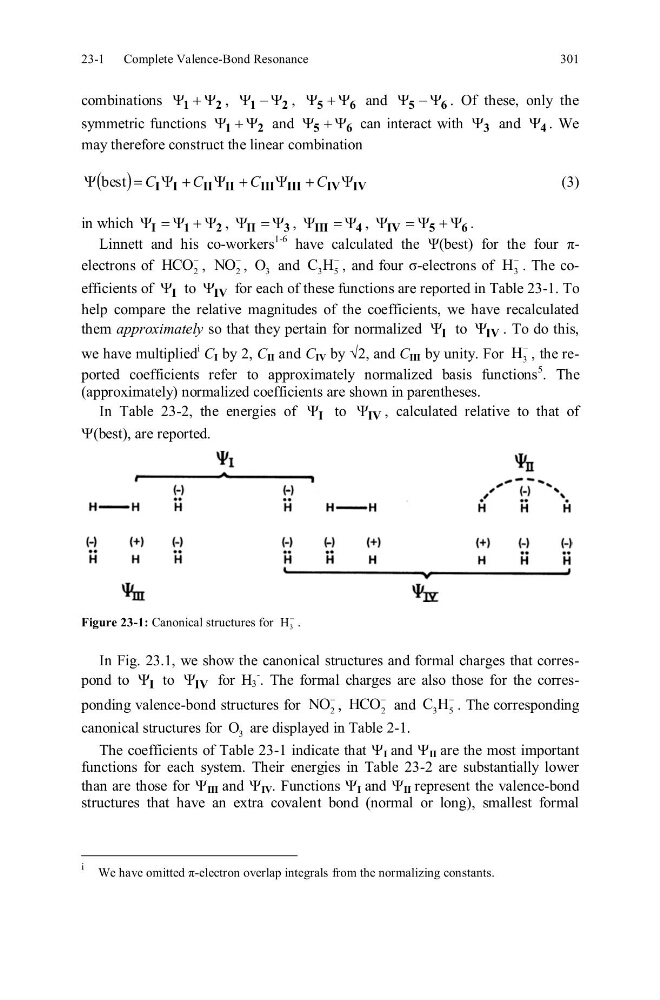
Figure 23-1: Canonical structures for 3
H
.
In Fig. 23.1, we show the canonical structures and formal charges that correspond to I
to IV
for H 3
- . The formal charges are also those for the corresponding valence-bond structures for
2
NO
,
2
HCO
and 3 5
C H
. The corresponding
canonical structures for 3
O are displayed in Table 2-1.
The coefficients of Table 23-1 indicate that I and II are the most important
functions for each system. Their energies in Table 23-2 are substantially lower
than are those for III and IV . Functions I and II represent the valence-bond
structures that have an extra covalent bond (normal or long), smallest formal
i We have omitted π-electron overlap integrals from the normalizing constants.
Complete Valence-Bond Resonance
301
combinations
2
1
,
2
1
,
6
5
and
6
5
. Of these, only the
symmetric functions
2
1
and
6
5
can interact with 3
and 4
. We
may therefore construct the linear combination
IV
IV
III
III
II
II
I
I
C
C
C
C
best
(3)
in which
2
1
I
,
3
II
,
4
III
,
6
5
IV
.
Linnett and his co-workers
1-6 have calculated the Ψ(best) for the four πelectrons of
2
HCO
,
2
NO
, 3
O and 3 5
C H
, and four σ-electrons of 3
H
. The coefficients of I
to IV
for each of these functions are reported in Table 23-1. To
help compare the relative magnitudes of the coefficients, we have recalculated
them approximately so that they pertain for normalized I
to IV
. To do this,
we have multiplied
i C I by 2, C II and C IV by 2, and C III by unity. For 3
H
, the reported coefficients refer to approximately normalized basis functions
5
. The
(approximately) normalized coefficients are shown in parentheses.
In Table 23-2, the energies of I
to IV
, calculated relative to that of
(best), are reported.
Figure 23-1: Canonical structures for 3
H
.
In Fig. 23.1, we show the canonical structures and formal charges that correspond to I
to IV
for H 3
- . The formal charges are also those for the corresponding valence-bond structures for
2
NO
,
2
HCO
and 3 5
C H
. The corresponding
canonical structures for 3
O are displayed in Table 2-1.
The coefficients of Table 23-1 indicate that I and II are the most important
functions for each system. Their energies in Table 23-2 are substantially lower
than are those for III and IV . Functions I and II represent the valence-bond
structures that have an extra covalent bond (normal or long), smallest formal
i We have omitted π-electron overlap integrals from the normalizing constants.