

300
Chapter 23 Some Comparisons of Types of Wave-Funcions
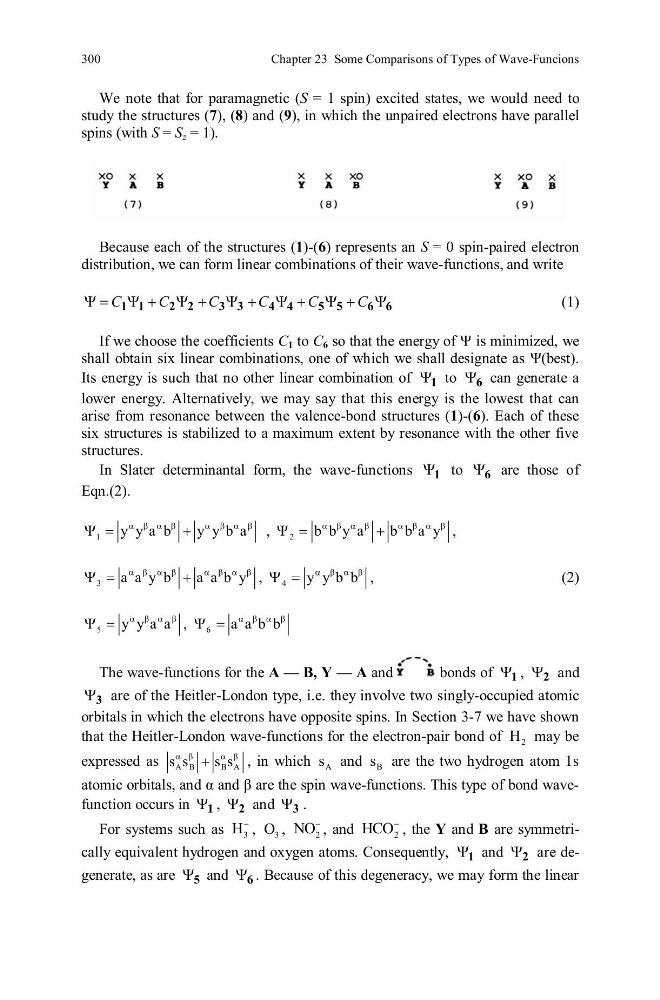
We note that for paramagnetic (S = 1 spin) excited states, we would need to
study the structures (7), (8) and (9), in which the unpaired electrons have parallel
spins (with S = S z = 1).
Because each of the structures (1)-(6) represents an S = 0 spin-paired electron
distribution, we can form linear combinations of their wave-functions, and write
6
6
5
5
4
4
3
3
2
2
1
1
C
C
C
C
C
C
(1)
If we choose the coefficients C 1 to C 6 so that the energy of Ψ is minimized, we
shall obtain six linear combinations, one of which we shall designate as Ψ(best).
Its energy is such that no other linear combination of 1
to 6
can generate a
lower energy. Alternatively, we may say that this energy is the lowest that can
arise from resonance between the valence-bond structures (1)-(6). Each of these
six structures is stabilized to a maximum extent by resonance with the other five
structures.
In Slater determinantal form, the wave-functions 1
to 6
are those of
Eqn.(2).
1
y y a b
y y b a
, 2 b b y a
b b a y
,
3
a a y b
a a b y
, 4 y y b b
,
(2)
5
y y a a
, 6 a a b b
The wave-functions for the A –– B, Y –– A and
bonds of 1
, 2
and
3
are of the Heitler-London type, i.e. they involve two singly-occupied atomic
orbitals in which the electrons have opposite spins. In Section 3-7 we have shown
that the Heitler-London wave-functions for the electron-pair bond of 2
H may be
expressed as A B
B A
s s
s s
, in which A
s and B
s are the two hydrogen atom 1s
atomic orbitals, and α and β are the spin wave-functions. This type of bond wavefunction occurs in 1
, 2
and 3
.
For systems such as 3
H
, 3
O ,
2
NO
, and
2
HCO
, the Υ and Β are symmetrically equivalent hydrogen and oxygen atoms. Consequently, 1
and 2
are degenerate, as are 5
and 6
. Because of this degeneracy, we may form the linear
Chapter 23 Some Comparisons of Types of Wave-Funcions
We note that for paramagnetic (S = 1 spin) excited states, we would need to
study the structures (7), (8) and (9), in which the unpaired electrons have parallel
spins (with S = S z = 1).
Because each of the structures (1)-(6) represents an S = 0 spin-paired electron
distribution, we can form linear combinations of their wave-functions, and write
6
6
5
5
4
4
3
3
2
2
1
1
C
C
C
C
C
C
(1)
If we choose the coefficients C 1 to C 6 so that the energy of Ψ is minimized, we
shall obtain six linear combinations, one of which we shall designate as Ψ(best).
Its energy is such that no other linear combination of 1
to 6
can generate a
lower energy. Alternatively, we may say that this energy is the lowest that can
arise from resonance between the valence-bond structures (1)-(6). Each of these
six structures is stabilized to a maximum extent by resonance with the other five
structures.
In Slater determinantal form, the wave-functions 1
to 6
are those of
Eqn.(2).
1
y y a b
y y b a
, 2 b b y a
b b a y
,
3
a a y b
a a b y
, 4 y y b b
,
(2)
5
y y a a
, 6 a a b b
The wave-functions for the A –– B, Y –– A and
bonds of 1
, 2
and
3
are of the Heitler-London type, i.e. they involve two singly-occupied atomic
orbitals in which the electrons have opposite spins. In Section 3-7 we have shown
that the Heitler-London wave-functions for the electron-pair bond of 2
H may be
expressed as A B
B A
s s
s s
, in which A
s and B
s are the two hydrogen atom 1s
atomic orbitals, and α and β are the spin wave-functions. This type of bond wavefunction occurs in 1
, 2
and 3
.
For systems such as 3
H
, 3
O ,
2
NO
, and
2
HCO
, the Υ and Β are symmetrically equivalent hydrogen and oxygen atoms. Consequently, 1
and 2
are degenerate, as are 5
and 6
. Because of this degeneracy, we may form the linear