

Chapter 23 Some Comparisons of Types of
Wave-Funcions for 4-Electron
3-Centre Bonding Units
With the simplest form of “increased-valence” theory, we have been concerned
with the “increased-valence” structure Υ — A · B , which summarizes resonance
between the Lewis structures Υ — A B and
, the latter structures
having electron-pair bonds between adjacent and non-adjacent atoms respectively.
We shall now examine in more detail some wave-functions for “increasedvalence” structures, and compare them with wave-functions that may be constructed for standard Lewis and Linnett non-paired spatial orbital structures, as
well as with the delocalized molecular orbital wave-functions.
23-1 Complete Valence-Bond Resonance
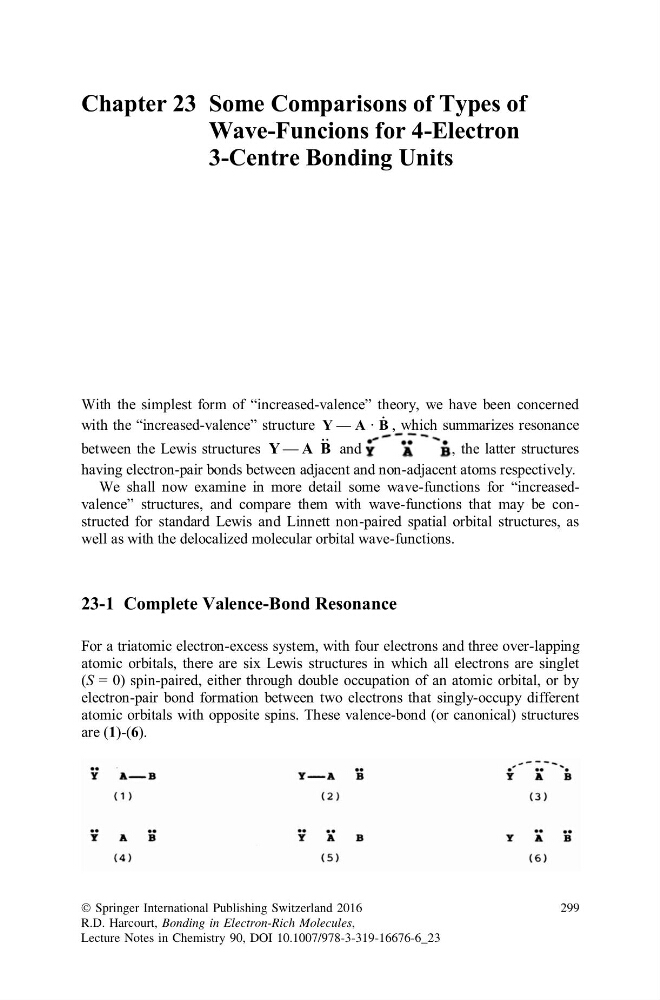
For a triatomic electron-excess system, with four electrons and three over-lapping
atomic orbitals, there are six Lewis structures in which all electrons are singlet
(S = 0) spin-paired, either through double occupation of an atomic orbital, or by
electron-pair bond formation between two electrons that singly-occupy different
atomic orbitals with opposite spins. These valence-bond (or canonical) structures
are (1)-(6).
Ó Springer International Publishing Switzerland 2016
R.D. Harcourt, Bonding in Electron-Rich Molecules,
Lecture Notes in Chemistry 90, DOI 10.1007/978-3-319-16676-6_23
299
Wave-Funcions for 4-Electron
3-Centre Bonding Units
With the simplest form of “increased-valence” theory, we have been concerned
with the “increased-valence” structure Υ — A · B , which summarizes resonance
between the Lewis structures Υ — A B and
, the latter structures
having electron-pair bonds between adjacent and non-adjacent atoms respectively.
We shall now examine in more detail some wave-functions for “increasedvalence” structures, and compare them with wave-functions that may be constructed for standard Lewis and Linnett non-paired spatial orbital structures, as
well as with the delocalized molecular orbital wave-functions.
23-1 Complete Valence-Bond Resonance
For a triatomic electron-excess system, with four electrons and three over-lapping
atomic orbitals, there are six Lewis structures in which all electrons are singlet
(S = 0) spin-paired, either through double occupation of an atomic orbital, or by
electron-pair bond formation between two electrons that singly-occupy different
atomic orbitals with opposite spins. These valence-bond (or canonical) structures
are (1)-(6).
Ó Springer International Publishing Switzerland 2016
R.D. Harcourt, Bonding in Electron-Rich Molecules,
Lecture Notes in Chemistry 90, DOI 10.1007/978-3-319-16676-6_23
299