

294
Chapter 22 Free-Radical and Spin-Paired Diradical Reactions
here to represent the electron distribution for a 6-electron 5-centre bonding unit.
One way to obtain this type of “increased-valence” structure in the transition state
for the “1,3 dipolar cycloaddition” involves the utilization of a Linnett non-paired
spatial orbital structure to represent the electronic structure of the “1,3 dipole”.
Thus for
2 2
CH N , the Linnett structure is (33)
17
, and the concerted mechanism for
the cycloaddition can be formulated
11,12,14 via structures (34), (35) and (36). In
structure (35), there is an “increased-valence” bonding unit of type (32). Firestone
used structure (33) to formulate the two-step mechanism of (37) (38) (39),
with only one O-C bond formed initially between the two reactants
17 .
Molecular orbital studies of 1,3-dipolar cycloaddition reactions are discussed in
Ref. 18.
22-5 Thermal Decomposition of o-Nitrophenylazide
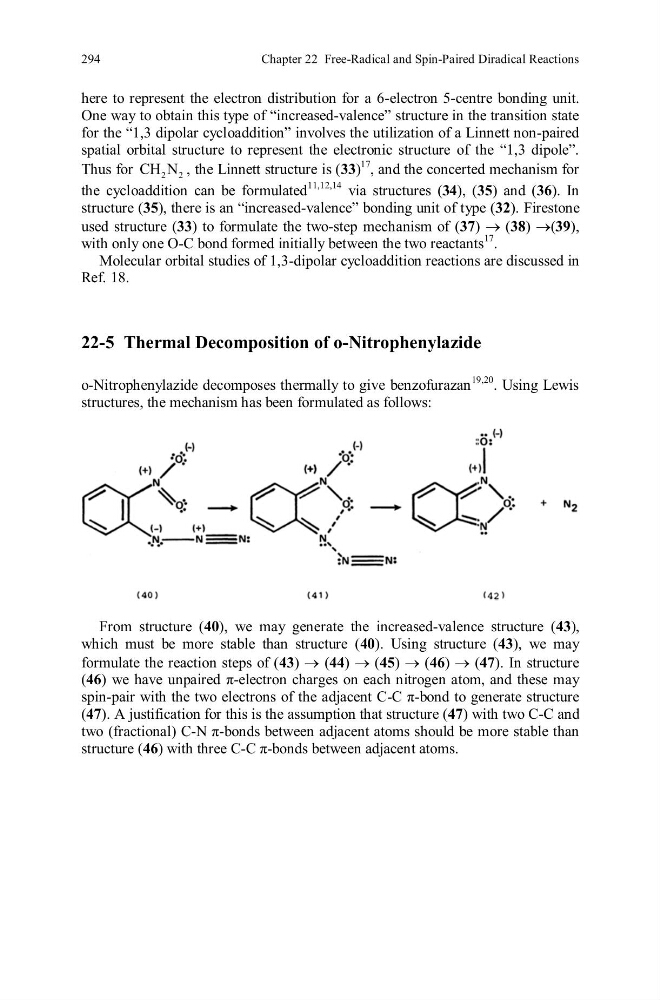
o-Nitrophenylazide decomposes thermally to give benzofurazan
19,20 . Using Lewis
structures, the mechanism has been formulated as follows:
From structure (40), we may generate the increased-valence structure (43),
which must be more stable than structure (40). Using structure (43), we may
formulate the reaction steps of (43) (44) (45) (46) (47). In structure
(46) we have unpaired π-electron charges on each nitrogen atom, and these may
spin-pair with the two electrons of the adjacent C-C π-bond to generate structure
(47). A justification for this is the assumption that structure (47) with two C-C and
two (fractional) C-N π-bonds between adjacent atoms should be more stable than
structure (46) with three C-C π-bonds between adjacent atoms.
Chapter 22 Free-Radical and Spin-Paired Diradical Reactions
here to represent the electron distribution for a 6-electron 5-centre bonding unit.
One way to obtain this type of “increased-valence” structure in the transition state
for the “1,3 dipolar cycloaddition” involves the utilization of a Linnett non-paired
spatial orbital structure to represent the electronic structure of the “1,3 dipole”.
Thus for
2 2
CH N , the Linnett structure is (33)
17
, and the concerted mechanism for
the cycloaddition can be formulated
11,12,14 via structures (34), (35) and (36). In
structure (35), there is an “increased-valence” bonding unit of type (32). Firestone
used structure (33) to formulate the two-step mechanism of (37) (38) (39),
with only one O-C bond formed initially between the two reactants
17 .
Molecular orbital studies of 1,3-dipolar cycloaddition reactions are discussed in
Ref. 18.
22-5 Thermal Decomposition of o-Nitrophenylazide
o-Nitrophenylazide decomposes thermally to give benzofurazan
19,20 . Using Lewis
structures, the mechanism has been formulated as follows:
From structure (40), we may generate the increased-valence structure (43),
which must be more stable than structure (40). Using structure (43), we may
formulate the reaction steps of (43) (44) (45) (46) (47). In structure
(46) we have unpaired π-electron charges on each nitrogen atom, and these may
spin-pair with the two electrons of the adjacent C-C π-bond to generate structure
(47). A justification for this is the assumption that structure (47) with two C-C and
two (fractional) C-N π-bonds between adjacent atoms should be more stable than
structure (46) with three C-C π-bonds between adjacent atoms.