

22-4
“1,3 Dipolar” (or “Zwitterionic Diradical Hybrid”) Cycloaddition Reactions
293
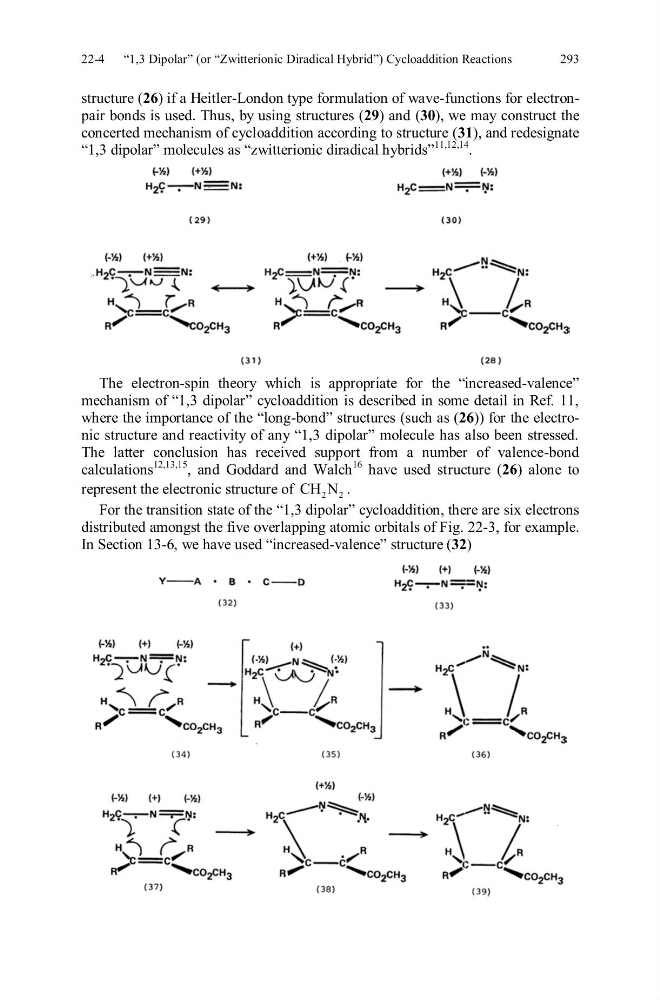
structure (26) if a Heitler-London type formulation of wave-functions for electronpair bonds is used. Thus, by using structures (29) and (30), we may construct the
concerted mechanism of cycloaddition according to structure (31), and redesignate
“1,3 dipolar” molecules as “zwitterionic diradical hybrids”
11,12,14
.
The electron-spin theory which is appropriate for the “increased-valence”
mechanism of “1,3 dipolar” cycloaddition is described in some detail in Ref. 11,
where the importance of the “long-bond” structures (such as (26)) for the electronic structure and reactivity of any “1,3 dipolar” molecule has also been stressed.
The latter conclusion has received support from a number of valence-bond
calculations
12,13,15
, and Goddard and Walch
16 have used structure (26) alone to
represent the electronic structure of
2 2
CH N .
For the transition state of the “1,3 dipolar” cycloaddition, there are six electrons
distributed amongst the five overlapping atomic orbitals of Fig. 22-3, for example.
In Section 13-6, we have used “increased-valence” structure (32)
“1,3 Dipolar” (or “Zwitterionic Diradical Hybrid”) Cycloaddition Reactions
293
structure (26) if a Heitler-London type formulation of wave-functions for electronpair bonds is used. Thus, by using structures (29) and (30), we may construct the
concerted mechanism of cycloaddition according to structure (31), and redesignate
“1,3 dipolar” molecules as “zwitterionic diradical hybrids”
11,12,14
.
The electron-spin theory which is appropriate for the “increased-valence”
mechanism of “1,3 dipolar” cycloaddition is described in some detail in Ref. 11,
where the importance of the “long-bond” structures (such as (26)) for the electronic structure and reactivity of any “1,3 dipolar” molecule has also been stressed.
The latter conclusion has received support from a number of valence-bond
calculations
12,13,15
, and Goddard and Walch
16 have used structure (26) alone to
represent the electronic structure of
2 2
CH N .
For the transition state of the “1,3 dipolar” cycloaddition, there are six electrons
distributed amongst the five overlapping atomic orbitals of Fig. 22-3, for example.
In Section 13-6, we have used “increased-valence” structure (32)