

292
Chapter 22 Free-Radical and Spin-Paired Diradical Reactions
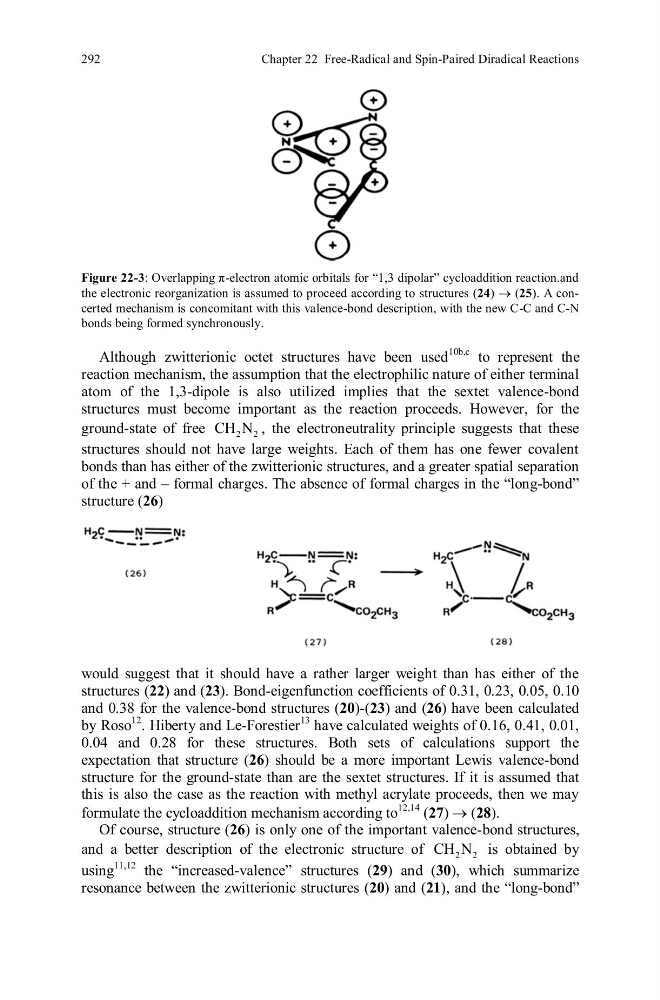
Figure 22-3: Overlapping π-electron atomic orbitals for “1,3 dipolar” cycloaddition reaction.and
the electronic reorganization is assumed to proceed according to structures (24) (25). A concerted mechanism is concomitant with this valence-bond description, with the new C-C and C-N
bonds being formed synchronously.
Although zwitterionic octet structures have been used
10b,c to represent the
reaction mechanism, the assumption that the electrophilic nature of either terminal
atom of the 1,3-dipole is also utilized implies that the sextet valence-bond
structures must become important as the reaction proceeds. However, for the
ground-state of free
2 2
CH N , the electroneutrality principle suggests that these
structures should not have large weights. Each of them has one fewer covalent
bonds than has either of the zwitterionic structures, and a greater spatial separation
of the + and – formal charges. The absence of formal charges in the “long-bond”
structure (26)
would suggest that it should have a rather larger weight than has either of the
structures (22) and (23). Bond-eigenfunction coefficients of 0.31, 0.23, 0.05, 0.10
and 0.38 for the valence-bond structures (20)-(23) and (26) have been calculated
by Roso
12 . Hiberty and Le-Forestier
13 have calculated weights of 0.16, 0.41, 0.01,
0.04 and 0.28 for these structures. Both sets of calculations support the
expectation that structure (26) should be a more important Lewis valence-bond
structure for the ground-state than are the sextet structures. If it is assumed that
this is also the case as the reaction with methyl acrylate proceeds, then we may
formulate the cycloaddition mechanism according to
12,14 (27) (28).
Of course, structure (26) is only one of the important valence-bond structures,
and a better description of the electronic structure of
2 2
CH N is obtained by
using
11,12 the “increased-valence” structures (29) and (30), which summarize
resonance between the zwitterionic structures (20) and (21), and the “long-bond”
Chapter 22 Free-Radical and Spin-Paired Diradical Reactions
Figure 22-3: Overlapping π-electron atomic orbitals for “1,3 dipolar” cycloaddition reaction.and
the electronic reorganization is assumed to proceed according to structures (24) (25). A concerted mechanism is concomitant with this valence-bond description, with the new C-C and C-N
bonds being formed synchronously.
Although zwitterionic octet structures have been used
10b,c to represent the
reaction mechanism, the assumption that the electrophilic nature of either terminal
atom of the 1,3-dipole is also utilized implies that the sextet valence-bond
structures must become important as the reaction proceeds. However, for the
ground-state of free
2 2
CH N , the electroneutrality principle suggests that these
structures should not have large weights. Each of them has one fewer covalent
bonds than has either of the zwitterionic structures, and a greater spatial separation
of the + and – formal charges. The absence of formal charges in the “long-bond”
structure (26)
would suggest that it should have a rather larger weight than has either of the
structures (22) and (23). Bond-eigenfunction coefficients of 0.31, 0.23, 0.05, 0.10
and 0.38 for the valence-bond structures (20)-(23) and (26) have been calculated
by Roso
12 . Hiberty and Le-Forestier
13 have calculated weights of 0.16, 0.41, 0.01,
0.04 and 0.28 for these structures. Both sets of calculations support the
expectation that structure (26) should be a more important Lewis valence-bond
structure for the ground-state than are the sextet structures. If it is assumed that
this is also the case as the reaction with methyl acrylate proceeds, then we may
formulate the cycloaddition mechanism according to
12,14 (27) (28).
Of course, structure (26) is only one of the important valence-bond structures,
and a better description of the electronic structure of
2 2
CH N is obtained by
using
11,12 the “increased-valence” structures (29) and (30), which summarize
resonance between the zwitterionic structures (20) and (21), and the “long-bond”