

22-4
“1,3 Dipolar” (or “Zwitterionic Diradical Hybrid”) Cycloaddition Reactions
291
In Ref. 10c, “1,3 dipoles” with C, N and Ο centres are classified, with their
zwitterionic structures displayed. “Increased-valence” structures for many of them
are displayed in Ref. 11.
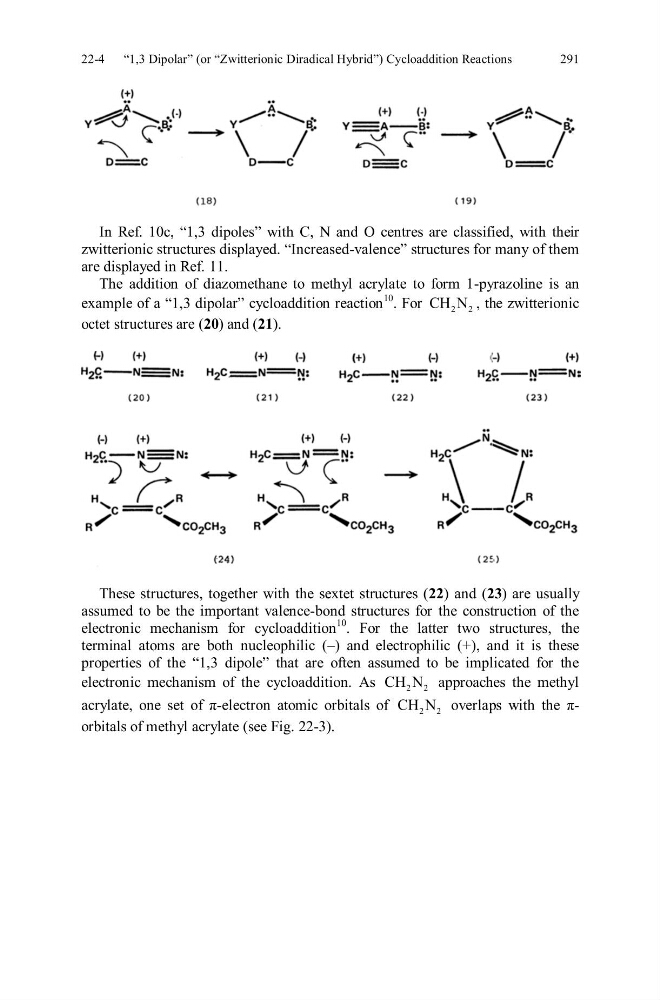
The addition of diazomethane to methyl acrylate to form 1-pyrazoline is an
example of a “1,3 dipolar” cycloaddition reaction
10 . For
2 2
CH N , the zwitterionic
octet structures are (20) and (21).
These structures, together with the sextet structures (22) and (23) are usually
assumed to be the important valence-bond structures for the construction of the
electronic mechanism for cycloaddition
10
. For the latter two structures, the
terminal atoms are both nucleophilic (–) and electrophilic (+), and it is these
properties of the “1,3 dipole” that are often assumed to be implicated for the
electronic mechanism of the cycloaddition. As
2 2
CH N approaches the methyl
acrylate, one set of π-electron atomic orbitals of
2 2
CH N overlaps with the πorbitals of methyl acrylate (see Fig. 22-3).
“1,3 Dipolar” (or “Zwitterionic Diradical Hybrid”) Cycloaddition Reactions
291
In Ref. 10c, “1,3 dipoles” with C, N and Ο centres are classified, with their
zwitterionic structures displayed. “Increased-valence” structures for many of them
are displayed in Ref. 11.
The addition of diazomethane to methyl acrylate to form 1-pyrazoline is an
example of a “1,3 dipolar” cycloaddition reaction
10 . For
2 2
CH N , the zwitterionic
octet structures are (20) and (21).
These structures, together with the sextet structures (22) and (23) are usually
assumed to be the important valence-bond structures for the construction of the
electronic mechanism for cycloaddition
10
. For the latter two structures, the
terminal atoms are both nucleophilic (–) and electrophilic (+), and it is these
properties of the “1,3 dipole” that are often assumed to be implicated for the
electronic mechanism of the cycloaddition. As
2 2
CH N approaches the methyl
acrylate, one set of π-electron atomic orbitals of
2 2
CH N overlaps with the πorbitals of methyl acrylate (see Fig. 22-3).