

290
Chapter 22 Free-Radical and Spin-Paired Diradical Reactions
electrons, and simultaneously to generate an O-O bond-number which is less than
unity in the resulting “increased-valence” structure (4). On breaking of the
weakened O-O bond, the Fe(II)O and Cu(I)O radicals of structures (5) and (6) can
then react with either Cu(I) or Fe(II) to form the μ-oxo Fe(II)OCu(I) complex (7),
or 2H
to form the
2
Fe(III) OH
and
2
Cu(II) OH
of structures (8) and (9).
One-electron reduction of each of the latter species generates Fe(III), Cu(II) and
2
H O . The Fe(II)OCu(I) complex corresponds to the
2
Fe(III) O
Cu(II)
resting state of the enzyme proposed by Reed and Landrum.
The
2
Fe(III) O
Cu(II)
may also react with H
to produce the
2
Fe(III) OH
and
2
Cu(II) OH
of structures (8) and (9). Whether or not
structure (7) is formed directly or bypassed via structures (5) and (6) → (8) and
(9) has yet to be ascertained. The essential point is that in the valence-bond
representation for the mechanism, easily-visualized electronic reorganizations lead
to the conversion of reactants into products, and these are achieved by utilizing the
Pauling “3-electron bond” structure of (1) for the 2
O ground state.
Consideration of the reactions of Sections 22-2 and 22-3, show that many
diamagnetic molecules that do not have a net number of unpaired electrons may
react as though they were free radicals. This is theoretically possible whenever we
may construct an “increased-valence” structure for a molecule, with one or more
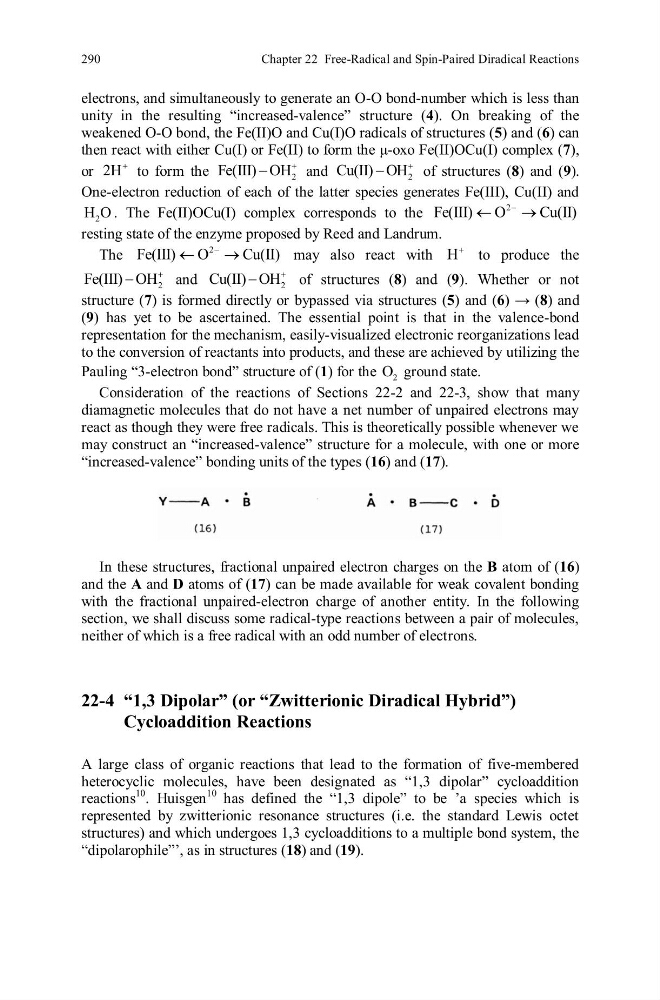
“increased-valence” bonding units of the types (16) and (17).
In these structures, fractional unpaired electron charges on the Β atom of (16)
and the A and D atoms of (17) can be made available for weak covalent bonding
with the fractional unpaired-electron charge of another entity. In the following
section, we shall discuss some radical-type reactions between a pair of molecules,
neither of which is a free radical with an odd number of electrons.
22-4 “1,3 Dipolar” (or “Zwitterionic Diradical Hybrid”)
Cycloaddition Reactions
A large class of organic reactions that lead to the formation of five-membered
heterocyclic molecules, have been designated as “1,3 dipolar” cycloaddition
reactions
10 . Huisgen
10 has defined the “1,3 dipole” to be ’a species which is
represented by zwitterionic resonance structures (i.e. the standard Lewis octet
structures) and which undergoes 1,3 cycloadditions to a multiple bond system, the
“dipolarophile”’, as in structures (18) and (19).
Chapter 22 Free-Radical and Spin-Paired Diradical Reactions
electrons, and simultaneously to generate an O-O bond-number which is less than
unity in the resulting “increased-valence” structure (4). On breaking of the
weakened O-O bond, the Fe(II)O and Cu(I)O radicals of structures (5) and (6) can
then react with either Cu(I) or Fe(II) to form the μ-oxo Fe(II)OCu(I) complex (7),
or 2H
to form the
2
Fe(III) OH
and
2
Cu(II) OH
of structures (8) and (9).
One-electron reduction of each of the latter species generates Fe(III), Cu(II) and
2
H O . The Fe(II)OCu(I) complex corresponds to the
2
Fe(III) O
Cu(II)
resting state of the enzyme proposed by Reed and Landrum.
The
2
Fe(III) O
Cu(II)
may also react with H
to produce the
2
Fe(III) OH
and
2
Cu(II) OH
of structures (8) and (9). Whether or not
structure (7) is formed directly or bypassed via structures (5) and (6) → (8) and
(9) has yet to be ascertained. The essential point is that in the valence-bond
representation for the mechanism, easily-visualized electronic reorganizations lead
to the conversion of reactants into products, and these are achieved by utilizing the
Pauling “3-electron bond” structure of (1) for the 2
O ground state.
Consideration of the reactions of Sections 22-2 and 22-3, show that many
diamagnetic molecules that do not have a net number of unpaired electrons may
react as though they were free radicals. This is theoretically possible whenever we
may construct an “increased-valence” structure for a molecule, with one or more
“increased-valence” bonding units of the types (16) and (17).
In these structures, fractional unpaired electron charges on the Β atom of (16)
and the A and D atoms of (17) can be made available for weak covalent bonding
with the fractional unpaired-electron charge of another entity. In the following
section, we shall discuss some radical-type reactions between a pair of molecules,
neither of which is a free radical with an odd number of electrons.
22-4 “1,3 Dipolar” (or “Zwitterionic Diradical Hybrid”)
Cycloaddition Reactions
A large class of organic reactions that lead to the formation of five-membered
heterocyclic molecules, have been designated as “1,3 dipolar” cycloaddition
reactions
10 . Huisgen
10 has defined the “1,3 dipole” to be ’a species which is
represented by zwitterionic resonance structures (i.e. the standard Lewis octet
structures) and which undergoes 1,3 cycloadditions to a multiple bond system, the
“dipolarophile”’, as in structures (18) and (19).