

Addendum Chapter 21
279
3. Robinson’s Curly Arrow and the Fishhook Arrow
Robinson’s “curly arrow”
19 is used to show the movements of pairs of electrons in
a reaction mechanism. “The tail of a curly arrow 'starts' at a mobile electron pair
and its head points to the ‘destination’ of the electron pair. Fishhook arrows indicate cleavage or movement of a single electron shown as a single-headed curved
arrow. They are widely used in radical chemistry to represent the homolytic
cleavage and reactions of radicals.”
20
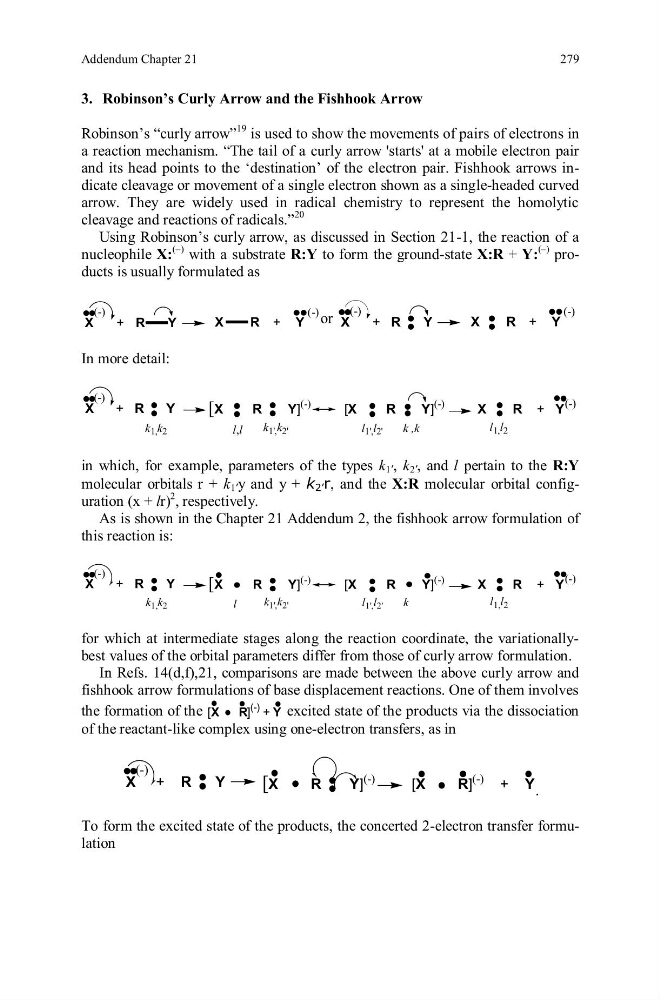
Using Robinson’s curly arrow, as discussed in Section 21-1, the reaction of a
nucleophile X:
(–) with a substrate R:Y to form the ground-state X:R + Y:
(–) products is usually formulated as
(-)
X
R + Y
X
+ R
Y
(-)
or
(-)
X
R + Y
X
+ R
Y
(-)
In more detail:
(-)
X
+ R
Y
(-)
[X
R
Y]
(-)
[X
R
Y]
(-)
X
R + Y
l,l
k 1', k 2'
k ,k
l 1', l 2'
k 1, k 2
l 1, l 2
in which, for example, parameters of the types k 1’ , k 2’ , and l pertain to the R:Y
molecular orbitals r + k 1’ y and y + k 2’ r, and the X:R molecular orbital configuration (x + lr)
2 , respectively.
As is shown in the Chapter 21 Addendum 2, the fishhook arrow formulation of
this reaction is:
(-)
X
+ R
Y
(-)
[X
R
Y]
(-)
[X
R
Y]
(-)
X
R + Y
l
k 1', k 2'
k
l 1', l 2'
k 1, k 2
l 1, l 2
for which at intermediate stages along the reaction coordinate, the variationallybest values of the orbital parameters differ from those of curly arrow formulation.
In Refs. 14(d,f),21, comparisons are made between the above curly arrow and
fishhook arrow formulations of base displacement reactions. One of them involves
the formation of the [X R]
(-) + Y excited state of the products via the dissociation
of the reactant-like complex using one-electron transfers, as in
X + R
Y
(-)
[X
R
Y]
(-)
[X
R]
(-) + Y .
To form the excited state of the products, the concerted 2-electron transfer formulation
279
3. Robinson’s Curly Arrow and the Fishhook Arrow
Robinson’s “curly arrow”
19 is used to show the movements of pairs of electrons in
a reaction mechanism. “The tail of a curly arrow 'starts' at a mobile electron pair
and its head points to the ‘destination’ of the electron pair. Fishhook arrows indicate cleavage or movement of a single electron shown as a single-headed curved
arrow. They are widely used in radical chemistry to represent the homolytic
cleavage and reactions of radicals.”
20
Using Robinson’s curly arrow, as discussed in Section 21-1, the reaction of a
nucleophile X:
(–) with a substrate R:Y to form the ground-state X:R + Y:
(–) products is usually formulated as
(-)
X
R + Y
X
+ R
Y
(-)
or
(-)
X
R + Y
X
+ R
Y
(-)
In more detail:
(-)
X
+ R
Y
(-)
[X
R
Y]
(-)
[X
R
Y]
(-)
X
R + Y
l,l
k 1', k 2'
k ,k
l 1', l 2'
k 1, k 2
l 1, l 2
in which, for example, parameters of the types k 1’ , k 2’ , and l pertain to the R:Y
molecular orbitals r + k 1’ y and y + k 2’ r, and the X:R molecular orbital configuration (x + lr)
2 , respectively.
As is shown in the Chapter 21 Addendum 2, the fishhook arrow formulation of
this reaction is:
(-)
X
+ R
Y
(-)
[X
R
Y]
(-)
[X
R
Y]
(-)
X
R + Y
l
k 1', k 2'
k
l 1', l 2'
k 1, k 2
l 1, l 2
for which at intermediate stages along the reaction coordinate, the variationallybest values of the orbital parameters differ from those of curly arrow formulation.
In Refs. 14(d,f),21, comparisons are made between the above curly arrow and
fishhook arrow formulations of base displacement reactions. One of them involves
the formation of the [X R]
(-) + Y excited state of the products via the dissociation
of the reactant-like complex using one-electron transfers, as in
X + R
Y
(-)
[X
R
Y]
(-)
[X
R]
(-) + Y .
To form the excited state of the products, the concerted 2-electron transfer formulation