

280
Chapter 21 Base-Displacement Reactions and Electron Conduction in Alkali Metals
[X
R
Y]
(-)
[X
R]
(-) + Y
X
+ R
Y
(-)
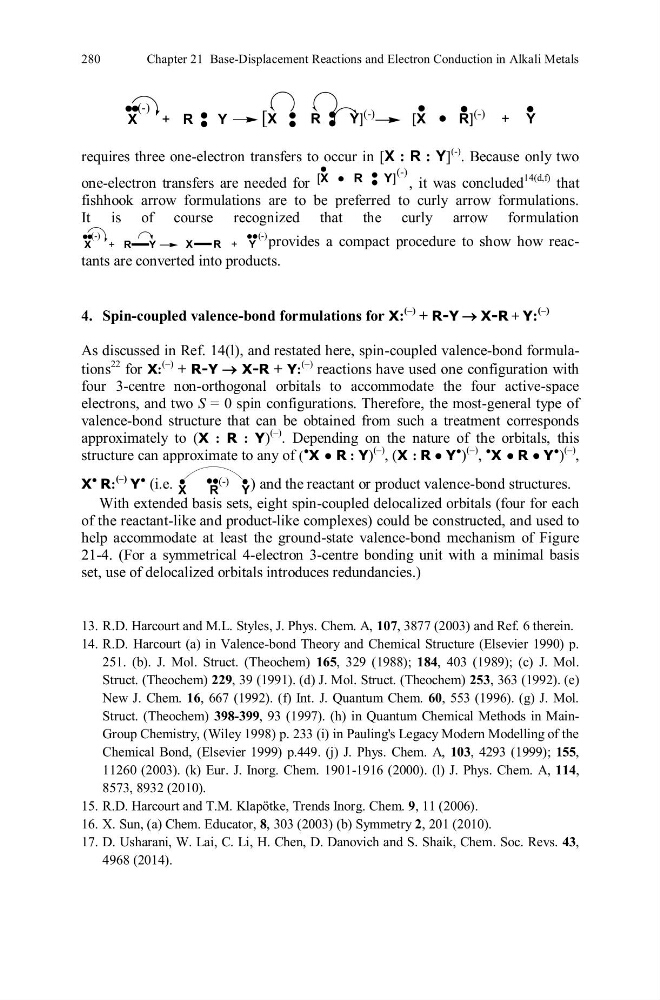
requires three one-electron transfers to occur in [X : R : Y]
(-) . Because only two
one-electron transfers are needed for [X
R
Y]
(-) , it was concluded
14(d,f) that
fishhook arrow formulations are to be preferred to curly arrow formulations.
It is of course recognized that the curly arrow formulation
(-)
X
R + Y
X
+ R
Y
(-)
provides a compact procedure to show how reactants are converted into products.
4. Spin-coupled valence-bond formulations for X:
(–) + R-Y X-R + Y:
(–)
As discussed in Ref. 14(l), and restated here, spin-coupled valence-bond formulations
22 for X:
(–) + R-Y X-R + Y:
(–) reactions have used one configuration with
four 3-centre non-orthogonal orbitals to accommodate the four active-space
electrons, and two S = 0 spin configurations. Therefore, the most-general type of
valence-bond structure that can be obtained from such a treatment corresponds
approximately to (X : R : Y)
(–) . Depending on the nature of the orbitals, this
structure can approximate to any of (
●
X ● R : Y)
(–) , (X : R ● Y
●
)
(–) ,
●
X ● R ● Y
●
)
(–)
,
X
●
R:
(–) Y
● (i.e. X
R
Y
(-)
) and the reactant or product valence-bond structures.
With extended basis sets, eight spin-coupled delocalized orbitals (four for each
of the reactant-like and product-like complexes) could be constructed, and used to
help accommodate at least the ground-state valence-bond mechanism of Figure
21-4. (For a symmetrical 4-electron 3-centre bonding unit with a minimal basis
set, use of delocalized orbitals introduces redundancies.)
13. R.D. Harcourt and M.L. Styles, J. Phys. Chem. A, 107, 3877 (2003) and Ref. 6 therein.
14. R.D. Harcourt (a) in Valence-bond Theory and Chemical Structure (Elsevier 1990) p.
251. (b). J. Mol. Struct. (Theochem) 165, 329 (1988); 184, 403 (1989); (c) J. Mol.
Struct. (Theochem) 229, 39 (1991). (d) J. Mol. Struct. (Theochem) 253, 363 (1992). (e)
New J. Chem. 16, 667 (1992). (f) Int. J. Quantum Chem. 60, 553 (1996). (g) J. Mol.
Struct. (Theochem) 398-399, 93 (1997). (h) in Quantum Chemical Methods in MainGroup Chemistry, (Wiley 1998) p. 233 (i) in Pauling's Legacy Modern Modelling of the
Chemical Bond, (Elsevier 1999) p.449. (j) J. Phys. Chem. A, 103, 4293 (1999); 155,
11260 (2003). (k) Eur. J. Inorg. Chem. 1901-1916 (2000). (l) J. Phys. Chem. A, 114,
8573, 8932 (2010).
15. R.D. Harcourt and T.M. Klapötke, Trends Inorg. Chem. 9, 11 (2006).
16. X. Sun, (a) Chem. Educator, 8, 303 (2003) (b) Symmetry 2, 201 (2010).
17. D. Usharani, W. Lai, C. Li, H. Chen, D. Danovich and S. Shaik, Chem. Soc. Revs. 43,
4968 (2014).
Chapter 21 Base-Displacement Reactions and Electron Conduction in Alkali Metals
[X
R
Y]
(-)
[X
R]
(-) + Y
X
+ R
Y
(-)
requires three one-electron transfers to occur in [X : R : Y]
(-) . Because only two
one-electron transfers are needed for [X
R
Y]
(-) , it was concluded
14(d,f) that
fishhook arrow formulations are to be preferred to curly arrow formulations.
It is of course recognized that the curly arrow formulation
(-)
X
R + Y
X
+ R
Y
(-)
provides a compact procedure to show how reactants are converted into products.
4. Spin-coupled valence-bond formulations for X:
(–) + R-Y X-R + Y:
(–)
As discussed in Ref. 14(l), and restated here, spin-coupled valence-bond formulations
22 for X:
(–) + R-Y X-R + Y:
(–) reactions have used one configuration with
four 3-centre non-orthogonal orbitals to accommodate the four active-space
electrons, and two S = 0 spin configurations. Therefore, the most-general type of
valence-bond structure that can be obtained from such a treatment corresponds
approximately to (X : R : Y)
(–) . Depending on the nature of the orbitals, this
structure can approximate to any of (
●
X ● R : Y)
(–) , (X : R ● Y
●
)
(–) ,
●
X ● R ● Y
●
)
(–)
,
X
●
R:
(–) Y
● (i.e. X
R
Y
(-)
) and the reactant or product valence-bond structures.
With extended basis sets, eight spin-coupled delocalized orbitals (four for each
of the reactant-like and product-like complexes) could be constructed, and used to
help accommodate at least the ground-state valence-bond mechanism of Figure
21-4. (For a symmetrical 4-electron 3-centre bonding unit with a minimal basis
set, use of delocalized orbitals introduces redundancies.)
13. R.D. Harcourt and M.L. Styles, J. Phys. Chem. A, 107, 3877 (2003) and Ref. 6 therein.
14. R.D. Harcourt (a) in Valence-bond Theory and Chemical Structure (Elsevier 1990) p.
251. (b). J. Mol. Struct. (Theochem) 165, 329 (1988); 184, 403 (1989); (c) J. Mol.
Struct. (Theochem) 229, 39 (1991). (d) J. Mol. Struct. (Theochem) 253, 363 (1992). (e)
New J. Chem. 16, 667 (1992). (f) Int. J. Quantum Chem. 60, 553 (1996). (g) J. Mol.
Struct. (Theochem) 398-399, 93 (1997). (h) in Quantum Chemical Methods in MainGroup Chemistry, (Wiley 1998) p. 233 (i) in Pauling's Legacy Modern Modelling of the
Chemical Bond, (Elsevier 1999) p.449. (j) J. Phys. Chem. A, 103, 4293 (1999); 155,
11260 (2003). (k) Eur. J. Inorg. Chem. 1901-1916 (2000). (l) J. Phys. Chem. A, 114,
8573, 8932 (2010).
15. R.D. Harcourt and T.M. Klapötke, Trends Inorg. Chem. 9, 11 (2006).
16. X. Sun, (a) Chem. Educator, 8, 303 (2003) (b) Symmetry 2, 201 (2010).
17. D. Usharani, W. Lai, C. Li, H. Chen, D. Danovich and S. Shaik, Chem. Soc. Revs. 43,
4968 (2014).