

Addendum Chapter 21
277
2. More on Base Displacement Reactions
14,15
The variationally-best formulation for the generalised base displacement reaction,
(-)
X
R + Y
X
+ R
Y
(-)
or
(-)
X
R + Y
X
+ R
Y
(-)
,
with overlapping AOs x, r and y that form a 4-electron 3-centre bonding unit, has
also been formulated as
(-)
X
+ R
Y
(-)
[X
R
Y]
(-)
[X
R
Y]
(-)
X
R + Y
l
k 1', k 2'
k
l 1', l 2'
k 1, k 2
l 1, l 2
Reactants
Reactant-like Complex Product-like Complex
Products
or
X
R Y
[X R Y
+
X
R
Y]
X R + Y
(-)
(-)
(-)
in which parameters of the types k 1 , k 2 , and l pertain to Coulson-Fischer orbitals r
+ k 1 y and y + k 2 r, and the molecular orbital x + lr, respectively. (This formulation
has also been used by Sun
16 .)
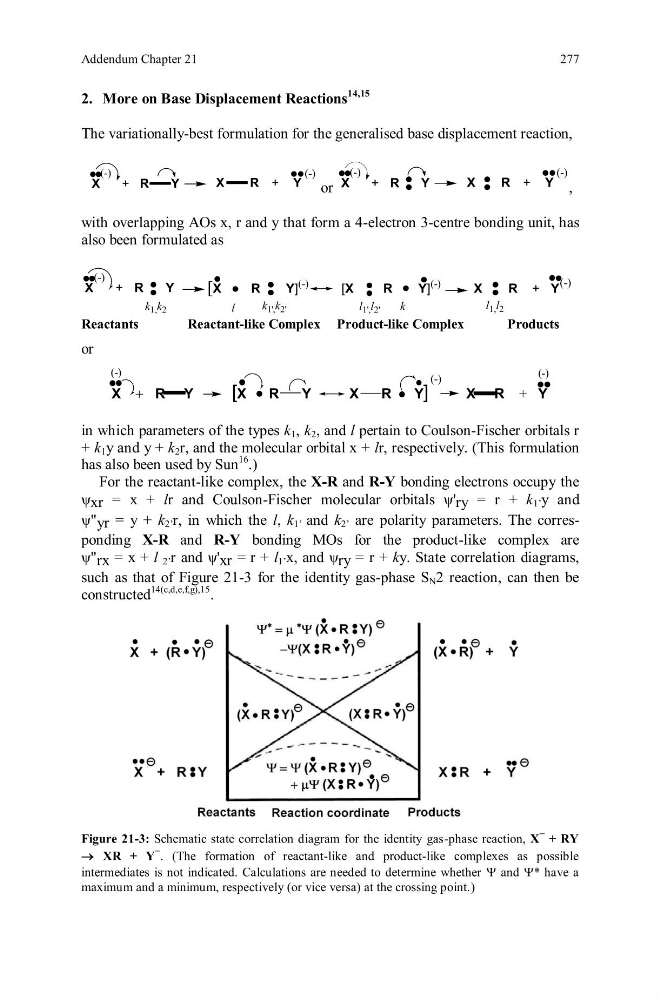
For the reactant-like complex, the X-R and R-Y bonding electrons occupy the
ψ xr = x + lr and Coulson-Fischer molecular orbitals ψ' ry = r + k 1’ y and
ψ" yr = y + k 2’ r, in which the l, k 1’ and k 2’ are polarity parameters. The corresponding X-R and R-Y bonding MOs for the product-like complex are
ψ" rx = x + l 2’ r and ψ' xr = r + l 1’ x, and ψ ry = r + ky. State correlation diagrams,
such as that of Figure 21-3 for the identity gas-phase S N 2 reaction, can then be
constructed
14(c,d,e,f,g),15 .
Figure 21-3: Schematic state correlation diagram for the identity gas-phase reaction, X
– + RY
XR + Y
– . (The formation of reactant-like and product-like complexes as possible
intermediates is not indicated. Calculations are needed to determine whether and * have a
maximum and a minimum, respectively (or vice versa) at the crossing point.)
277
2. More on Base Displacement Reactions
14,15
The variationally-best formulation for the generalised base displacement reaction,
(-)
X
R + Y
X
+ R
Y
(-)
or
(-)
X
R + Y
X
+ R
Y
(-)
,
with overlapping AOs x, r and y that form a 4-electron 3-centre bonding unit, has
also been formulated as
(-)
X
+ R
Y
(-)
[X
R
Y]
(-)
[X
R
Y]
(-)
X
R + Y
l
k 1', k 2'
k
l 1', l 2'
k 1, k 2
l 1, l 2
Reactants
Reactant-like Complex Product-like Complex
Products
or
X
R Y
[X R Y
+
X
R
Y]
X R + Y
(-)
(-)
(-)
in which parameters of the types k 1 , k 2 , and l pertain to Coulson-Fischer orbitals r
+ k 1 y and y + k 2 r, and the molecular orbital x + lr, respectively. (This formulation
has also been used by Sun
16 .)
For the reactant-like complex, the X-R and R-Y bonding electrons occupy the
ψ xr = x + lr and Coulson-Fischer molecular orbitals ψ' ry = r + k 1’ y and
ψ" yr = y + k 2’ r, in which the l, k 1’ and k 2’ are polarity parameters. The corresponding X-R and R-Y bonding MOs for the product-like complex are
ψ" rx = x + l 2’ r and ψ' xr = r + l 1’ x, and ψ ry = r + ky. State correlation diagrams,
such as that of Figure 21-3 for the identity gas-phase S N 2 reaction, can then be
constructed
14(c,d,e,f,g),15 .
Figure 21-3: Schematic state correlation diagram for the identity gas-phase reaction, X
– + RY
XR + Y
– . (The formation of reactant-like and product-like complexes as possible
intermediates is not indicated. Calculations are needed to determine whether and * have a
maximum and a minimum, respectively (or vice versa) at the crossing point.)