

276
Chapter 21 Base-Displacement Reactions and Electron Conduction in Alkali Metals
6. R.J. Gillespie, J. Chem. Soc., 1002 (1952).
7. C.A. Coulson, Nature, 221, 1106 (1969).
8. A. Dedieu and A. Veillard, Quantum Theory of Chemical-Reactions, Vol. 1, (R.
Daudel, A. Pullman, L. Salem and A. Veillard, eds.) Reidel (1980), p. 69.
9. L. Pauling, College Chemistry, W.H. Freeman, 3rd. Ed., 1964, p. 558.
10. L. Pauling, Nature of the Chemical Bond, 3rd. Ed., 1960, p. 400.
11. R.D. Harcourt, J. Phys. B., 7, L41 (1974).
12. J. March, ref. 5, p. 896.
Addendum Chapter 21
1. Electron Conduction with Positive Hole + Electron Transfer
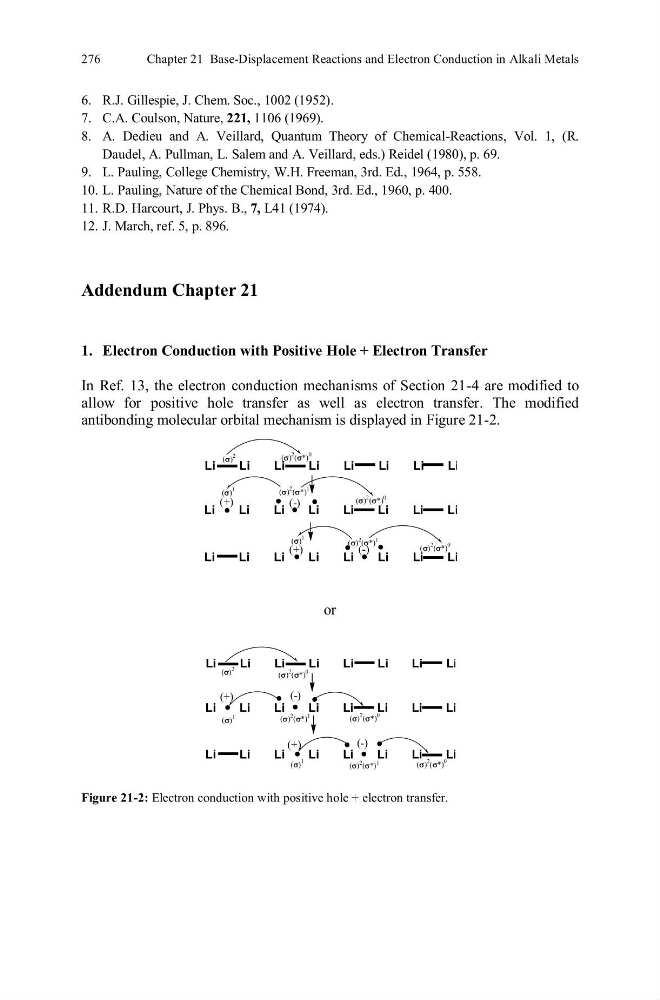
In Ref. 13, the electron conduction mechanisms of Section 21-4 are modified to
allow for positive hole transfer as well as electron transfer. The modified
antibonding molecular orbital mechanism is displayed in Figure 21-2.
Li
Li
Li
Li
Li
Li
Li
Li
Li
Li
Li
Li
Li
Li
Li
Li
Li
Li
Li
Li
Li
Li
Li
Li
.
.
.
.
.
.
.
. (-)
(-)
(+)
(+)
()
2
()
1
()
2 (*)
1
()
2 (*)
0
()
2
(*)
0
()
2
(*)
0
()
1
()
2
(*)
1
or
Li
Li
Li
Li
Li
Li
Li
Li
Li
Li
Li
Li
Li
Li
Li
Li
Li
Li
Li
Li
Li
Li
Li
Li
.
.
.
.
.
.
.
. (-)
(-)
(+)
(+)
()
2
(*)
1
()
2
()
1
()
1
()
2
(*)
1
()
2
(*)
0
()
2
(*)
0
()
2
(*)
0
Figure 21-2: Electron conduction with positive hole + electron transfer.
Chapter 21 Base-Displacement Reactions and Electron Conduction in Alkali Metals
6. R.J. Gillespie, J. Chem. Soc., 1002 (1952).
7. C.A. Coulson, Nature, 221, 1106 (1969).
8. A. Dedieu and A. Veillard, Quantum Theory of Chemical-Reactions, Vol. 1, (R.
Daudel, A. Pullman, L. Salem and A. Veillard, eds.) Reidel (1980), p. 69.
9. L. Pauling, College Chemistry, W.H. Freeman, 3rd. Ed., 1964, p. 558.
10. L. Pauling, Nature of the Chemical Bond, 3rd. Ed., 1960, p. 400.
11. R.D. Harcourt, J. Phys. B., 7, L41 (1974).
12. J. March, ref. 5, p. 896.
Addendum Chapter 21
1. Electron Conduction with Positive Hole + Electron Transfer
In Ref. 13, the electron conduction mechanisms of Section 21-4 are modified to
allow for positive hole transfer as well as electron transfer. The modified
antibonding molecular orbital mechanism is displayed in Figure 21-2.
Li
Li
Li
Li
Li
Li
Li
Li
Li
Li
Li
Li
Li
Li
Li
Li
Li
Li
Li
Li
Li
Li
Li
Li
.
.
.
.
.
.
.
. (-)
(-)
(+)
(+)
()
2
()
1
()
2 (*)
1
()
2 (*)
0
()
2
(*)
0
()
2
(*)
0
()
1
()
2
(*)
1
or
Li
Li
Li
Li
Li
Li
Li
Li
Li
Li
Li
Li
Li
Li
Li
Li
Li
Li
Li
Li
Li
Li
Li
Li
.
.
.
.
.
.
.
. (-)
(-)
(+)
(+)
()
2
(*)
1
()
2
()
1
()
1
()
2
(*)
1
()
2
(*)
0
()
2
(*)
0
()
2
(*)
0
Figure 21-2: Electron conduction with positive hole + electron transfer.