

References
275
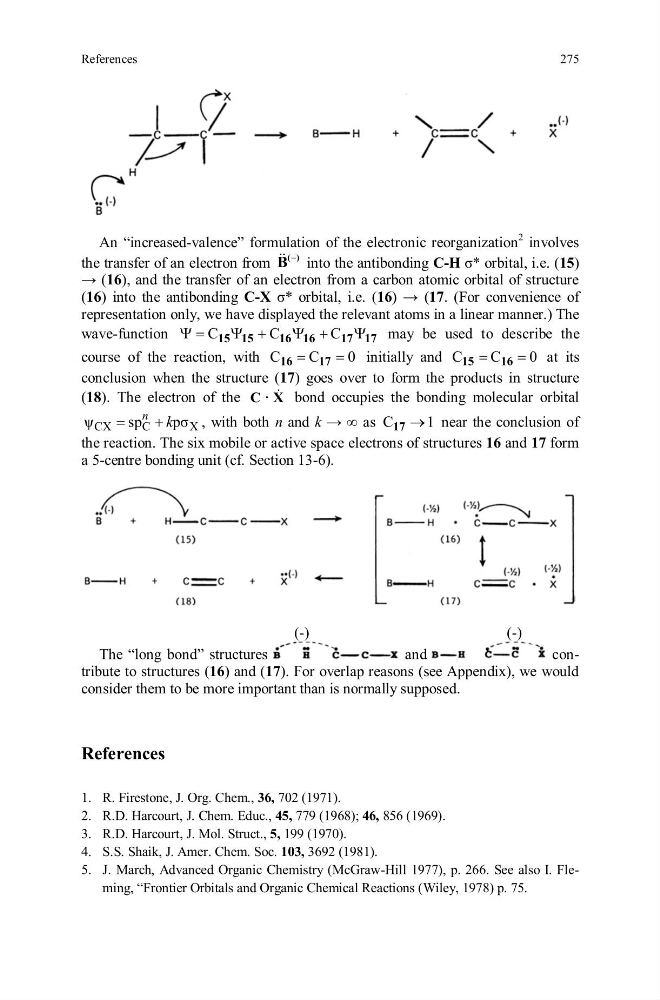
An “increased-valence” formulation of the electronic reorganization
2 involves
the transfer of an electron from
( )
B into the antibonding C-H σ* orbital, i.e. (15)
→ (16), and the transfer of an electron from a carbon atomic orbital of structure
(16) into the antibonding C-X σ* orbital, i.e. (16) → (17. (For convenience of
representation only, we have displayed the relevant atoms in a linear manner.) The
wave-function
17
17
16
16
15
15
C
C
C
may be used to describe the
course of the reaction, with
0
C
C
17
16
initially and
0
C
C
16
15
at its
conclusion when the structure (17) goes over to form the products in structure
(18). The electron of the
C · X bond occupies the bonding molecular orbital
X
C
CX
pσ
sp
ψ
k
n
, with both n and k → ∞ as
1
C
17
near the conclusion of
the reaction. The six mobile or active space electrons of structures 16 and 17 form
a 5-centre bonding unit (cf. Section 13-6).
(-)
(-)
The “long bond” structures
and
contribute to structures (16) and (17). For overlap reasons (see Appendix), we would
consider them to be more important than is normally supposed.
References
1. R. Firestone, J. Org. Chem., 36, 702 (1971).
2. R.D. Harcourt, J. Chem. Educ., 45, 779 (1968); 46, 856 (1969).
3. R.D. Harcourt, J. Mol. Struct., 5, 199 (1970).
4. S.S. Shaik, J. Amer. Chem. Soc. 103, 3692 (1981).
5. J. March, Advanced Organic Chemistry (McGraw-Hill 1977), p. 266. See also I. Fleming, “Frontier Orbitals and Organic Chemical Reactions (Wiley, 1978) p. 75.
275
An “increased-valence” formulation of the electronic reorganization
2 involves
the transfer of an electron from
( )
B into the antibonding C-H σ* orbital, i.e. (15)
→ (16), and the transfer of an electron from a carbon atomic orbital of structure
(16) into the antibonding C-X σ* orbital, i.e. (16) → (17. (For convenience of
representation only, we have displayed the relevant atoms in a linear manner.) The
wave-function
17
17
16
16
15
15
C
C
C
may be used to describe the
course of the reaction, with
0
C
C
17
16
initially and
0
C
C
16
15
at its
conclusion when the structure (17) goes over to form the products in structure
(18). The electron of the
C · X bond occupies the bonding molecular orbital
X
C
CX
pσ
sp
ψ
k
n
, with both n and k → ∞ as
1
C
17
near the conclusion of
the reaction. The six mobile or active space electrons of structures 16 and 17 form
a 5-centre bonding unit (cf. Section 13-6).
(-)
(-)
The “long bond” structures
and
contribute to structures (16) and (17). For overlap reasons (see Appendix), we would
consider them to be more important than is normally supposed.
References
1. R. Firestone, J. Org. Chem., 36, 702 (1971).
2. R.D. Harcourt, J. Chem. Educ., 45, 779 (1968); 46, 856 (1969).
3. R.D. Harcourt, J. Mol. Struct., 5, 199 (1970).
4. S.S. Shaik, J. Amer. Chem. Soc. 103, 3692 (1981).
5. J. March, Advanced Organic Chemistry (McGraw-Hill 1977), p. 266. See also I. Fleming, “Frontier Orbitals and Organic Chemical Reactions (Wiley, 1978) p. 75.