

274
Chapter 21 Base-Displacement Reactions and Electron Conduction in Alkali Metals
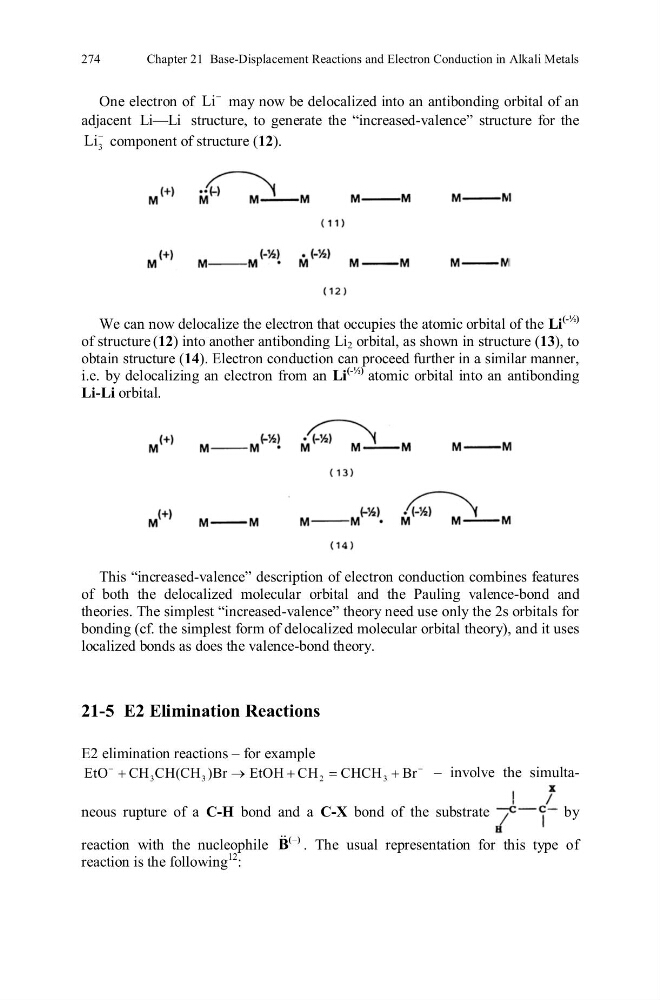
One electron of Li
may now be delocalized into an antibonding orbital of an
adjacent Li—Li structure, to generate the “increased-valence” structure for the
3
Li
component of structure (12).
We can now delocalize the electron that occupies the atomic orbital of the Li
(-½)
of structure (12) into another antibonding Li 2 orbital, as shown in structure (13), to
obtain structure (14). Electron conduction can proceed further in a similar manner,
i.e. by delocalizing an electron from an Li
(-½) atomic orbital into an antibonding
Li-Li orbital.
This “increased-valence” description of electron conduction combines features
of both the delocalized molecular orbital and the Pauling valence-bond and
theories. The simplest “increased-valence” theory need use only the 2s orbitals for
bonding (cf. the simplest form of delocalized molecular orbital theory), and it uses
localized bonds as does the valence-bond theory.
21-5 E2 Elimination Reactions
E2 elimination reactions – for example
3
3
2
3
EtO CH CH(CH )Br
EtOH CH
CHCH Br
– involve the simultaneous rupture of a C-H bond and a C-X bond of the substrate
by
reaction with the nucleophile
( )
B . The usual representation for this type of
reaction is the following
12 :
Chapter 21 Base-Displacement Reactions and Electron Conduction in Alkali Metals
One electron of Li
may now be delocalized into an antibonding orbital of an
adjacent Li—Li structure, to generate the “increased-valence” structure for the
3
Li
component of structure (12).
We can now delocalize the electron that occupies the atomic orbital of the Li
(-½)
of structure (12) into another antibonding Li 2 orbital, as shown in structure (13), to
obtain structure (14). Electron conduction can proceed further in a similar manner,
i.e. by delocalizing an electron from an Li
(-½) atomic orbital into an antibonding
Li-Li orbital.
This “increased-valence” description of electron conduction combines features
of both the delocalized molecular orbital and the Pauling valence-bond and
theories. The simplest “increased-valence” theory need use only the 2s orbitals for
bonding (cf. the simplest form of delocalized molecular orbital theory), and it uses
localized bonds as does the valence-bond theory.
21-5 E2 Elimination Reactions
E2 elimination reactions – for example
3
3
2
3
EtO CH CH(CH )Br
EtOH CH
CHCH Br
– involve the simultaneous rupture of a C-H bond and a C-X bond of the substrate
by
reaction with the nucleophile
( )
B . The usual representation for this type of
reaction is the following
12 :