

21-4
Electron Conduction in Alkali Metal Solids
273
21-4 Electron Conduction in Alkali Metal Solids
In the resonating valence-bond theory of metallic solids, Pauling
9, 10 has suggested
that alkali metals use their p as well as their s atomic orbitals for bonding. Pauling
designated the p orbitals as “metallic orbitals”. When both s and p orbitals are
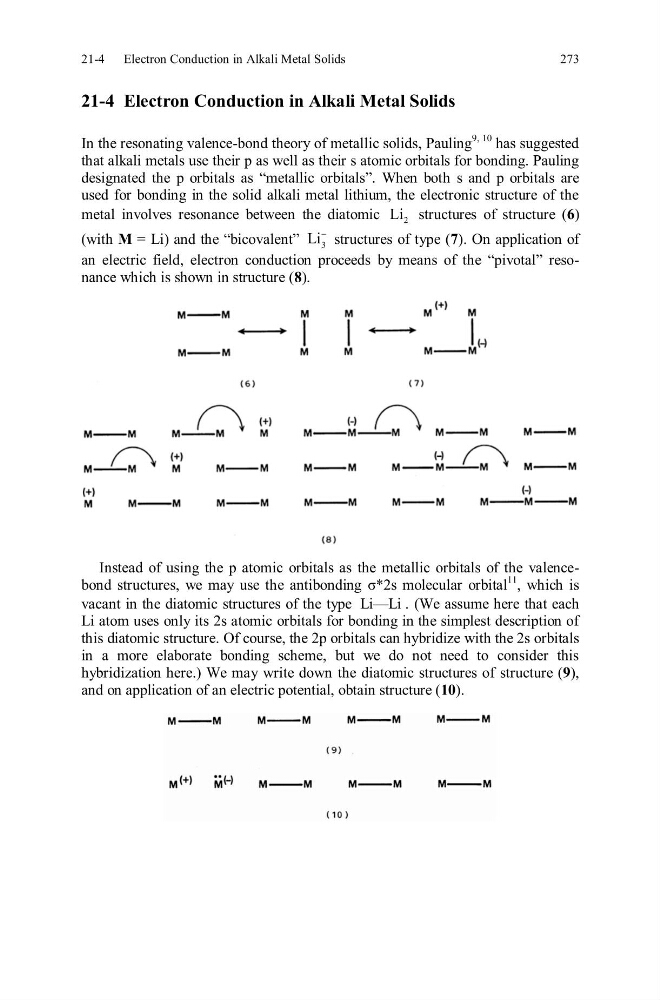
used for bonding in the solid alkali metal lithium, the electronic structure of the
metal involves resonance between the diatomic
2
Li structures of structure (6)
(with M = Li) and the “bicovalent” 3
Li
structures of type (7). On application of
an electric field, electron conduction proceeds by means of the “pivotal” resonance which is shown in structure (8).
Instead of using the p atomic orbitals as the metallic orbitals of the valencebond structures, we may use the antibonding σ*2s molecular orbital
11
, which is
vacant in the diatomic structures of the type Li—Li . (We assume here that each
Li atom uses only its 2s atomic orbitals for bonding in the simplest description of
this diatomic structure. Of course, the 2p orbitals can hybridize with the 2s orbitals
in a more elaborate bonding scheme, but we do not need to consider this
hybridization here.) We may write down the diatomic structures of structure (9),
and on application of an electric potential, obtain structure (10).
Electron Conduction in Alkali Metal Solids
273
21-4 Electron Conduction in Alkali Metal Solids
In the resonating valence-bond theory of metallic solids, Pauling
9, 10 has suggested
that alkali metals use their p as well as their s atomic orbitals for bonding. Pauling
designated the p orbitals as “metallic orbitals”. When both s and p orbitals are
used for bonding in the solid alkali metal lithium, the electronic structure of the
metal involves resonance between the diatomic
2
Li structures of structure (6)
(with M = Li) and the “bicovalent” 3
Li
structures of type (7). On application of
an electric field, electron conduction proceeds by means of the “pivotal” resonance which is shown in structure (8).
Instead of using the p atomic orbitals as the metallic orbitals of the valencebond structures, we may use the antibonding σ*2s molecular orbital
11
, which is
vacant in the diatomic structures of the type Li—Li . (We assume here that each
Li atom uses only its 2s atomic orbitals for bonding in the simplest description of
this diatomic structure. Of course, the 2p orbitals can hybridize with the 2s orbitals
in a more elaborate bonding scheme, but we do not need to consider this
hybridization here.) We may write down the diatomic structures of structure (9),
and on application of an electric potential, obtain structure (10).