

272
Chapter 21 Base-Displacement Reactions and Electron Conduction in Alkali Metals
undergoes inversion of configuration as the reaction proceeds. The electronic
reorganization that is associated with this S N 2 reaction is usually represented
according to Eqn. (5)
5
:
(5)
In the transition state (4), the carbon atom is bonded simultaneously to five
atoms. To account for this (apparent) quinquevalence, some workers have
assumed that a carbon 3d orbital as well as the 2s and 2p orbitals can participate as
a hybridization function in the bonding
6, 7 . But it is more probable that the carbon
uses primarily only its 2s and 2p orbitals, and forms two bonds which are not
orthogonal, as we have described for the general transition state of Section 21-1.
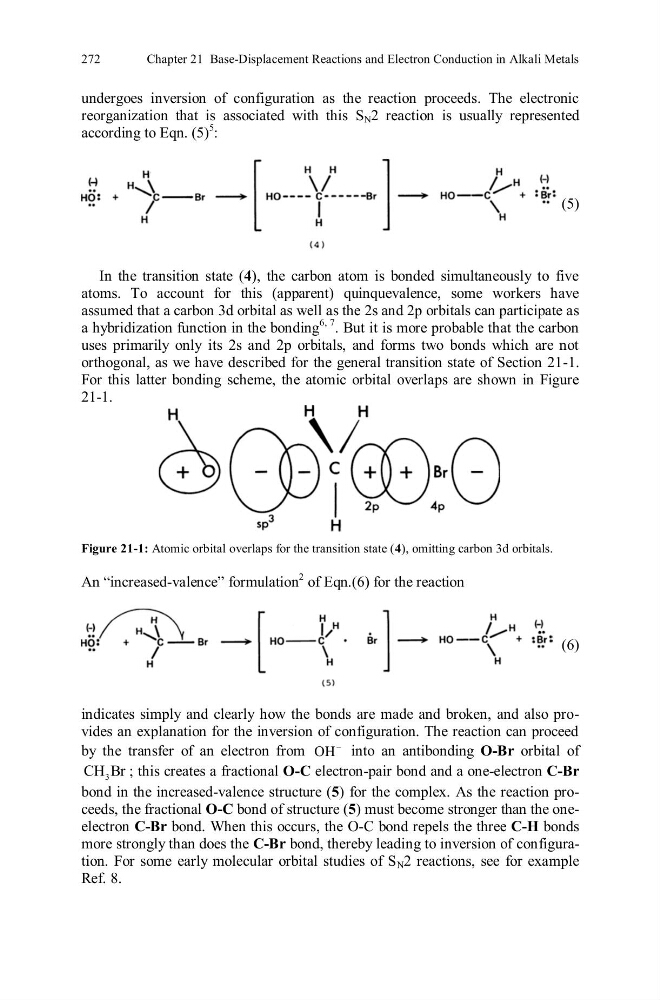
For this latter bonding scheme, the atomic orbital overlaps are shown in Figure
21-1.
Figure 21-1: Atomic orbital overlaps for the transition state (4), omitting carbon 3d orbitals.
An “increased-valence” formulation
2 of Eqn.(6) for the reaction
(6)
indicates simply and clearly how the bonds are made and broken, and also provides an explanation for the inversion of configuration. The reaction can proceed
by the transfer of an electron from OH
into an antibonding O-Br orbital of
3
CH Br ; this creates a fractional O-C electron-pair bond and a one-electron C-Br
bond in the increased-valence structure (5) for the complex. As the reaction proceeds, the fractional O-C bond of structure (5) must become stronger than the oneelectron C-Br bond. When this occurs, the O-C bond repels the three C-H bonds
more strongly than does the C-Br bond, thereby leading to inversion of configuration. For some early molecular orbital studies of S N 2 reactions, see for example
Ref. 8.
Chapter 21 Base-Displacement Reactions and Electron Conduction in Alkali Metals
undergoes inversion of configuration as the reaction proceeds. The electronic
reorganization that is associated with this S N 2 reaction is usually represented
according to Eqn. (5)
5
:
(5)
In the transition state (4), the carbon atom is bonded simultaneously to five
atoms. To account for this (apparent) quinquevalence, some workers have
assumed that a carbon 3d orbital as well as the 2s and 2p orbitals can participate as
a hybridization function in the bonding
6, 7 . But it is more probable that the carbon
uses primarily only its 2s and 2p orbitals, and forms two bonds which are not
orthogonal, as we have described for the general transition state of Section 21-1.
For this latter bonding scheme, the atomic orbital overlaps are shown in Figure
21-1.
Figure 21-1: Atomic orbital overlaps for the transition state (4), omitting carbon 3d orbitals.
An “increased-valence” formulation
2 of Eqn.(6) for the reaction
(6)
indicates simply and clearly how the bonds are made and broken, and also provides an explanation for the inversion of configuration. The reaction can proceed
by the transfer of an electron from OH
into an antibonding O-Br orbital of
3
CH Br ; this creates a fractional O-C electron-pair bond and a one-electron C-Br
bond in the increased-valence structure (5) for the complex. As the reaction proceeds, the fractional O-C bond of structure (5) must become stronger than the oneelectron C-Br bond. When this occurs, the O-C bond repels the three C-H bonds
more strongly than does the C-Br bond, thereby leading to inversion of configuration. For some early molecular orbital studies of S N 2 reactions, see for example
Ref. 8.