

21-3
Walden Inversion Mechanism
271
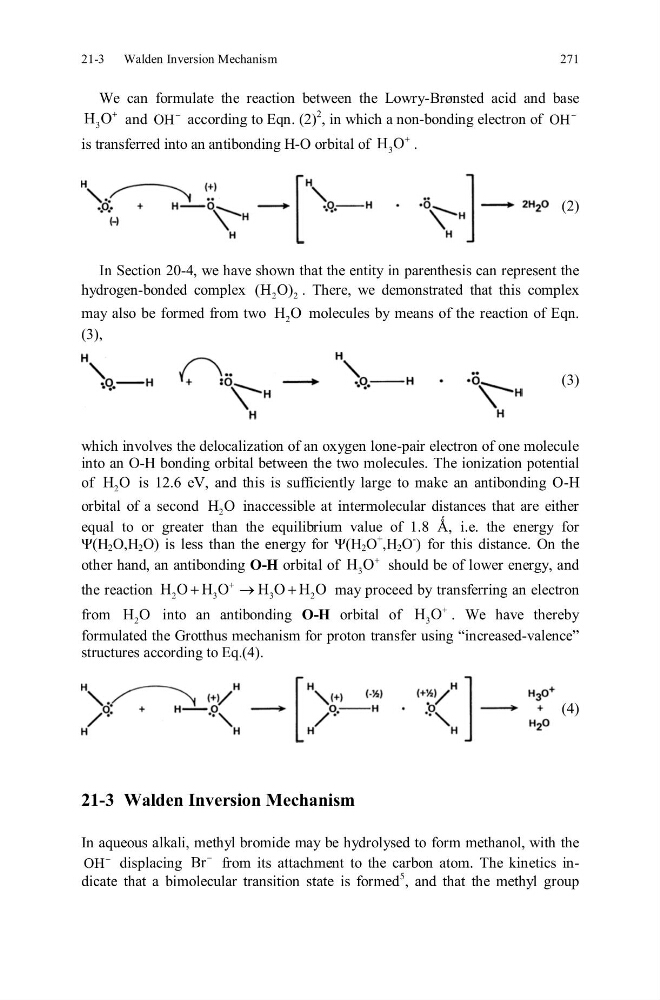
We can formulate the reaction between the Lowry-Brønsted acid and base
3
H O
and OH
according to Eqn. (2)
2 , in which a non-bonding electron of OH
is transferred into an antibonding H-O orbital of 3
H O
.
(2)
In Section 20-4, we have shown that the entity in parenthesis can represent the
hydrogen-bonded complex
2
2
(H O) . There, we demonstrated that this complex
may also be formed from two 2
H O molecules by means of the reaction of Eqn.
(3),
(3)
which involves the delocalization of an oxygen lone-pair electron of one molecule
into an O-H bonding orbital between the two molecules. The ionization potential
of 2
H O is 12.6 eV, and this is sufficiently large to make an antibonding O-H
orbital of a second 2
H O inaccessible at intermolecular distances that are either
equal to or greater than the equilibrium value of 1.8 Ǻ, i.e. the energy for
Ψ(H 2 O,H 2 O) is less than the energy for Ψ(H 2 O
+
,H 2 O
- ) for this distance. On the
other hand, an antibonding O-H orbital of 3
H O
should be of lower energy, and
the reaction 2
3
3
2
H O H O
H O H O
may proceed by transferring an electron
from
2
H O into an antibonding O-H orbital of
3
H O
. We have thereby
formulated the Grotthus mechanism for proton transfer using “increased-valence”
structures according to Eq.(4).
(4)
21-3 Walden Inversion Mechanism
In aqueous alkali, methyl bromide may be hydrolysed to form methanol, with the
OH
displacing Br
from its attachment to the carbon atom. The kinetics indicate that a bimolecular transition state is formed
5 , and that the methyl group
Walden Inversion Mechanism
271
We can formulate the reaction between the Lowry-Brønsted acid and base
3
H O
and OH
according to Eqn. (2)
2 , in which a non-bonding electron of OH
is transferred into an antibonding H-O orbital of 3
H O
.
(2)
In Section 20-4, we have shown that the entity in parenthesis can represent the
hydrogen-bonded complex
2
2
(H O) . There, we demonstrated that this complex
may also be formed from two 2
H O molecules by means of the reaction of Eqn.
(3),
(3)
which involves the delocalization of an oxygen lone-pair electron of one molecule
into an O-H bonding orbital between the two molecules. The ionization potential
of 2
H O is 12.6 eV, and this is sufficiently large to make an antibonding O-H
orbital of a second 2
H O inaccessible at intermolecular distances that are either
equal to or greater than the equilibrium value of 1.8 Ǻ, i.e. the energy for
Ψ(H 2 O,H 2 O) is less than the energy for Ψ(H 2 O
+
,H 2 O
- ) for this distance. On the
other hand, an antibonding O-H orbital of 3
H O
should be of lower energy, and
the reaction 2
3
3
2
H O H O
H O H O
may proceed by transferring an electron
from
2
H O into an antibonding O-H orbital of
3
H O
. We have thereby
formulated the Grotthus mechanism for proton transfer using “increased-valence”
structures according to Eq.(4).
(4)
21-3 Walden Inversion Mechanism
In aqueous alkali, methyl bromide may be hydrolysed to form methanol, with the
OH
displacing Br
from its attachment to the carbon atom. The kinetics indicate that a bimolecular transition state is formed
5 , and that the methyl group