

270
Chapter 21 Base-Displacement Reactions and Electron Conduction in Alkali Metals
transferred into an atomic orbital on Y. (This atomic orbital is the same orbital that
is used by Y to form the bond of R—Y ). The transition state is usually
represented as X––R––Y, which shows the simultaneous making of the X-R bond
and breaking of the R-Y bond. Since X, R and Y each contribute one atomic
orbital for the bonding, the X-R and R-Y bond orbitals of this transition state
cannot be orthogonal, and therefore the divalence of R is apparent, not real (cf.
Chapter 16). Firestone
1 has also used the Linnett theory to formulate the transition
state as X · R · Y
.
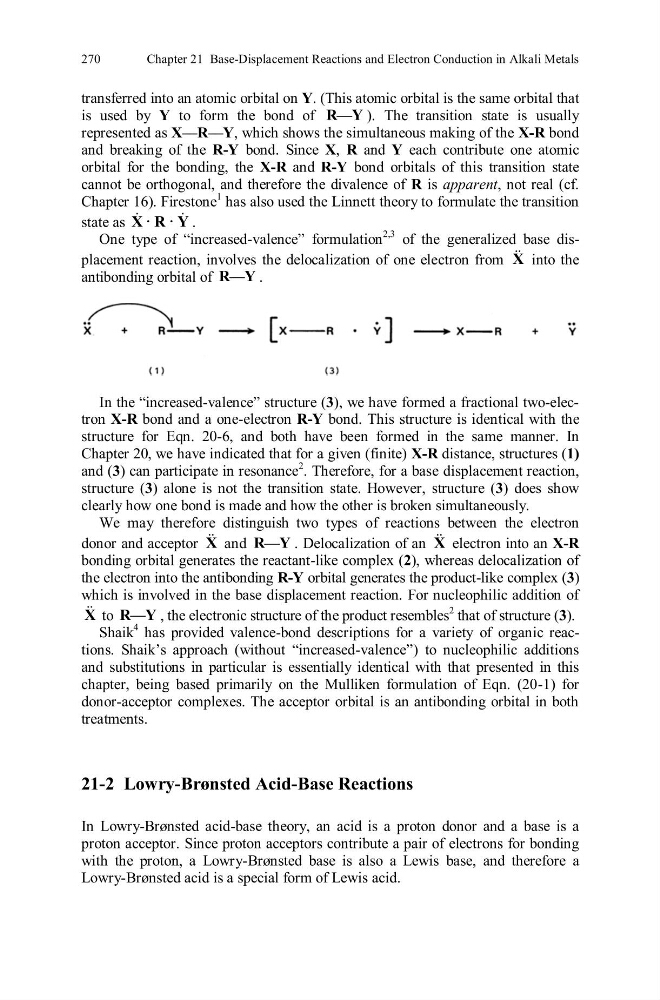
One type of “increased-valence” formulation
2,3 of the generalized base displacement reaction, involves the delocalization of one electron from X into the
antibonding orbital of R—Y .
In the “increased-valence” structure (3), we have formed a fractional two-electron X-R bond and a one-electron R-Y bond. This structure is identical with the
structure for Eqn. 20-6, and both have been formed in the same manner. In
Chapter 20, we have indicated that for a given (finite) X-R distance, structures (1)
and (3) can participate in resonance
2 . Therefore, for a base displacement reaction,
structure (3) alone is not the transition state. However, structure (3) does show
clearly how one bond is made and how the other is broken simultaneously.
We may therefore distinguish two types of reactions between the electron
donor and acceptor X and R—Y . Delocalization of an X electron into an X-R
bonding orbital generates the reactant-like complex (2), whereas delocalization of
the electron into the antibonding R-Y orbital generates the product-like complex (3)
which is involved in the base displacement reaction. For nucleophilic addition of
X to R—Y , the electronic structure of the product resembles
2 that of structure (3).
Shaik
4 has provided valence-bond descriptions for a variety of organic reactions. Shaik’s approach (without “increased-valence”) to nucleophilic additions
and substitutions in particular is essentially identical with that presented in this
chapter, being based primarily on the Mulliken formulation of Eqn. (20-1) for
donor-acceptor complexes. The acceptor orbital is an antibonding orbital in both
treatments.
21-2 Lowry-Brønsted Acid-Base Reactions
In Lowry-Brønsted acid-base theory, an acid is a proton donor and a base is a
proton acceptor. Since proton acceptors contribute a pair of electrons for bonding
with the proton, a Lowry-Brønsted base is also a Lewis base, and therefore a
Lowry-Brønsted acid is a special form of Lewis acid.
Chapter 21 Base-Displacement Reactions and Electron Conduction in Alkali Metals
transferred into an atomic orbital on Y. (This atomic orbital is the same orbital that
is used by Y to form the bond of R—Y ). The transition state is usually
represented as X––R––Y, which shows the simultaneous making of the X-R bond
and breaking of the R-Y bond. Since X, R and Y each contribute one atomic
orbital for the bonding, the X-R and R-Y bond orbitals of this transition state
cannot be orthogonal, and therefore the divalence of R is apparent, not real (cf.
Chapter 16). Firestone
1 has also used the Linnett theory to formulate the transition
state as X · R · Y
.
One type of “increased-valence” formulation
2,3 of the generalized base displacement reaction, involves the delocalization of one electron from X into the
antibonding orbital of R—Y .
In the “increased-valence” structure (3), we have formed a fractional two-electron X-R bond and a one-electron R-Y bond. This structure is identical with the
structure for Eqn. 20-6, and both have been formed in the same manner. In
Chapter 20, we have indicated that for a given (finite) X-R distance, structures (1)
and (3) can participate in resonance
2 . Therefore, for a base displacement reaction,
structure (3) alone is not the transition state. However, structure (3) does show
clearly how one bond is made and how the other is broken simultaneously.
We may therefore distinguish two types of reactions between the electron
donor and acceptor X and R—Y . Delocalization of an X electron into an X-R
bonding orbital generates the reactant-like complex (2), whereas delocalization of
the electron into the antibonding R-Y orbital generates the product-like complex (3)
which is involved in the base displacement reaction. For nucleophilic addition of
X to R—Y , the electronic structure of the product resembles
2 that of structure (3).
Shaik
4 has provided valence-bond descriptions for a variety of organic reactions. Shaik’s approach (without “increased-valence”) to nucleophilic additions
and substitutions in particular is essentially identical with that presented in this
chapter, being based primarily on the Mulliken formulation of Eqn. (20-1) for
donor-acceptor complexes. The acceptor orbital is an antibonding orbital in both
treatments.
21-2 Lowry-Brønsted Acid-Base Reactions
In Lowry-Brønsted acid-base theory, an acid is a proton donor and a base is a
proton acceptor. Since proton acceptors contribute a pair of electrons for bonding
with the proton, a Lowry-Brønsted base is also a Lewis base, and therefore a
Lowry-Brønsted acid is a special form of Lewis acid.