

Chapter 21 Base-Displacement Reactions and
Electron Conduction in Alkali
Metals
21-1 Introduction
The donor-acceptor complexes of Chapter 20 were usually formed by reacting a
neutral electron donor X with a neutral electron acceptor R—Y . When the X
and R atomic orbitals overlap, delocalization of an X electron of valence-bond
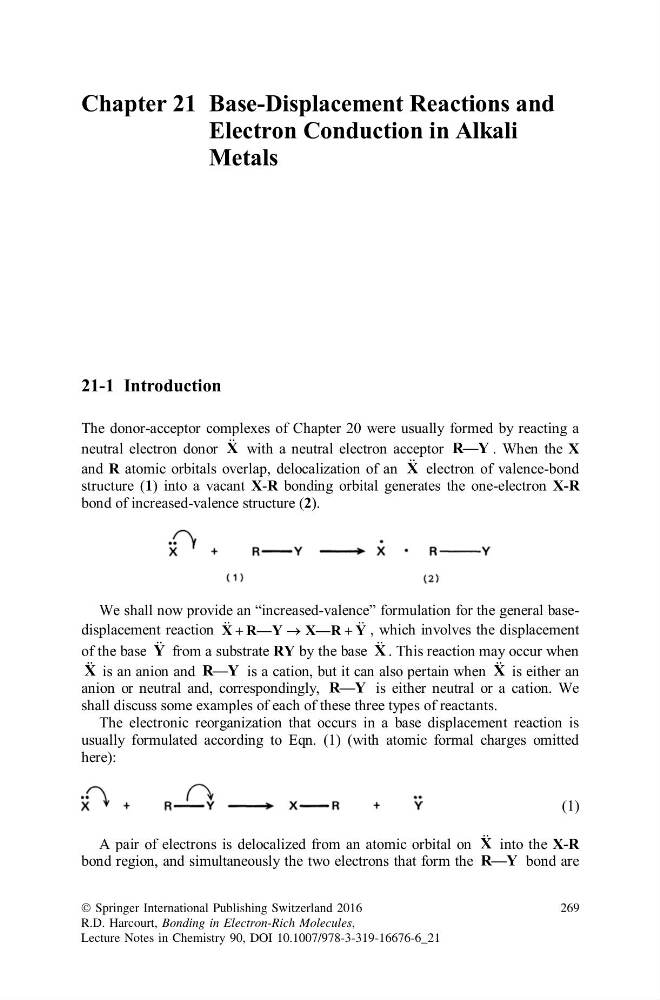
structure (1) into a vacant X-R bonding orbital generates the one-electron X-R
bond of increased-valence structure (2).
We shall now provide an “increased-valence” formulation for the general basedisplacement reaction X R—Y
X—R Y
, which involves the displacement
of the base Y from a substrate RY by the base X . This reaction may occur when
X is an anion and R—Y is a cation, but it can also pertain when X is either an
anion or neutral and, correspondingly, R—Y is either neutral or a cation. We
shall discuss some examples of each of these three types of reactants.
The electronic reorganization that occurs in a base displacement reaction is
usually formulated according to Eqn. (1) (with atomic formal charges omitted
here):
(1)
A pair of electrons is delocalized from an atomic orbital on X into the X-R
bond region, and simultaneously the two electrons that form the R—Y bond are
Ó Springer International Publishing Switzerland 2016
R.D. Harcourt, Bonding in Electron-Rich Molecules,
Lecture Notes in Chemistry 90, DOI 10.1007/978-3-319-16676-6_21
269
Electron Conduction in Alkali
Metals
21-1 Introduction
The donor-acceptor complexes of Chapter 20 were usually formed by reacting a
neutral electron donor X with a neutral electron acceptor R—Y . When the X
and R atomic orbitals overlap, delocalization of an X electron of valence-bond
structure (1) into a vacant X-R bonding orbital generates the one-electron X-R
bond of increased-valence structure (2).
We shall now provide an “increased-valence” formulation for the general basedisplacement reaction X R—Y
X—R Y
, which involves the displacement
of the base Y from a substrate RY by the base X . This reaction may occur when
X is an anion and R—Y is a cation, but it can also pertain when X is either an
anion or neutral and, correspondingly, R—Y is either neutral or a cation. We
shall discuss some examples of each of these three types of reactants.
The electronic reorganization that occurs in a base displacement reaction is
usually formulated according to Eqn. (1) (with atomic formal charges omitted
here):
(1)
A pair of electrons is delocalized from an atomic orbital on X into the X-R
bond region, and simultaneously the two electrons that form the R—Y bond are
Ó Springer International Publishing Switzerland 2016
R.D. Harcourt, Bonding in Electron-Rich Molecules,
Lecture Notes in Chemistry 90, DOI 10.1007/978-3-319-16676-6_21
269