

20-6
H5O2
+ and HF2
–
265
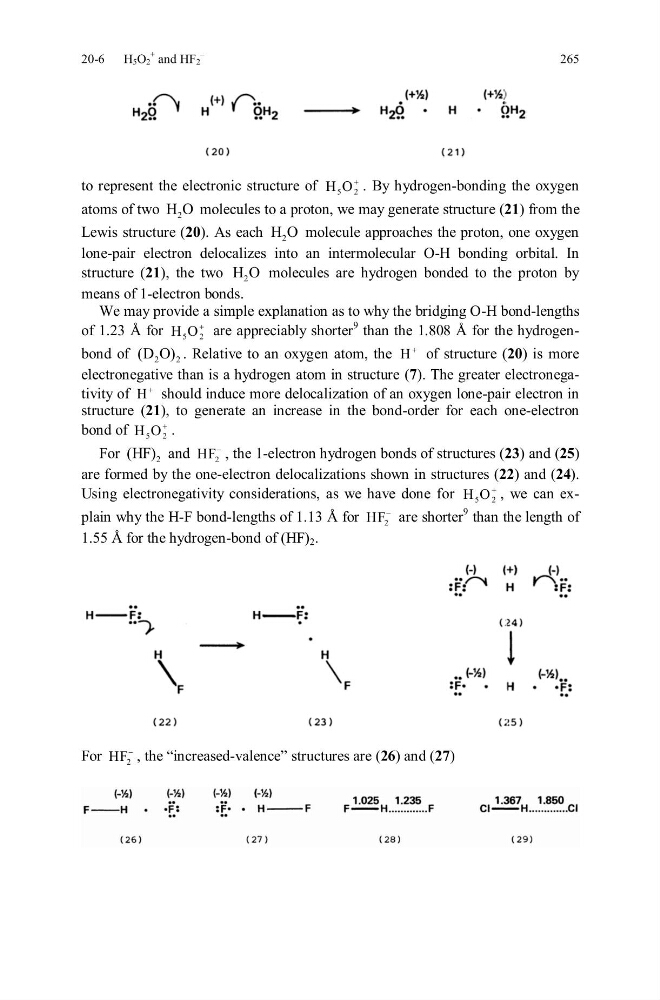
to represent the electronic structure of 5 2
H O
. By hydrogen-bonding the oxygen
atoms of two 2
H O molecules to a proton, we may generate structure (21) from the
Lewis structure (20). As each 2
H O molecule approaches the proton, one oxygen
lone-pair electron delocalizes into an intermolecular O-H bonding orbital. In
structure (21), the two 2
H O molecules are hydrogen bonded to the proton by
means of 1-electron bonds.
We may provide a simple explanation as to why the bridging O-H bond-lengths
of 1.23 Å for 5 2
H O
are appreciably shorter
9 than the 1.808 Å for the hydrogenbond of
2
2
(D O) . Relative to an oxygen atom, the H
of structure (20) is more
electronegative than is a hydrogen atom in structure (7). The greater electronegativity of H
should induce more delocalization of an oxygen lone-pair electron in
structure (21), to generate an increase in the bond-order for each one-electron
bond of 5 2
H O
.
For
2
(HF) and
2
HF
, the 1-electron hydrogen bonds of structures (23) and (25)
are formed by the one-electron delocalizations shown in structures (22) and (24).
Using electronegativity considerations, as we have done for 5 2
H O
, we can explain why the H-F bond-lengths of 1.13 Å for
2
HF
are shorter
9 than the length of
1.55 Å for the hydrogen-bond of (HF) 2 .
For
2
HF
, the “increased-valence” structures are (26) and (27)
H5O2
+ and HF2
–
265
to represent the electronic structure of 5 2
H O
. By hydrogen-bonding the oxygen
atoms of two 2
H O molecules to a proton, we may generate structure (21) from the
Lewis structure (20). As each 2
H O molecule approaches the proton, one oxygen
lone-pair electron delocalizes into an intermolecular O-H bonding orbital. In
structure (21), the two 2
H O molecules are hydrogen bonded to the proton by
means of 1-electron bonds.
We may provide a simple explanation as to why the bridging O-H bond-lengths
of 1.23 Å for 5 2
H O
are appreciably shorter
9 than the 1.808 Å for the hydrogenbond of
2
2
(D O) . Relative to an oxygen atom, the H
of structure (20) is more
electronegative than is a hydrogen atom in structure (7). The greater electronegativity of H
should induce more delocalization of an oxygen lone-pair electron in
structure (21), to generate an increase in the bond-order for each one-electron
bond of 5 2
H O
.
For
2
(HF) and
2
HF
, the 1-electron hydrogen bonds of structures (23) and (25)
are formed by the one-electron delocalizations shown in structures (22) and (24).
Using electronegativity considerations, as we have done for 5 2
H O
, we can explain why the H-F bond-lengths of 1.13 Å for
2
HF
are shorter
9 than the length of
1.55 Å for the hydrogen-bond of (HF) 2 .
For
2
HF
, the “increased-valence” structures are (26) and (27)