

264
Chapter 20 Intermolecular Donor-Acceptor Complexes
X
ry ry
( R — Y) | x x
|
(5)
The wave-function for the dative structure
X —RY , for which one nonbonding electron of structure (15) has been transferred into the antibonding RY
orbital
ry
*
*r y
k
, is given by Eqn. (6).
X
Y
*
*
ry ry ry
ry
ry ry
( — R · ) | x
| |
x
|
(6)
It has been deduced
8c that the Mulliken wave-function for the complex, namely
Eqn. (1), is equivalent to the wave-function of Eqn. (4) for the “increasedvalence” structure (13). Therefore, the Mulliken wave-function of Eqn. (1)
implies, but conceals an (approximate) description of the intermolecular bond as a
1-electron bond.
1
1
2
13
xr
ry
X
·
R — Y
(x) (
) ( )
( )
2
2
15
ry
X
R — Y
(x)
(
)
( )
20-6 H 5 O 2
+
and HF 2
–
The isoelectronic ions 5 2
H O
and
2
HF
with 16 valence-shell electrons, are
examples of systems that have strong hydrogen bonds
9 . In Fig. 2-4, we have
displayed the set of hydrogen 1s and fluorine 2pσ-atomic orbitals of
2
HF
that
may be utilized for 4-electron 3-centre bonding. For
5
2
H O
, oxygen hybrid
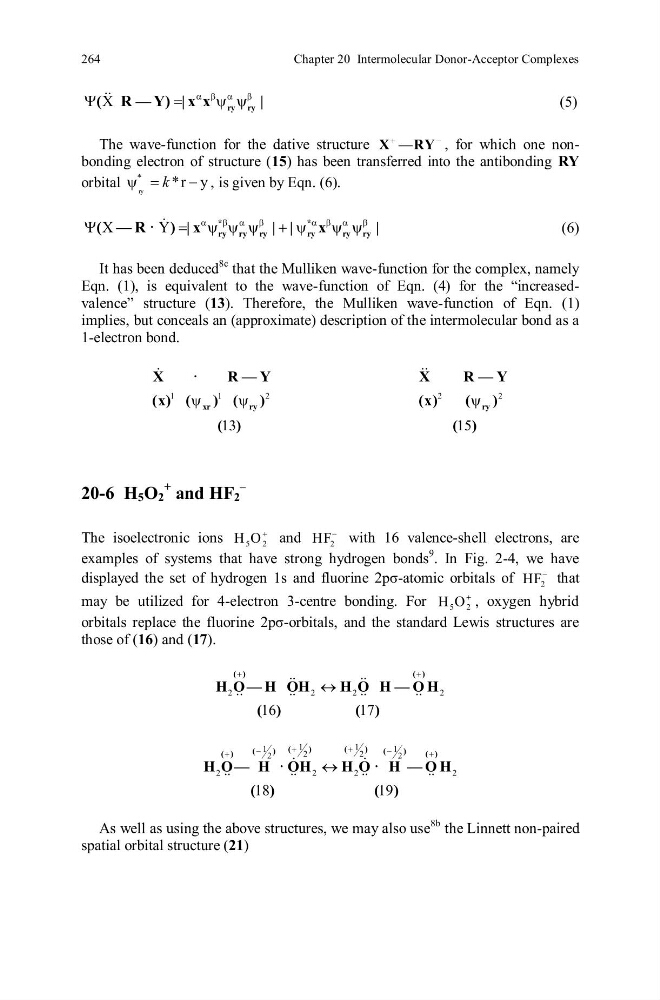
orbitals replace the fluorine 2pσ-orbitals, and the standard Lewis structures are
those of (16) and (17).
2
2
2
2
16
17
( )
( )
H O — H OH
H O H — O H
( )
( )
1
1
1
1
2
2
2
2
2
2
2
2
18
19
(
)
(
)
(
)
(
)
( )
( )
H O — H · OH
H O · H — O H
( )
( )
As well as using the above structures, we may also use
8b the Linnett non-paired
spatial orbital structure (21)
Chapter 20 Intermolecular Donor-Acceptor Complexes
X
ry ry
( R — Y) | x x
|
(5)
The wave-function for the dative structure
X —RY , for which one nonbonding electron of structure (15) has been transferred into the antibonding RY
orbital
ry
*
*r y
k
, is given by Eqn. (6).
X
Y
*
*
ry ry ry
ry
ry ry
( — R · ) | x
| |
x
|
(6)
It has been deduced
8c that the Mulliken wave-function for the complex, namely
Eqn. (1), is equivalent to the wave-function of Eqn. (4) for the “increasedvalence” structure (13). Therefore, the Mulliken wave-function of Eqn. (1)
implies, but conceals an (approximate) description of the intermolecular bond as a
1-electron bond.
1
1
2
13
xr
ry
X
·
R — Y
(x) (
) ( )
( )
2
2
15
ry
X
R — Y
(x)
(
)
( )
20-6 H 5 O 2
+
and HF 2
–
The isoelectronic ions 5 2
H O
and
2
HF
with 16 valence-shell electrons, are
examples of systems that have strong hydrogen bonds
9 . In Fig. 2-4, we have
displayed the set of hydrogen 1s and fluorine 2pσ-atomic orbitals of
2
HF
that
may be utilized for 4-electron 3-centre bonding. For
5
2
H O
, oxygen hybrid
orbitals replace the fluorine 2pσ-orbitals, and the standard Lewis structures are
those of (16) and (17).
2
2
2
2
16
17
( )
( )
H O — H OH
H O H — O H
( )
( )
1
1
1
1
2
2
2
2
2
2
2
2
18
19
(
)
(
)
(
)
(
)
( )
( )
H O — H · OH
H O · H — O H
( )
( )
As well as using the above structures, we may also use
8b the Linnett non-paired
spatial orbital structure (21)