

20-5
Increased-Valence Structure with three 2-Centre Bond Orbitals
263
For the hydrogen bonding interaction between two water molecules we may
write
to obtain a 1-electron bond as the intermolecular hydrogen bond, and reducing the
bond-number for the adjacent H—O bond below the value that pertains for a free
2
H O molecule.
In the theory of Sections 20-1 to 20-3, the electron donor (
X ) and the electron
acceptor ( R—Y ) were designated as increvalent and sacrificial donors and
acceptors respectively. Here, in structures (12), (13) and (14), donors and acceptors are both increvalent species.
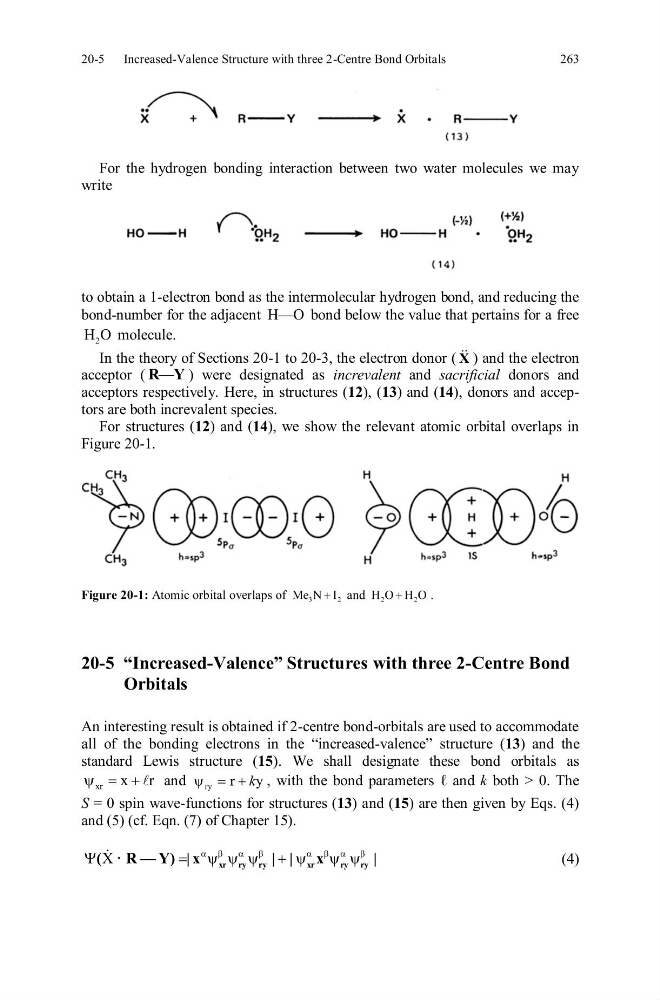
For structures (12) and (14), we show the relevant atomic orbital overlaps in
Figure 20-1.
Figure 20-1: Atomic orbital overlaps of
3
2
Me N I
and 2
2
H O H O
.
20-5
with three 2-Centre Bond
Orbitals
An interesting result is obtained if 2-centre bond-orbitals are used to accommodate
all of the bonding electrons in the “increased-valence” structure (13) and the
standard Lewis structure (15). We shall designate these bond orbitals as
xr
x r
and ry r y
k , with the bond parameters ℓ and k both > 0. The
S = 0 spin wave-functions for structures (13) and (15) are then given by Eqs. (4)
and (5) (cf. Eqn. (7) of Chapter 15).
X
xr ry ry
xr
ry ry
( · R — Y) | x
| |
x
|
(4)
Structures
“Increased-Valence”
Increased-Valence Structure with three 2-Centre Bond Orbitals
263
For the hydrogen bonding interaction between two water molecules we may
write
to obtain a 1-electron bond as the intermolecular hydrogen bond, and reducing the
bond-number for the adjacent H—O bond below the value that pertains for a free
2
H O molecule.
In the theory of Sections 20-1 to 20-3, the electron donor (
X ) and the electron
acceptor ( R—Y ) were designated as increvalent and sacrificial donors and
acceptors respectively. Here, in structures (12), (13) and (14), donors and acceptors are both increvalent species.
For structures (12) and (14), we show the relevant atomic orbital overlaps in
Figure 20-1.
Figure 20-1: Atomic orbital overlaps of
3
2
Me N I
and 2
2
H O H O
.
20-5
with three 2-Centre Bond
Orbitals
An interesting result is obtained if 2-centre bond-orbitals are used to accommodate
all of the bonding electrons in the “increased-valence” structure (13) and the
standard Lewis structure (15). We shall designate these bond orbitals as
xr
x r
and ry r y
k , with the bond parameters ℓ and k both > 0. The
S = 0 spin wave-functions for structures (13) and (15) are then given by Eqs. (4)
and (5) (cf. Eqn. (7) of Chapter 15).
X
xr ry ry
xr
ry ry
( · R — Y) | x
| |
x
|
(4)
Structures
“Increased-Valence”