

262
Chapter 20 Intermolecular Donor-Acceptor Complexes
20-4 Reformulation of Charge-Transfer Theory
8
Mulliken
3 has shown that the dative structure
2
3
I
N
Me
A
D
for the
3
2
Me N...I complex summarizes resonance between the standard and
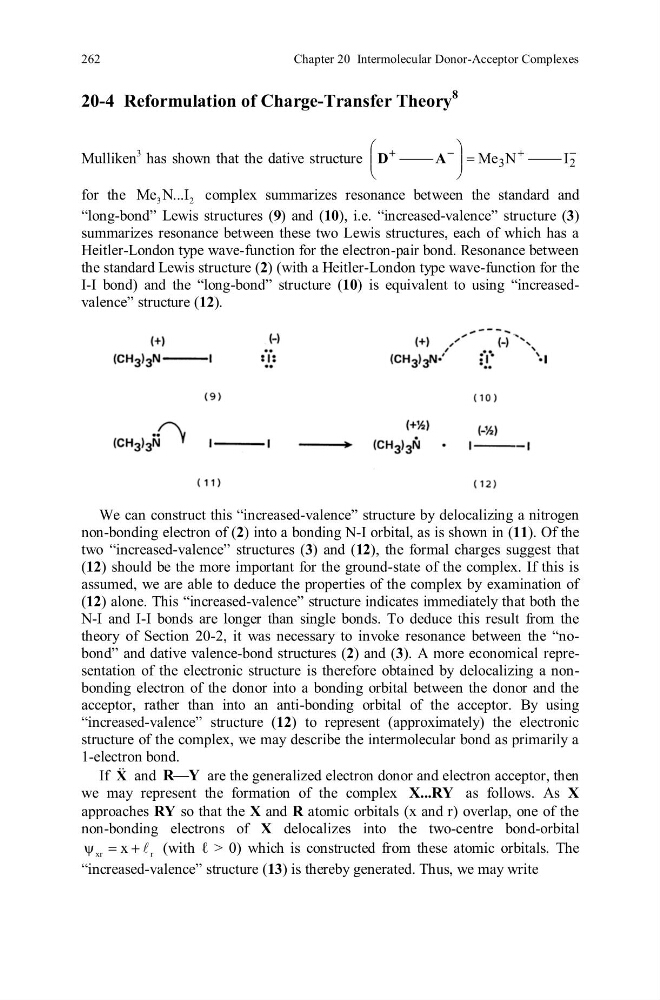
“long-bond” Lewis structures (9) and (10), i.e. “increased-valence” structure (3)
summarizes resonance between these two Lewis structures, each of which has a
Heitler-London type wave-function for the electron-pair bond. Resonance between
the standard Lewis structure (2) (with a Heitler-London type wave-function for the
I-I bond) and the “long-bond” structure (10) is equivalent to using “increasedvalence” structure (12).
We can construct this “increased-valence” structure by delocalizing a nitrogen
non-bonding electron of (2) into a bonding N-I orbital, as is shown in (11). Of the
two “increased-valence” structures (3) and (12), the formal charges suggest that
(12) should be the more important for the ground-state of the complex. If this is
assumed, we are able to deduce the properties of the complex by examination of
(12) alone. This “increased-valence” structure indicates immediately that both the
N-I and I-I bonds are longer than single bonds. To deduce this result from the
theory of Section 20-2, it was necessary to invoke resonance between the “nobond” and dative valence-bond structures (2) and (3). A more economical representation of the electronic structure is therefore obtained by delocalizing a nonbonding electron of the donor into a bonding orbital between the donor and the
acceptor, rather than into an anti-bonding orbital of the acceptor. By using
“increased-valence” structure (12) to represent (approximately) the electronic
structure of the complex, we may describe the intermolecular bond as primarily a
1-electron bond.
If
X and R—Y are the generalized electron donor and electron acceptor, then
we may represent the formation of the complex X...RY as follows. As X
approaches RY so that the X and R atomic orbitals (x and r) overlap, one of the
non-bonding electrons of X delocalizes into the two-centre bond-orbital
xr
r
x
(with ℓ > 0) which is constructed from these atomic orbitals. The
“increased-valence” structure (13) is thereby generated. Thus, we may write
Chapter 20 Intermolecular Donor-Acceptor Complexes
20-4 Reformulation of Charge-Transfer Theory
8
Mulliken
3 has shown that the dative structure
2
3
I
N
Me
A
D
for the
3
2
Me N...I complex summarizes resonance between the standard and
“long-bond” Lewis structures (9) and (10), i.e. “increased-valence” structure (3)
summarizes resonance between these two Lewis structures, each of which has a
Heitler-London type wave-function for the electron-pair bond. Resonance between
the standard Lewis structure (2) (with a Heitler-London type wave-function for the
I-I bond) and the “long-bond” structure (10) is equivalent to using “increasedvalence” structure (12).
We can construct this “increased-valence” structure by delocalizing a nitrogen
non-bonding electron of (2) into a bonding N-I orbital, as is shown in (11). Of the
two “increased-valence” structures (3) and (12), the formal charges suggest that
(12) should be the more important for the ground-state of the complex. If this is
assumed, we are able to deduce the properties of the complex by examination of
(12) alone. This “increased-valence” structure indicates immediately that both the
N-I and I-I bonds are longer than single bonds. To deduce this result from the
theory of Section 20-2, it was necessary to invoke resonance between the “nobond” and dative valence-bond structures (2) and (3). A more economical representation of the electronic structure is therefore obtained by delocalizing a nonbonding electron of the donor into a bonding orbital between the donor and the
acceptor, rather than into an anti-bonding orbital of the acceptor. By using
“increased-valence” structure (12) to represent (approximately) the electronic
structure of the complex, we may describe the intermolecular bond as primarily a
1-electron bond.
If
X and R—Y are the generalized electron donor and electron acceptor, then
we may represent the formation of the complex X...RY as follows. As X
approaches RY so that the X and R atomic orbitals (x and r) overlap, one of the
non-bonding electrons of X delocalizes into the two-centre bond-orbital
xr
r
x
(with ℓ > 0) which is constructed from these atomic orbitals. The
“increased-valence” structure (13) is thereby generated. Thus, we may write