

20-3
Hydrogen Bonding Between two H2O Molecules
261
20-3 Hydrogen Bonding Between two H 2 O Molecules
In the vapour, free H 2 O molecules have O-H bond-lengths of 0.976 Å. When H 2 O
molecules associate to form clusters in the gaseous, liquid or solid states, these OH bonds lengthen and weaken a little, and the intermolecular O-H hydrogen bonds
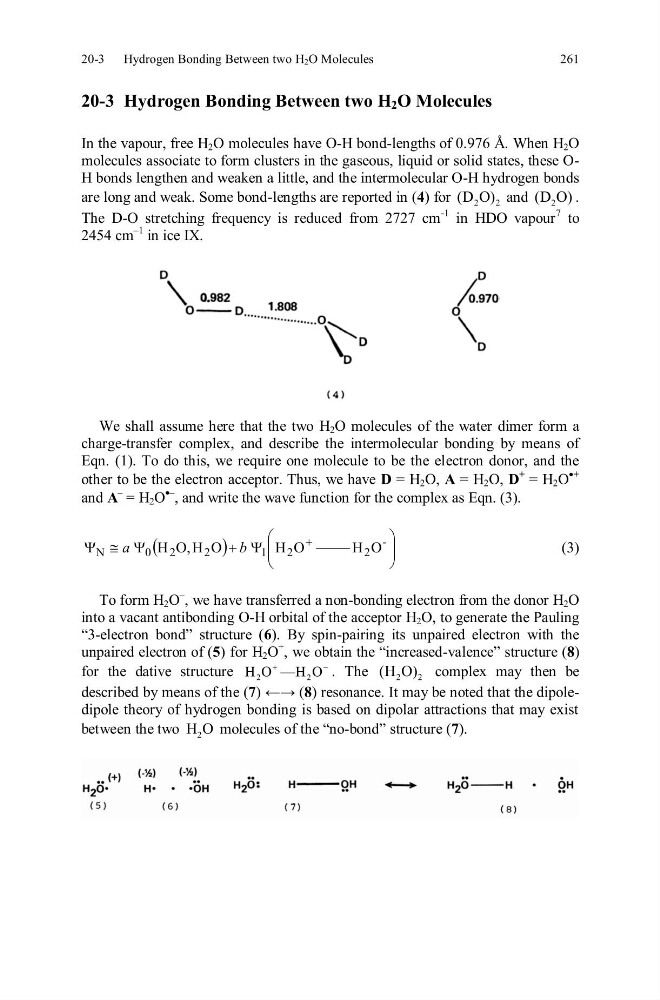
are long and weak. Some bond-lengths are reported in (4) for
2
2
(D O) and 2
(D O) .
The D-O stretching frequency is reduced from 2727 cm
-1 in HDO vapour
7 to
2454 cm
–1 in ice IX.
We shall assume here that the two H 2 O molecules of the water dimer form a
charge-transfer complex, and describe the intermolecular bonding by means of
Eqn. (1). To do this, we require one molecule to be the electron donor, and the
other to be the electron acceptor. Thus, we have D = H 2 O, A = H 2 O, D
+ = H 2 O
+
and A
– = H 2 O
– , and write the wave function for the complex as Eqn. (3).
-
2
2
1
2
2
0
N
O
H
O
H
O
H
O,
H
b
a
(3)
To form H 2 O
– , we have transferred a non-bonding electron from the donor H 2 O
into a vacant antibonding O-H orbital of the acceptor H 2 O, to generate the Pauling
“3-electron bond” structure (6). By spin-pairing its unpaired electron with the
unpaired electron of (5) for H 2 O
+
, we obtain the “increased-valence” structure (8)
for the dative structure
2
2
H O —H O
. The
2
2
(H O) complex may then be
described by means of the (7) ←→ (8) resonance. It may be noted that the dipoledipole theory of hydrogen bonding is based on dipolar attractions that may exist
between the two 2
H O molecules of the “no-bond” structure (7).
Hydrogen Bonding Between two H2O Molecules
261
20-3 Hydrogen Bonding Between two H 2 O Molecules
In the vapour, free H 2 O molecules have O-H bond-lengths of 0.976 Å. When H 2 O
molecules associate to form clusters in the gaseous, liquid or solid states, these OH bonds lengthen and weaken a little, and the intermolecular O-H hydrogen bonds
are long and weak. Some bond-lengths are reported in (4) for
2
2
(D O) and 2
(D O) .
The D-O stretching frequency is reduced from 2727 cm
-1 in HDO vapour
7 to
2454 cm
–1 in ice IX.
We shall assume here that the two H 2 O molecules of the water dimer form a
charge-transfer complex, and describe the intermolecular bonding by means of
Eqn. (1). To do this, we require one molecule to be the electron donor, and the
other to be the electron acceptor. Thus, we have D = H 2 O, A = H 2 O, D
+ = H 2 O
+
and A
– = H 2 O
– , and write the wave function for the complex as Eqn. (3).
-
2
2
1
2
2
0
N
O
H
O
H
O
H
O,
H
b
a
(3)
To form H 2 O
– , we have transferred a non-bonding electron from the donor H 2 O
into a vacant antibonding O-H orbital of the acceptor H 2 O, to generate the Pauling
“3-electron bond” structure (6). By spin-pairing its unpaired electron with the
unpaired electron of (5) for H 2 O
+
, we obtain the “increased-valence” structure (8)
for the dative structure
2
2
H O —H O
. The
2
2
(H O) complex may then be
described by means of the (7) ←→ (8) resonance. It may be noted that the dipoledipole theory of hydrogen bonding is based on dipolar attractions that may exist
between the two 2
H O molecules of the “no-bond” structure (7).