

260
Chapter 20 Intermolecular Donor-Acceptor Complexes
to an “increased-valence” structure. We shall now describe two examples which
illustrate this type of bonding scheme. In Section 20-4, we shall examine an
alternative procedure that may be used to describe such complexes.
20-2 Complexing of Trimethylamine with Molecular Iodine
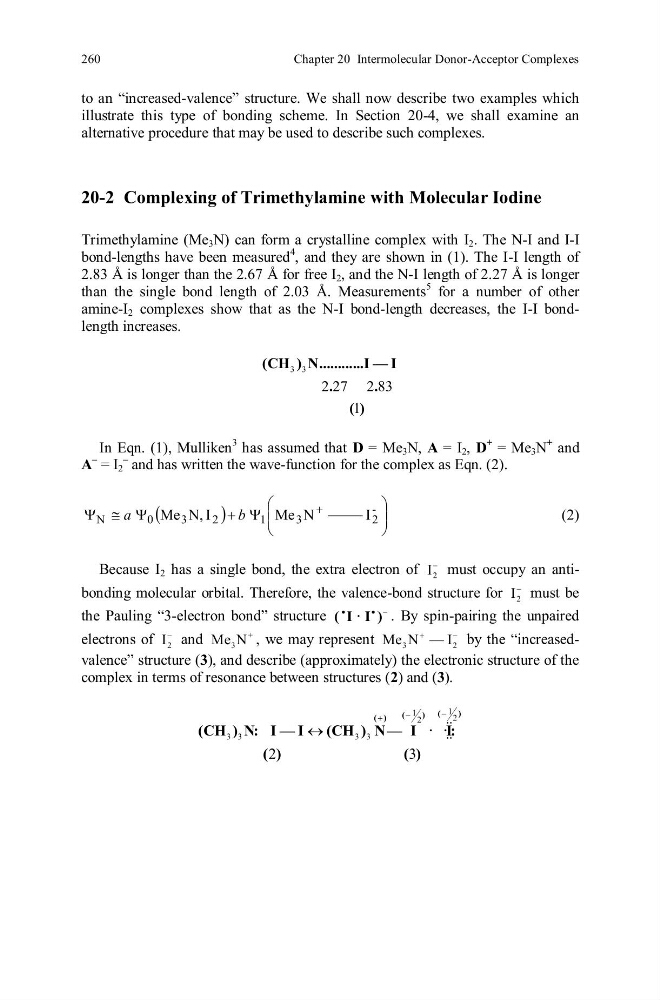
Trimethylamine (Me 3 N) can form a crystalline complex with I 2 . The N-I and I-I
bond-lengths have been measured
4
, and they are shown in (1). The I-I length of
2.83 Å is longer than the 2.67 Å for free I 2 , and the N-I length of 2.27 Å is longer
than the single bond length of 2.03 Å. Measurements
5 for a number of other
amine-I 2 complexes show that as the N-I bond-length decreases, the I-I bondlength increases.
3 3
2 27 2 83
1
(CH ) N............I — I
.
.
( )
In Eqn. (1), Mulliken
3 has assumed that D = Me 3 N, A = I 2 , D
+ = Me 3 N
+ and
A
– = I 2
– and has written the wave-function for the complex as Eqn. (2).
-
2
3
1
2
3
0
N
I
N
Me
I
N,
Me
b
a
(2)
Because I 2 has a single bond, the extra electron of 2
I
must occupy an antibonding molecular orbital. Therefore, the valence-bond structure for 2
I
must be
the Pauling “3-electron bond” structure
( I · I ) . By spin-pairing the unpaired
electrons of 2
I
and
+
3
Me N , we may represent
3
2
Me N — I
by the “increasedvalence” structure (3), and describe (approximately) the electronic structure of the
complex in terms of resonance between structures (2) and (3).
1
1
2
2
3 3
3 3
2
3
(
)
(
)
( )
(CH ) N: I — I
(CH ) N — I · ·I:
( )
( )
Chapter 20 Intermolecular Donor-Acceptor Complexes
to an “increased-valence” structure. We shall now describe two examples which
illustrate this type of bonding scheme. In Section 20-4, we shall examine an
alternative procedure that may be used to describe such complexes.
20-2 Complexing of Trimethylamine with Molecular Iodine
Trimethylamine (Me 3 N) can form a crystalline complex with I 2 . The N-I and I-I
bond-lengths have been measured
4
, and they are shown in (1). The I-I length of
2.83 Å is longer than the 2.67 Å for free I 2 , and the N-I length of 2.27 Å is longer
than the single bond length of 2.03 Å. Measurements
5 for a number of other
amine-I 2 complexes show that as the N-I bond-length decreases, the I-I bondlength increases.
3 3
2 27 2 83
1
(CH ) N............I — I
.
.
( )
In Eqn. (1), Mulliken
3 has assumed that D = Me 3 N, A = I 2 , D
+ = Me 3 N
+ and
A
– = I 2
– and has written the wave-function for the complex as Eqn. (2).
-
2
3
1
2
3
0
N
I
N
Me
I
N,
Me
b
a
(2)
Because I 2 has a single bond, the extra electron of 2
I
must occupy an antibonding molecular orbital. Therefore, the valence-bond structure for 2
I
must be
the Pauling “3-electron bond” structure
( I · I ) . By spin-pairing the unpaired
electrons of 2
I
and
+
3
Me N , we may represent
3
2
Me N — I
by the “increasedvalence” structure (3), and describe (approximately) the electronic structure of the
complex in terms of resonance between structures (2) and (3).
1
1
2
2
3 3
3 3
2
3
(
)
(
)
( )
(CH ) N: I — I
(CH ) N — I · ·I:
( )
( )