

Chapter 20 Intermolecular Donor-Acceptor
Complexes
20-1 Quantum Mechanical Description of Donor-Acceptor
Complexes
Mulliken
1–3 has provided a quantum mechanical description of molecular complexes that are formed by reaction between an electron-donor (D) and an electron
acceptor (A). The wave-function for the normal or ground-state of the complex
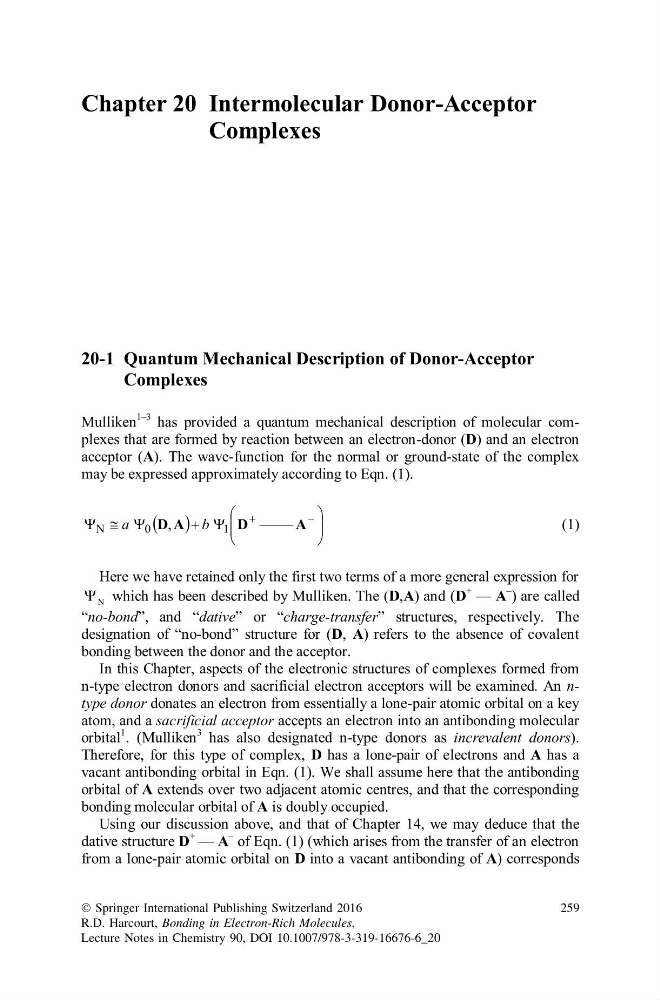
may be expressed approximately according to Eqn. (1).
A
D
A
D
1
0
N
,
b
a
(1)
Here we have retained only the first two terms of a more general expression for
N
which has been described by Mulliken. The (D,A) and (D
+ –– A
– ) are called
“no-bond”, and “dative” or “charge-transfer” structures, respectively. The
designation of “no-bond” structure for (D, A) refers to the absence of covalent
bonding between the donor and the acceptor.
In this Chapter, aspects of the electronic structures of complexes formed from
n-type electron donors and sacrificial electron acceptors will be examined. An ntype donor donates an electron from essentially a lone-pair atomic orbital on a key
atom, and a sacrificial acceptor accepts an electron into an antibonding molecular
orbital
1 . (Mulliken
3 has also designated n-type donors as increvalent donors).
Therefore, for this type of complex, D has a lone-pair of electrons and A has a
vacant antibonding orbital in Eqn. (1). We shall assume here that the antibonding
orbital of A extends over two adjacent atomic centres, and that the corresponding
bonding molecular orbital of A is doubly occupied.
Using our discussion above, and that of Chapter 14, we may deduce that the
dative structure D
+ –– A
– of Eqn. (1) (which arises from the transfer of an electron
from a lone-pair atomic orbital on D into a vacant antibonding of A) corresponds
Ó Springer International Publishing Switzerland 2016
R.D. Harcourt, Bonding in Electron-Rich Molecules,
Lecture Notes in Chemistry 90, DOI 10.1007/978-3-319-16676-6_20
259
Complexes
20-1 Quantum Mechanical Description of Donor-Acceptor
Complexes
Mulliken
1–3 has provided a quantum mechanical description of molecular complexes that are formed by reaction between an electron-donor (D) and an electron
acceptor (A). The wave-function for the normal or ground-state of the complex
may be expressed approximately according to Eqn. (1).
A
D
A
D
1
0
N
,
b
a
(1)
Here we have retained only the first two terms of a more general expression for
N
which has been described by Mulliken. The (D,A) and (D
+ –– A
– ) are called
“no-bond”, and “dative” or “charge-transfer” structures, respectively. The
designation of “no-bond” structure for (D, A) refers to the absence of covalent
bonding between the donor and the acceptor.
In this Chapter, aspects of the electronic structures of complexes formed from
n-type electron donors and sacrificial electron acceptors will be examined. An ntype donor donates an electron from essentially a lone-pair atomic orbital on a key
atom, and a sacrificial acceptor accepts an electron into an antibonding molecular
orbital
1 . (Mulliken
3 has also designated n-type donors as increvalent donors).
Therefore, for this type of complex, D has a lone-pair of electrons and A has a
vacant antibonding orbital in Eqn. (1). We shall assume here that the antibonding
orbital of A extends over two adjacent atomic centres, and that the corresponding
bonding molecular orbital of A is doubly occupied.
Using our discussion above, and that of Chapter 14, we may deduce that the
dative structure D
+ –– A
– of Eqn. (1) (which arises from the transfer of an electron
from a lone-pair atomic orbital on D into a vacant antibonding of A) corresponds
Ó Springer International Publishing Switzerland 2016
R.D. Harcourt, Bonding in Electron-Rich Molecules,
Lecture Notes in Chemistry 90, DOI 10.1007/978-3-319-16676-6_20
259