

266
Chapter 20 Intermolecular Donor-Acceptor Complexes
(cf. structures (18) and (19) for 5 2
H O
), with both structures having equal weights
and equal H-F bond-lengths when the
2
HF
is located in a symmetrical environment. Williams and Schneemeyer
10 have reported the geometries of (28) and (29)
for
2
HF
and
2
HCl
in non-symmetrical environments. Each of the bond-lengths is
longer than the single-bond lengths of 0.92 and 1.27 Å for gaseous HF and HCl.
“Increased-valence” structures of type (26) alone (with unequal bond-lengths) are
compatible with the observed bond-lengths for both anions, although of course
(26) will be stabilized by resonance with (27). The latter structure will have the
smaller weight.
The anion HOHOH
is isoelectronic with 5 2
H O
and
2
HF
, and a suitable
valence-bond structure for it is similar to structure (25), with OH replacing F, i.e.
1
1
2
2
(
)
(
)
· ·
· ·
H O · H · O H . The bridging O-H bonds of 5 2
H O
and HOHOH
have been
estimated to have similar lengths and strengths
11
.
Firestone
12 has also used Linnett structures to describe the electronic structures
of symmetrical hydrogen-bonded molecules.
20-7 2:1 Donor-Acceptor Complexes
Two molecules of acetone or dioxan can interact with one molecule of 2
Br to form
the intermolecular complexes
2
2
2
Me CO....Br ....OCMe and 5 10
2
5 10
C H O....Br ....OC H .
The reported Br-Br lengths
4 of 2.28 Å and 2.31 Å are not sufficiently different
from the length of 2.28 Å for free 2
Br to indicate much interaction of 2
Br with
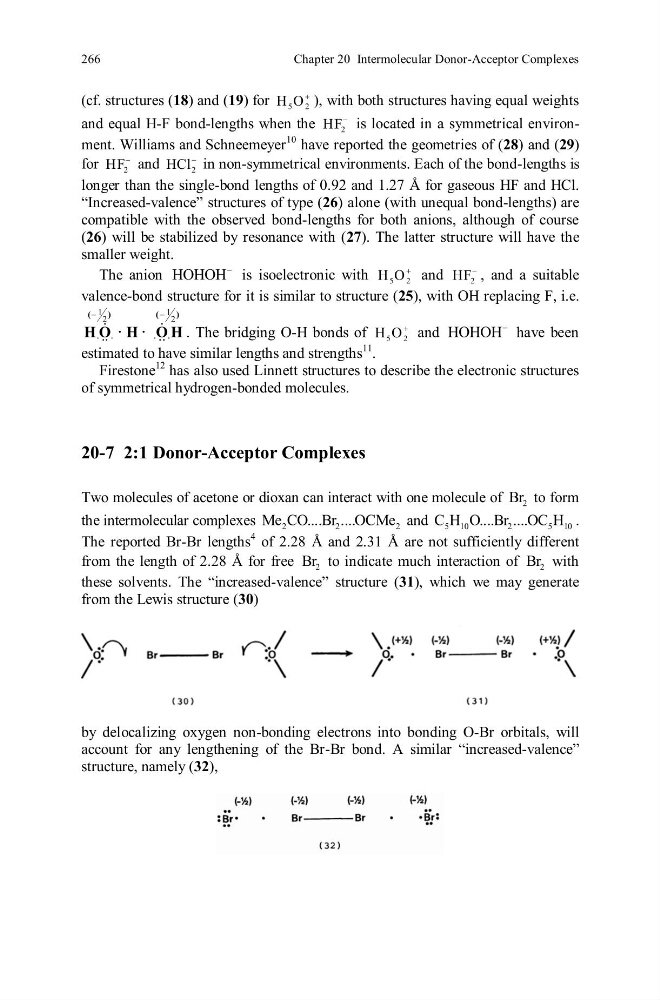
these solvents. The “increased-valence” structure (31), which we may generate
from the Lewis structure (30)
by delocalizing oxygen non-bonding electrons into bonding O-Br orbitals, will
account for any lengthening of the Br-Br bond. A similar “increased-valence”
structure, namely (32),
Chapter 20 Intermolecular Donor-Acceptor Complexes
(cf. structures (18) and (19) for 5 2
H O
), with both structures having equal weights
and equal H-F bond-lengths when the
2
HF
is located in a symmetrical environment. Williams and Schneemeyer
10 have reported the geometries of (28) and (29)
for
2
HF
and
2
HCl
in non-symmetrical environments. Each of the bond-lengths is
longer than the single-bond lengths of 0.92 and 1.27 Å for gaseous HF and HCl.
“Increased-valence” structures of type (26) alone (with unequal bond-lengths) are
compatible with the observed bond-lengths for both anions, although of course
(26) will be stabilized by resonance with (27). The latter structure will have the
smaller weight.
The anion HOHOH
is isoelectronic with 5 2
H O
and
2
HF
, and a suitable
valence-bond structure for it is similar to structure (25), with OH replacing F, i.e.
1
1
2
2
(
)
(
)
· ·
· ·
H O · H · O H . The bridging O-H bonds of 5 2
H O
and HOHOH
have been
estimated to have similar lengths and strengths
11
.
Firestone
12 has also used Linnett structures to describe the electronic structures
of symmetrical hydrogen-bonded molecules.
20-7 2:1 Donor-Acceptor Complexes
Two molecules of acetone or dioxan can interact with one molecule of 2
Br to form
the intermolecular complexes
2
2
2
Me CO....Br ....OCMe and 5 10
2
5 10
C H O....Br ....OC H .
The reported Br-Br lengths
4 of 2.28 Å and 2.31 Å are not sufficiently different
from the length of 2.28 Å for free 2
Br to indicate much interaction of 2
Br with
these solvents. The “increased-valence” structure (31), which we may generate
from the Lewis structure (30)
by delocalizing oxygen non-bonding electrons into bonding O-Br orbitals, will
account for any lengthening of the Br-Br bond. A similar “increased-valence”
structure, namely (32),