

254
Chapter 19 Some Electron-Excess σ Bonded Systems
19-4 ClF 5 and SF 6
Table 19-1: Axial and equatorial bond-lengths (Å) for AF5 molecules.
ax
(A – F )
r
eq
(A F )
r
ax
(A – F )
r
eq
(A F )
r
5
ClF
i
1.571
1.669
2
5
SbF
ii
1.916
2.075
5
BrF
iii
1.699
1.768
5
TeF
iv
1.862
1.952
5
IF
v, vi
1.834
1.868
5
XeF
vii, viii
1.813
1.843
1.817
1.873
1.793
1.845 (av)
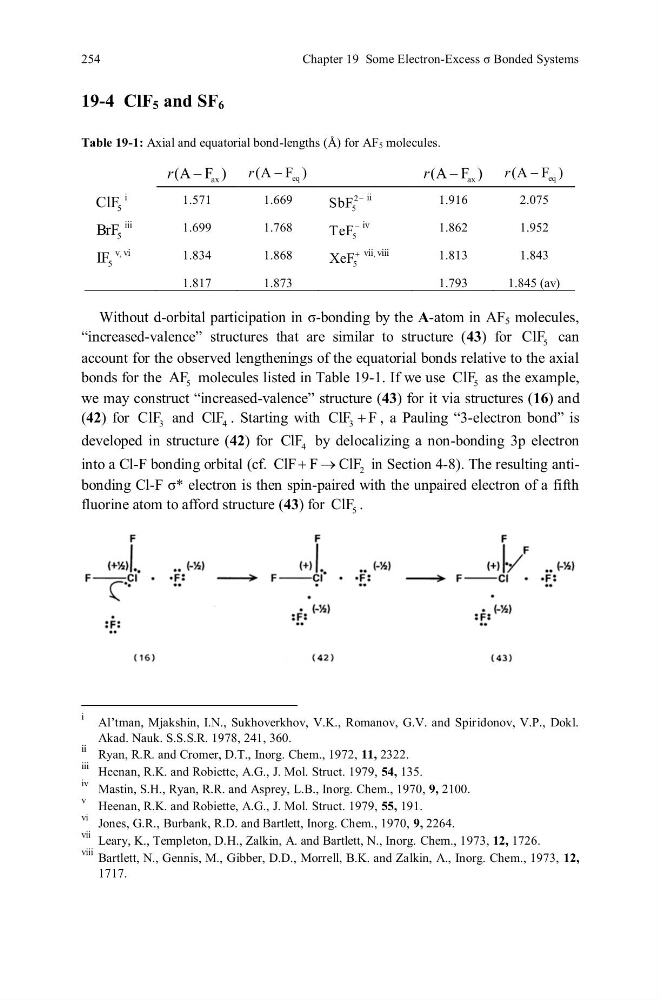
Without d-orbital participation in σ-bonding by the A-atom in AF 5 molecules,
“increased-valence” structures that are similar to structure (43) for
5
ClF can
account for the observed lengthenings of the equatorial bonds relative to the axial
bonds for the
5
AF molecules listed in Table 19-1. If we use
5
ClF as the example,
we may construct “increased-valence” structure (43) for it via structures (16) and
(42) for
3
ClF and
4
ClF . Starting with
3
ClF F
, a Pauling “3-electron bond” is
developed in structure (42) for
4
ClF by delocalizing a non-bonding 3p electron
into a Cl-F bonding orbital (cf.
2
ClF F ClF
in Section 4-8). The resulting antibonding Cl-F σ* electron is then spin-paired with the unpaired electron of a fifth
fluorine atom to afford structure (43) for
5
ClF .
i Al’tman, Mjakshin, I.N., Sukhoverkhov, V.K., Romanov, G.V. and Spiridonov, V.P., Dokl.
Akad. Nauk. S.S.S.R. 1978, 241, 360.
ii Ryan, R.R. and Cromer, D.T., Inorg. Chem., 1972, 11, 2322.
iii Heenan, R.K. and Robiette, A.G., J. Mol. Struct. 1979, 54, 135.
iv Mastin, S.H., Ryan, R.R. and Asprey, L.B., Inorg. Chem., 1970, 9, 2100.
v Heenan, R.K. and Robiette, A.G., J. Mol. Struct. 1979, 55, 191.
vi Jones, G.R., Burbank, R.D. and Bartlett, Inorg. Chem., 1970, 9, 2264.
vii Leary, K., Templeton, D.H., Zalkin, A. and Bartlett, N., Inorg. Chem., 1973, 12, 1726.
viii Bartlett, N., Gennis, M., Gibber, D.D., Morrell, B.K. and Zalkin, A., Inorg. Chem., 1973, 12,
1717.
Chapter 19 Some Electron-Excess σ Bonded Systems
19-4 ClF 5 and SF 6
Table 19-1: Axial and equatorial bond-lengths (Å) for AF5 molecules.
ax
(A – F )
r
eq
(A F )
r
ax
(A – F )
r
eq
(A F )
r
5
ClF
i
1.571
1.669
2
5
SbF
ii
1.916
2.075
5
BrF
iii
1.699
1.768
5
TeF
iv
1.862
1.952
5
IF
v, vi
1.834
1.868
5
XeF
vii, viii
1.813
1.843
1.817
1.873
1.793
1.845 (av)
Without d-orbital participation in σ-bonding by the A-atom in AF 5 molecules,
“increased-valence” structures that are similar to structure (43) for
5
ClF can
account for the observed lengthenings of the equatorial bonds relative to the axial
bonds for the
5
AF molecules listed in Table 19-1. If we use
5
ClF as the example,
we may construct “increased-valence” structure (43) for it via structures (16) and
(42) for
3
ClF and
4
ClF . Starting with
3
ClF F
, a Pauling “3-electron bond” is
developed in structure (42) for
4
ClF by delocalizing a non-bonding 3p electron
into a Cl-F bonding orbital (cf.
2
ClF F ClF
in Section 4-8). The resulting antibonding Cl-F σ* electron is then spin-paired with the unpaired electron of a fifth
fluorine atom to afford structure (43) for
5
ClF .
i Al’tman, Mjakshin, I.N., Sukhoverkhov, V.K., Romanov, G.V. and Spiridonov, V.P., Dokl.
Akad. Nauk. S.S.S.R. 1978, 241, 360.
ii Ryan, R.R. and Cromer, D.T., Inorg. Chem., 1972, 11, 2322.
iii Heenan, R.K. and Robiette, A.G., J. Mol. Struct. 1979, 54, 135.
iv Mastin, S.H., Ryan, R.R. and Asprey, L.B., Inorg. Chem., 1970, 9, 2100.
v Heenan, R.K. and Robiette, A.G., J. Mol. Struct. 1979, 55, 191.
vi Jones, G.R., Burbank, R.D. and Bartlett, Inorg. Chem., 1970, 9, 2264.
vii Leary, K., Templeton, D.H., Zalkin, A. and Bartlett, N., Inorg. Chem., 1973, 12, 1726.
viii Bartlett, N., Gennis, M., Gibber, D.D., Morrell, B.K. and Zalkin, A., Inorg. Chem., 1973, 12,
1717.