

19-4
ClF5 and SF6
255
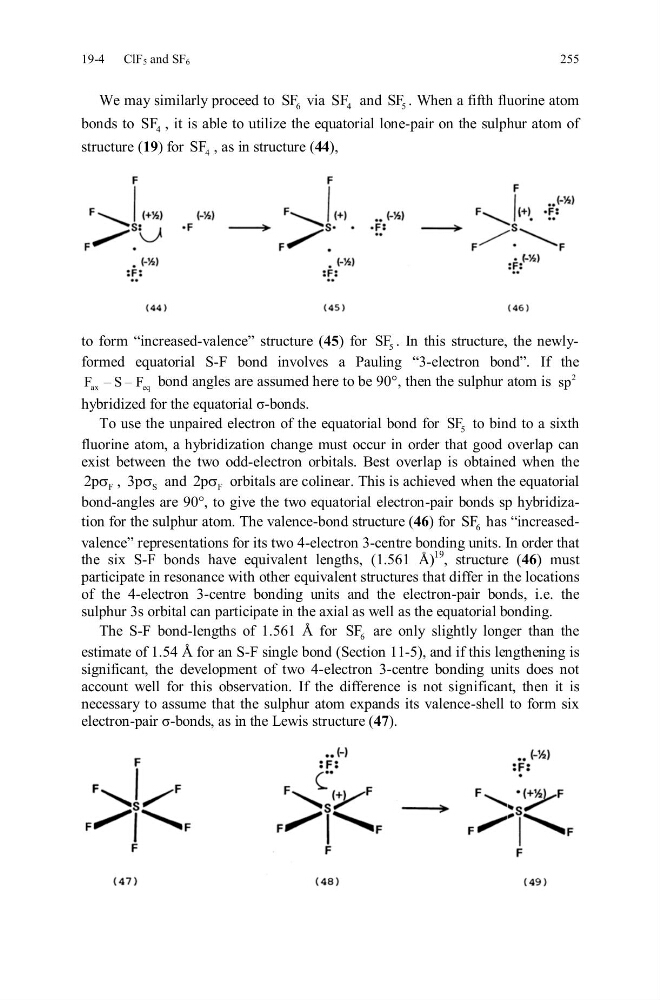
We may similarly proceed to 6
SF via 4
SF and 5
SF . When a fifth fluorine atom
bonds to 4
SF , it is able to utilize the equatorial lone-pair on the sulphur atom of
structure (19) for 4
SF , as in structure (44),
to form “increased-valence” structure (45) for 5
SF . In this structure, the newlyformed equatorial S-F bond involves a Pauling “3-electron bond”. If the
ax
eq
F – S – F bond angles are assumed here to be 90°, then the sulphur atom is
2
sp
hybridized for the equatorial σ-bonds.
To use the unpaired electron of the equatorial bond for 5
SF to bind to a sixth
fluorine atom, a hybridization change must occur in order that good overlap can
exist between the two odd-electron orbitals. Best overlap is obtained when the
F
2p ,
S
3p and
F
2p orbitals are colinear. This is achieved when the equatorial
bond-angles are 90°, to give the two equatorial electron-pair bonds sp hybridization for the sulphur atom. The valence-bond structure (46) for 6
SF has “increasedvalence” representations for its two 4-electron 3-centre bonding units. In order that
the six S-F bonds have equivalent lengths, (1.561 Å)
19
, structure (46) must
participate in resonance with other equivalent structures that differ in the locations
of the 4-electron 3-centre bonding units and the electron-pair bonds, i.e. the
sulphur 3s orbital can participate in the axial as well as the equatorial bonding.
The S-F bond-lengths of 1.561 Å for
6
SF are only slightly longer than the
estimate of 1.54 Å for an S-F single bond (Section 11-5), and if this lengthening is
significant, the development of two 4-electron 3-centre bonding units does not
account well for this observation. If the difference is not significant, then it is
necessary to assume that the sulphur atom expands its valence-shell to form six
electron-pair σ-bonds, as in the Lewis structure (47).
ClF5 and SF6
255
We may similarly proceed to 6
SF via 4
SF and 5
SF . When a fifth fluorine atom
bonds to 4
SF , it is able to utilize the equatorial lone-pair on the sulphur atom of
structure (19) for 4
SF , as in structure (44),
to form “increased-valence” structure (45) for 5
SF . In this structure, the newlyformed equatorial S-F bond involves a Pauling “3-electron bond”. If the
ax
eq
F – S – F bond angles are assumed here to be 90°, then the sulphur atom is
2
sp
hybridized for the equatorial σ-bonds.
To use the unpaired electron of the equatorial bond for 5
SF to bind to a sixth
fluorine atom, a hybridization change must occur in order that good overlap can
exist between the two odd-electron orbitals. Best overlap is obtained when the
F
2p ,
S
3p and
F
2p orbitals are colinear. This is achieved when the equatorial
bond-angles are 90°, to give the two equatorial electron-pair bonds sp hybridization for the sulphur atom. The valence-bond structure (46) for 6
SF has “increasedvalence” representations for its two 4-electron 3-centre bonding units. In order that
the six S-F bonds have equivalent lengths, (1.561 Å)
19
, structure (46) must
participate in resonance with other equivalent structures that differ in the locations
of the 4-electron 3-centre bonding units and the electron-pair bonds, i.e. the
sulphur 3s orbital can participate in the axial as well as the equatorial bonding.
The S-F bond-lengths of 1.561 Å for
6
SF are only slightly longer than the
estimate of 1.54 Å for an S-F single bond (Section 11-5), and if this lengthening is
significant, the development of two 4-electron 3-centre bonding units does not
account well for this observation. If the difference is not significant, then it is
necessary to assume that the sulphur atom expands its valence-shell to form six
electron-pair σ-bonds, as in the Lewis structure (47).