

240
Chapter 18 Transition Metal Complexes with CO, N2, NO and O2 Ligands
Each of the Fe(II) ions of hemoglobin has four unpaired electrons with parallel
spins in the ground-state, and therefore the molecule is paramagnetic
12 . The six
electrons of an Fe
2+ ion have the orbital occupations displayed in Fig. 5-1 for highspin S = 2 spin-states. Because five ligand nitrogen atoms of structure (31) can
coordinate to the high-spin
2
Fe
, and there are only four vacant orbitals (4s and
4p) for this ion, hemoglobin is an example of a hypoligated complex (Section
5-1). The bonding of the four nitrogen atoms of porphyrin to the iron may be
described by utilizing three electron-pair bonds and a Pauling “3-electron bond”.
The remaining vacant orbital of
2
Fe
may be used to form an Fe-N single bond
between
2
Fe
and the nitrogen atom of the proximal histidine of structure (31).
Resonance between the four valence-bond structures of type (32) therefore
provides a valence-bond description of the Fe-N bonding for each heme group of
hemoglobin.
When four oxygen molecules bind to the four iron atoms of hemoglobin,
oxyhemoglobin is formed. Magnetic susceptibility measurements
13, 14 indicate that
each
2
Fe(II)O linkage of oxyhemoglobin is diamagnetic at room temperature, i.e.
no unpaired electron spins are present. (It may be noted that magnetic susceptibility measurements
15 through the temperature range of 25-250 K indicate that
although the ground-state is an S = 0 spin state, antiferromagnetic rather than
diamagnetic behaviour occurs as the temperature is raised above 50 K. However,
the experimental basis for this work was questioned
14 .) Here we shall describe
some bonding theories for the S = 0 spin ground-state of each
2
Fe(II)O linkage.
Similar theories are also appropriate for oxymyoglobin with one
2
Fe(II)O linkage,
and the “picket fence” Fe(II) oxygen carriers.
To account for the diamagnetism of oxyhemoglobin, in 1936 Pauling and
Coryell
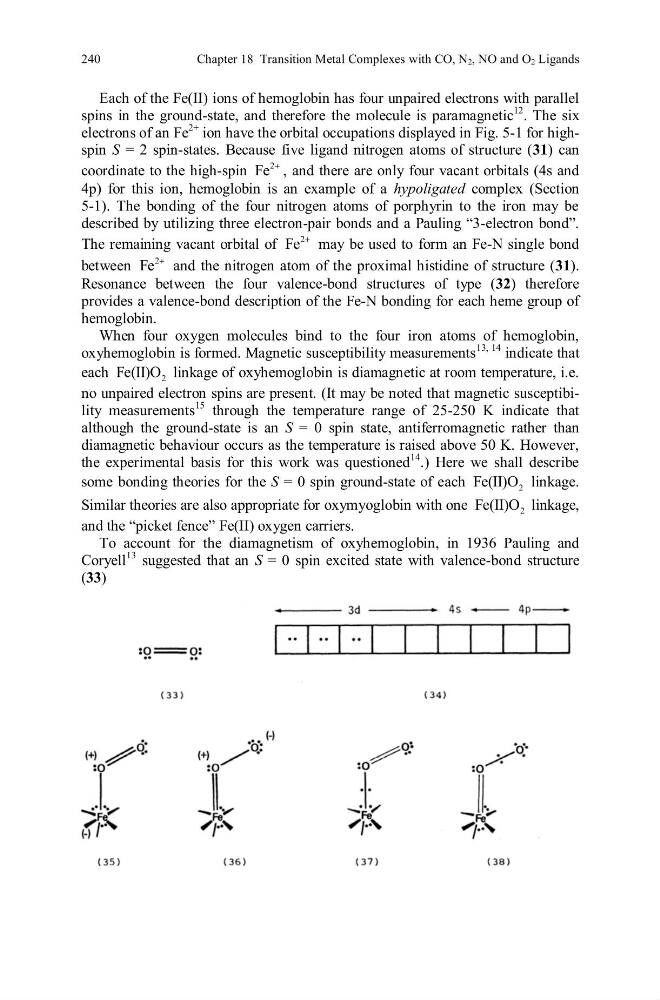
13 suggested that an S = 0 spin excited state with valence-bond structure
(33)
Chapter 18 Transition Metal Complexes with CO, N2, NO and O2 Ligands
Each of the Fe(II) ions of hemoglobin has four unpaired electrons with parallel
spins in the ground-state, and therefore the molecule is paramagnetic
12 . The six
electrons of an Fe
2+ ion have the orbital occupations displayed in Fig. 5-1 for highspin S = 2 spin-states. Because five ligand nitrogen atoms of structure (31) can
coordinate to the high-spin
2
Fe
, and there are only four vacant orbitals (4s and
4p) for this ion, hemoglobin is an example of a hypoligated complex (Section
5-1). The bonding of the four nitrogen atoms of porphyrin to the iron may be
described by utilizing three electron-pair bonds and a Pauling “3-electron bond”.
The remaining vacant orbital of
2
Fe
may be used to form an Fe-N single bond
between
2
Fe
and the nitrogen atom of the proximal histidine of structure (31).
Resonance between the four valence-bond structures of type (32) therefore
provides a valence-bond description of the Fe-N bonding for each heme group of
hemoglobin.
When four oxygen molecules bind to the four iron atoms of hemoglobin,
oxyhemoglobin is formed. Magnetic susceptibility measurements
13, 14 indicate that
each
2
Fe(II)O linkage of oxyhemoglobin is diamagnetic at room temperature, i.e.
no unpaired electron spins are present. (It may be noted that magnetic susceptibility measurements
15 through the temperature range of 25-250 K indicate that
although the ground-state is an S = 0 spin state, antiferromagnetic rather than
diamagnetic behaviour occurs as the temperature is raised above 50 K. However,
the experimental basis for this work was questioned
14 .) Here we shall describe
some bonding theories for the S = 0 spin ground-state of each
2
Fe(II)O linkage.
Similar theories are also appropriate for oxymyoglobin with one
2
Fe(II)O linkage,
and the “picket fence” Fe(II) oxygen carriers.
To account for the diamagnetism of oxyhemoglobin, in 1936 Pauling and
Coryell
13 suggested that an S = 0 spin excited state with valence-bond structure
(33)