

18-4
Dioxygenyl Adducts
239
paired. However, it seems easier to generate structure (25) by assuming that free
NO radicals rather than NO
and NO
are the valence-states for the ligands.
Further examples of “increased-valence” descriptions for transition-metal
nitrosyls are provided in Ref. 10.
18-4 Dioxygenyl Adducts
Many transition metal complexes form adducts with molecular oxygen. Those that
combine reversibly with O 2 are designated as oxygen carriers; adducts in which
O 2 is absorbed irreversibly are also known. Here, we shall provide “increasedvalence” descriptions for some reversible Fe(II) and Co(II) dioxygenyl adducts,
thereby contrasting different formulations for the oxidation state of the metal ion
that have been proposed for these types of complexes.
18-4(a) Oxyhemoglobin
Hemoglobin (Hb) transports O 2 from the lungs to the tissues of the body. At high
pressures in the lungs, O 2 combines with the iron atoms of hemoglobin, and is released into the body tissues at low pressures.
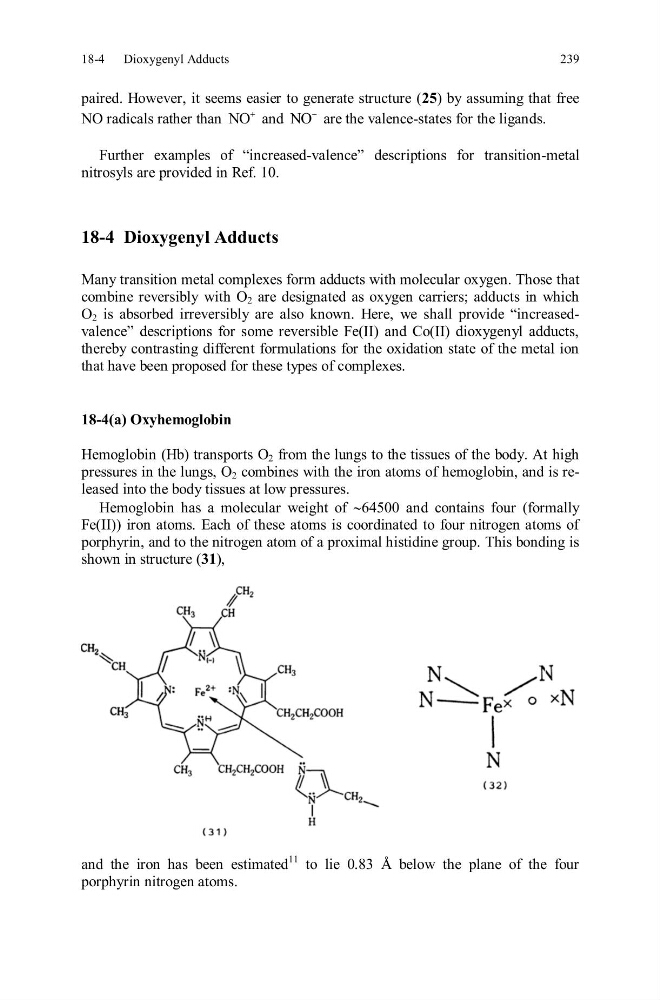
Hemoglobin has a molecular weight of 64500 and contains four (formally
Fe(II)) iron atoms. Each of these atoms is coordinated to four nitrogen atoms of
porphyrin, and to the nitrogen atom of a proximal histidine group. This bonding is
shown in structure (31),
and the iron has been estimated
11 to lie 0.83 Å below the plane of the four
porphyrin nitrogen atoms.
Dioxygenyl Adducts
239
paired. However, it seems easier to generate structure (25) by assuming that free
NO radicals rather than NO
and NO
are the valence-states for the ligands.
Further examples of “increased-valence” descriptions for transition-metal
nitrosyls are provided in Ref. 10.
18-4 Dioxygenyl Adducts
Many transition metal complexes form adducts with molecular oxygen. Those that
combine reversibly with O 2 are designated as oxygen carriers; adducts in which
O 2 is absorbed irreversibly are also known. Here, we shall provide “increasedvalence” descriptions for some reversible Fe(II) and Co(II) dioxygenyl adducts,
thereby contrasting different formulations for the oxidation state of the metal ion
that have been proposed for these types of complexes.
18-4(a) Oxyhemoglobin
Hemoglobin (Hb) transports O 2 from the lungs to the tissues of the body. At high
pressures in the lungs, O 2 combines with the iron atoms of hemoglobin, and is released into the body tissues at low pressures.
Hemoglobin has a molecular weight of 64500 and contains four (formally
Fe(II)) iron atoms. Each of these atoms is coordinated to four nitrogen atoms of
porphyrin, and to the nitrogen atom of a proximal histidine group. This bonding is
shown in structure (31),
and the iron has been estimated
11 to lie 0.83 Å below the plane of the four
porphyrin nitrogen atoms.