

238
Chapter 18 Transition Metal Complexes with CO, N2, NO and O2 Ligands
electrons occurs when they have parallel spins. Thus, if both Ru-NO linkages are
linear, the complex would have a paramagnetic ground state.
To obtain diamagnetism, it is necessary to assume that one of the NO ligands
does not coordinate to the
2
Ru
as a Lewis base, and that the
*
NO
unpaired
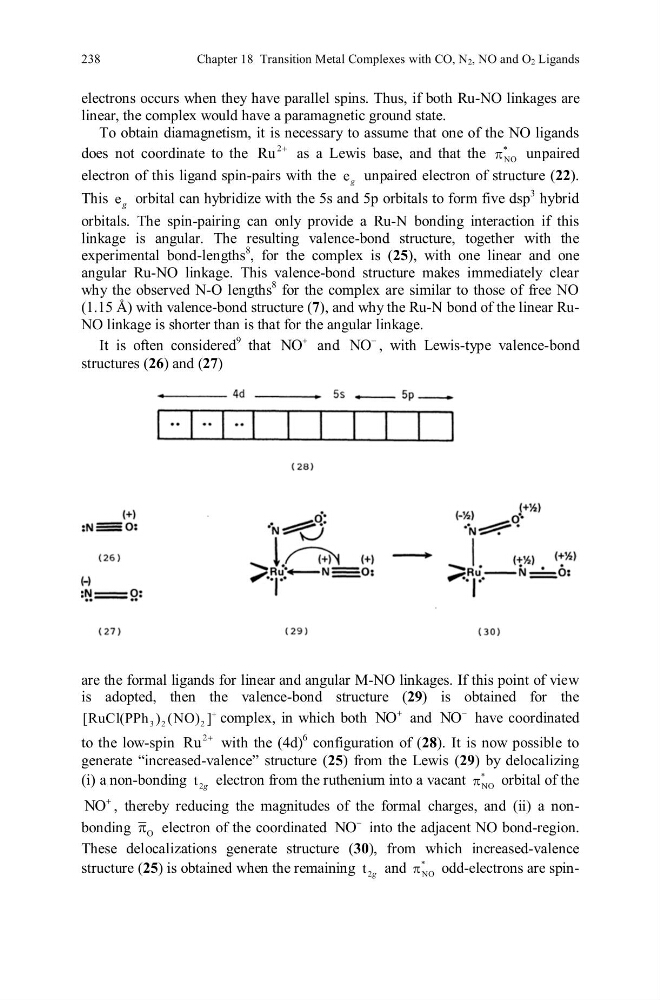
electron of this ligand spin-pairs with the e g unpaired electron of structure (22).
This e g orbital can hybridize with the 5s and 5p orbitals to form five dsp
3 hybrid
orbitals. The spin-pairing can only provide a Ru-N bonding interaction if this
linkage is angular. The resulting valence-bond structure, together with the
experimental bond-lengths
8
, for the complex is (25), with one linear and one
angular Ru-NO linkage. This valence-bond structure makes immediately clear
why the observed N-O lengths
8 for the complex are similar to those of free NO
(1.15 Å) with valence-bond structure (7), and why the Ru-N bond of the linear RuNO linkage is shorter than is that for the angular linkage.
It is often considered
9 that NO
and NO
, with Lewis-type valence-bond
structures (26) and (27)
are the formal ligands for linear and angular M-NO linkages. If this point of view
is adopted, then the valence-bond structure (29) is obtained for the
3 2
2
[RuCl(PPh ) (N ) ]
complex, in which both NO
and NO
have coordinated
to the low-spin
2
Ru
with the (4d)
6 configuration of (28). It is now possible to
generate “increased-valence” structure (25) from the Lewis (29) by delocalizing
(i) a non-bonding 2
t g electron from the ruthenium into a vacant
*
NO
orbital of the
NO
, thereby reducing the magnitudes of the formal charges, and (ii) a nonbonding O
electron of the coordinated NO
into the adjacent NO bond-region.
These delocalizations generate structure (30), from which increased-valence
structure (25) is obtained when the remaining 2
t g and
*
NO
odd-electrons are spin-
Chapter 18 Transition Metal Complexes with CO, N2, NO and O2 Ligands
electrons occurs when they have parallel spins. Thus, if both Ru-NO linkages are
linear, the complex would have a paramagnetic ground state.
To obtain diamagnetism, it is necessary to assume that one of the NO ligands
does not coordinate to the
2
Ru
as a Lewis base, and that the
*
NO
unpaired
electron of this ligand spin-pairs with the e g unpaired electron of structure (22).
This e g orbital can hybridize with the 5s and 5p orbitals to form five dsp
3 hybrid
orbitals. The spin-pairing can only provide a Ru-N bonding interaction if this
linkage is angular. The resulting valence-bond structure, together with the
experimental bond-lengths
8
, for the complex is (25), with one linear and one
angular Ru-NO linkage. This valence-bond structure makes immediately clear
why the observed N-O lengths
8 for the complex are similar to those of free NO
(1.15 Å) with valence-bond structure (7), and why the Ru-N bond of the linear RuNO linkage is shorter than is that for the angular linkage.
It is often considered
9 that NO
and NO
, with Lewis-type valence-bond
structures (26) and (27)
are the formal ligands for linear and angular M-NO linkages. If this point of view
is adopted, then the valence-bond structure (29) is obtained for the
3 2
2
[RuCl(PPh ) (N ) ]
complex, in which both NO
and NO
have coordinated
to the low-spin
2
Ru
with the (4d)
6 configuration of (28). It is now possible to
generate “increased-valence” structure (25) from the Lewis (29) by delocalizing
(i) a non-bonding 2
t g electron from the ruthenium into a vacant
*
NO
orbital of the
NO
, thereby reducing the magnitudes of the formal charges, and (ii) a nonbonding O
electron of the coordinated NO
into the adjacent NO bond-region.
These delocalizations generate structure (30), from which increased-valence
structure (25) is obtained when the remaining 2
t g and
*
NO
odd-electrons are spin-