

18-3
Transition Metal Nitrosyl Compounds
237
18-3 Transition Metal Nitrosyl Compounds
In the introduction to this chapter we have indicated that NO may react with
transition metals either as a free radical, by using its unpaired electron, or as a
Lewis base by using the nitrogen lone-pair of electrons. To give consideration to
these two types of behaviour, we shall examine the bonding for the Ru-NO
linkages of the diamagnetic complex
3 2
2
[RuCl(PPh ) (N ) ]
, which we shall
initially express in terms of its components as
2
3
Ru
Cl 2 PPh 2NO
. The
bond-angles for the two Ru-NO linkages are
8 178° and 138°, and therefore essentially linear and angular linkages are present in this complex.
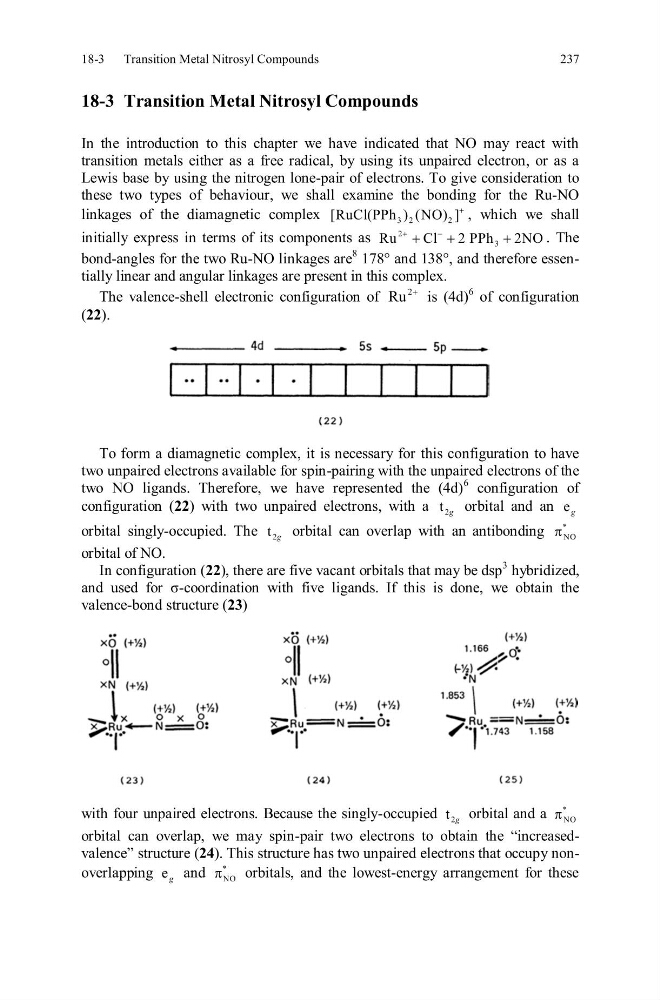
The valence-shell electronic configuration of
2
Ru
is (4d)
6 of configuration
(22).
To form a diamagnetic complex, it is necessary for this configuration to have
two unpaired electrons available for spin-pairing with the unpaired electrons of the
two NO ligands. Therefore, we have represented the (4d)
6 configuration of
configuration (22) with two unpaired electrons, with a 2
t g orbital and an e g
orbital singly-occupied. The 2
t g orbital can overlap with an antibonding
*
NO
orbital of NO.
In configuration (22), there are five vacant orbitals that may be dsp
3 hybridized,
and used for σ-coordination with five ligands. If this is done, we obtain the
valence-bond structure (23)
with four unpaired electrons. Because the singly-occupied 2
t g orbital and a
*
NO
orbital can overlap, we may spin-pair two electrons to obtain the “increasedvalence” structure (24). This structure has two unpaired electrons that occupy nonoverlapping e g and
*
NO
orbitals, and the lowest-energy arrangement for these
Transition Metal Nitrosyl Compounds
237
18-3 Transition Metal Nitrosyl Compounds
In the introduction to this chapter we have indicated that NO may react with
transition metals either as a free radical, by using its unpaired electron, or as a
Lewis base by using the nitrogen lone-pair of electrons. To give consideration to
these two types of behaviour, we shall examine the bonding for the Ru-NO
linkages of the diamagnetic complex
3 2
2
[RuCl(PPh ) (N ) ]
, which we shall
initially express in terms of its components as
2
3
Ru
Cl 2 PPh 2NO
. The
bond-angles for the two Ru-NO linkages are
8 178° and 138°, and therefore essentially linear and angular linkages are present in this complex.
The valence-shell electronic configuration of
2
Ru
is (4d)
6 of configuration
(22).
To form a diamagnetic complex, it is necessary for this configuration to have
two unpaired electrons available for spin-pairing with the unpaired electrons of the
two NO ligands. Therefore, we have represented the (4d)
6 configuration of
configuration (22) with two unpaired electrons, with a 2
t g orbital and an e g
orbital singly-occupied. The 2
t g orbital can overlap with an antibonding
*
NO
orbital of NO.
In configuration (22), there are five vacant orbitals that may be dsp
3 hybridized,
and used for σ-coordination with five ligands. If this is done, we obtain the
valence-bond structure (23)
with four unpaired electrons. Because the singly-occupied 2
t g orbital and a
*
NO
orbital can overlap, we may spin-pair two electrons to obtain the “increasedvalence” structure (24). This structure has two unpaired electrons that occupy nonoverlapping e g and
*
NO
orbitals, and the lowest-energy arrangement for these