

236
Chapter 18 Transition Metal Complexes with CO, N2, NO and O2 Ligands
We note that the
2
Co N
bonding is similar to that which we have described
for 2
N O in Section 13-1. Other “increased-valence” structures such as (17), (18)
and (19) may also be constructed. Elsewhere
5 , we have shown that structure (16)
should be the most important of the four types of structures, but all will participate
in resonance to some extent.
1
1
1
1
2
2
2
2
17
18
19
(
)
(
)
(
)
(
)
( )
( )
: Co N N: : Co N N: : Co N — N:
( )
( )
( )
18-2(b)
4
3 5 2
2
[{Ru(NH ) } N ]
2
N can bond simultaneously to two Ru(II) ions, and this occurs in the cation
[{ (
) }
]
4
3 5 2
2
Ru NH
N
. The
2
Ru
configuration is (4d)
6
, and the σ-bonding with
the 2
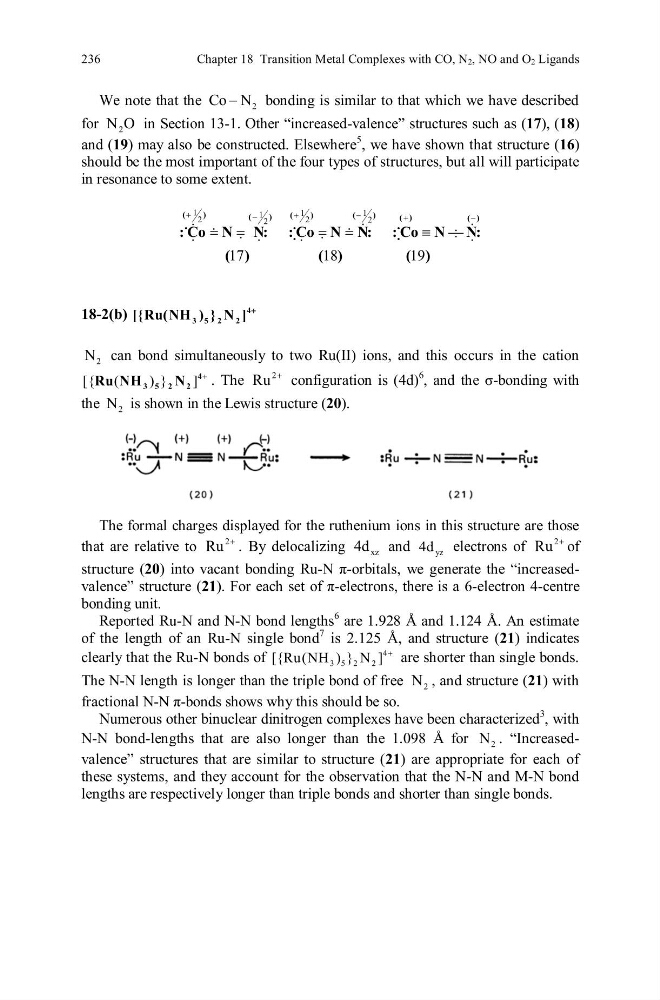
N is shown in the Lewis structure (20).
The formal charges displayed for the ruthenium ions in this structure are those
that are relative to
2
Ru
. By delocalizing
xz
4d and
yz
4d electrons of
2
Ru
of
structure (20) into vacant bonding Ru-N π-orbitals, we generate the “increasedvalence” structure (21). For each set of π-electrons, there is a 6-electron 4-centre
bonding unit.
Reported Ru-N and N-N bond lengths
6 are 1.928 Å and 1.124 Å. An estimate
of the length of an Ru-N single bond
7 is 2.125 Å, and structure (21) indicates
clearly that the Ru-N bonds of
4
3 5 2
2
[{Ru(NH ) } N ]
are shorter than single bonds.
The N-N length is longer than the triple bond of free 2
N , and structure (21) with
fractional N-N π-bonds shows why this should be so.
Numerous other binuclear dinitrogen complexes have been characterized
3
, with
N-N bond-lengths that are also longer than the 1.098 Å for 2
N . “Increasedvalence” structures that are similar to structure (21) are appropriate for each of
these systems, and they account for the observation that the N-N and M-N bond
lengths are respectively longer than triple bonds and shorter than single bonds.
Chapter 18 Transition Metal Complexes with CO, N2, NO and O2 Ligands
We note that the
2
Co N
bonding is similar to that which we have described
for 2
N O in Section 13-1. Other “increased-valence” structures such as (17), (18)
and (19) may also be constructed. Elsewhere
5 , we have shown that structure (16)
should be the most important of the four types of structures, but all will participate
in resonance to some extent.
1
1
1
1
2
2
2
2
17
18
19
(
)
(
)
(
)
(
)
( )
( )
: Co N N: : Co N N: : Co N — N:
( )
( )
( )
18-2(b)
4
3 5 2
2
[{Ru(NH ) } N ]
2
N can bond simultaneously to two Ru(II) ions, and this occurs in the cation
[{ (
) }
]
4
3 5 2
2
Ru NH
N
. The
2
Ru
configuration is (4d)
6
, and the σ-bonding with
the 2
N is shown in the Lewis structure (20).
The formal charges displayed for the ruthenium ions in this structure are those
that are relative to
2
Ru
. By delocalizing
xz
4d and
yz
4d electrons of
2
Ru
of
structure (20) into vacant bonding Ru-N π-orbitals, we generate the “increasedvalence” structure (21). For each set of π-electrons, there is a 6-electron 4-centre
bonding unit.
Reported Ru-N and N-N bond lengths
6 are 1.928 Å and 1.124 Å. An estimate
of the length of an Ru-N single bond
7 is 2.125 Å, and structure (21) indicates
clearly that the Ru-N bonds of
4
3 5 2
2
[{Ru(NH ) } N ]
are shorter than single bonds.
The N-N length is longer than the triple bond of free 2
N , and structure (21) with
fractional N-N π-bonds shows why this should be so.
Numerous other binuclear dinitrogen complexes have been characterized
3
, with
N-N bond-lengths that are also longer than the 1.098 Å for 2
N . “Increasedvalence” structures that are similar to structure (21) are appropriate for each of
these systems, and they account for the observation that the N-N and M-N bond
lengths are respectively longer than triple bonds and shorter than single bonds.