

18-2
Dinitrogen Complexes
235
18-2(a)
2
3 3
CoH(N )(PPh )
For
2
3 3
CoH(N )(PPh ) , the
2
Co N
linkage has been found to be linear
4
, with CoN and N-N lengths of 1.802 Å and 1.126 Å. We may compare these lengths with
the estimate of 1.96 Å for a Co-N single bond
4
, and the 1.098 Å for the triple bond
of free 2
N .
From the (3d)
7 (4s)
2 ground-state configuration of Co, we may obtain a (3d)
9
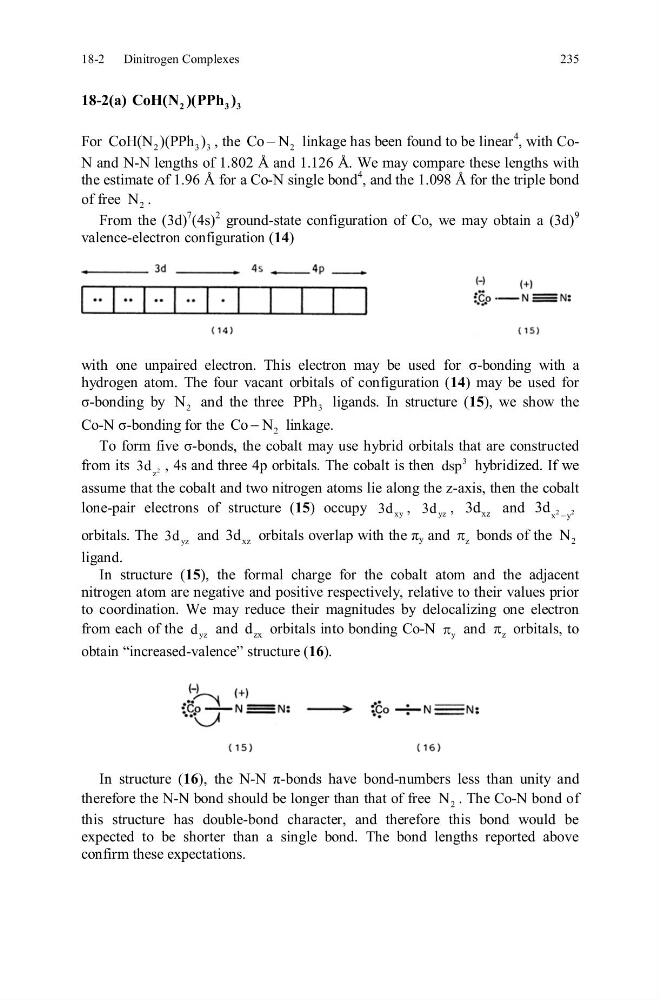
valence-electron configuration (14)
with one unpaired electron. This electron may be used for σ-bonding with a
hydrogen atom. The four vacant orbitals of configuration (14) may be used for
σ-bonding by 2
N and the three
3
PPh ligands. In structure (15), we show the
Co-N σ-bonding for the
2
Co N
linkage.
To form five σ-bonds, the cobalt may use hybrid orbitals that are constructed
from its
2
z
3d , 4s and three 4p orbitals. The cobalt is then
3
dsp hybridized. If we
assume that the cobalt and two nitrogen atoms lie along the z-axis, then the cobalt
lone-pair electrons of structure (15) occupy
xy
3d ,
yz
3d ,
xz
3d and
2
2
x y
3d
orbitals. The
yz
3d and
xz
3d orbitals overlap with the π y and z
bonds of the 2
N
ligand.
In structure (15), the formal charge for the cobalt atom and the adjacent
nitrogen atom are negative and positive respectively, relative to their values prior
to coordination. We may reduce their magnitudes by delocalizing one electron
from each of the yz
d and zx
d orbitals into bonding Co-N y
and z
orbitals, to
obtain “increased-valence” structure (16).
In structure (16), the N-N π-bonds have bond-numbers less than unity and
therefore the N-N bond should be longer than that of free 2
N . The Co-N bond of
this structure has double-bond character, and therefore this bond would be
expected to be shorter than a single bond. The bond lengths reported above
confirm these expectations.
Dinitrogen Complexes
235
18-2(a)
2
3 3
CoH(N )(PPh )
For
2
3 3
CoH(N )(PPh ) , the
2
Co N
linkage has been found to be linear
4
, with CoN and N-N lengths of 1.802 Å and 1.126 Å. We may compare these lengths with
the estimate of 1.96 Å for a Co-N single bond
4
, and the 1.098 Å for the triple bond
of free 2
N .
From the (3d)
7 (4s)
2 ground-state configuration of Co, we may obtain a (3d)
9
valence-electron configuration (14)
with one unpaired electron. This electron may be used for σ-bonding with a
hydrogen atom. The four vacant orbitals of configuration (14) may be used for
σ-bonding by 2
N and the three
3
PPh ligands. In structure (15), we show the
Co-N σ-bonding for the
2
Co N
linkage.
To form five σ-bonds, the cobalt may use hybrid orbitals that are constructed
from its
2
z
3d , 4s and three 4p orbitals. The cobalt is then
3
dsp hybridized. If we
assume that the cobalt and two nitrogen atoms lie along the z-axis, then the cobalt
lone-pair electrons of structure (15) occupy
xy
3d ,
yz
3d ,
xz
3d and
2
2
x y
3d
orbitals. The
yz
3d and
xz
3d orbitals overlap with the π y and z
bonds of the 2
N
ligand.
In structure (15), the formal charge for the cobalt atom and the adjacent
nitrogen atom are negative and positive respectively, relative to their values prior
to coordination. We may reduce their magnitudes by delocalizing one electron
from each of the yz
d and zx
d orbitals into bonding Co-N y
and z
orbitals, to
obtain “increased-valence” structure (16).
In structure (16), the N-N π-bonds have bond-numbers less than unity and
therefore the N-N bond should be longer than that of free 2
N . The Co-N bond of
this structure has double-bond character, and therefore this bond would be
expected to be shorter than a single bond. The bond lengths reported above
confirm these expectations.